
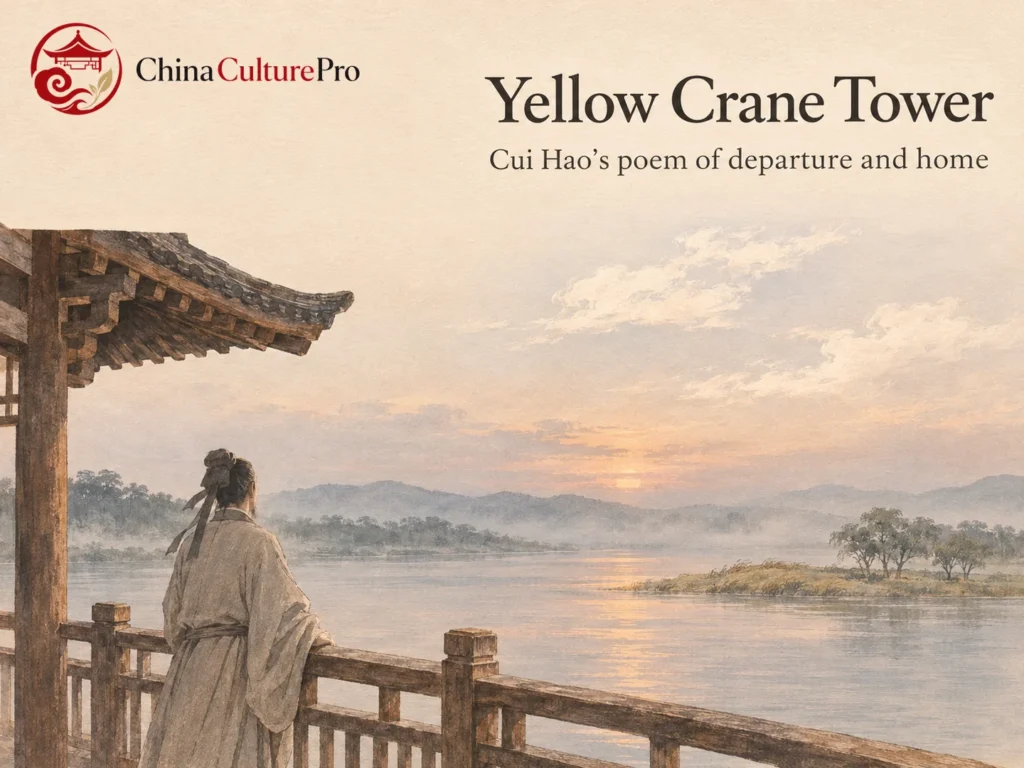

Quick Answer: What Is Cui Hao’s Yellow Crane Tower About?
Yellow Crane Tower (黄鹤楼, Huáng Hè Lóu) by Cui Hao (崔颢, Cuī Hào) moves from a legendary departure to a traveler’s longing for home. A crane has gone, the tower remains, trees and grass come into view, and dusk leaves the speaker asking where home lies.
- Keep the author clear: This is Cui Hao’s eight-line poem, not another poet’s farewell at the same tower.
- Read departure as legend: The opening imagines an absent figure rather than reporting a witnessed flight.
- Follow the final question: A clear view of the surroundings does not resolve homesickness.
The poem’s named landscape is not a diagram of the present-day riverfront or a description of today’s tower building.
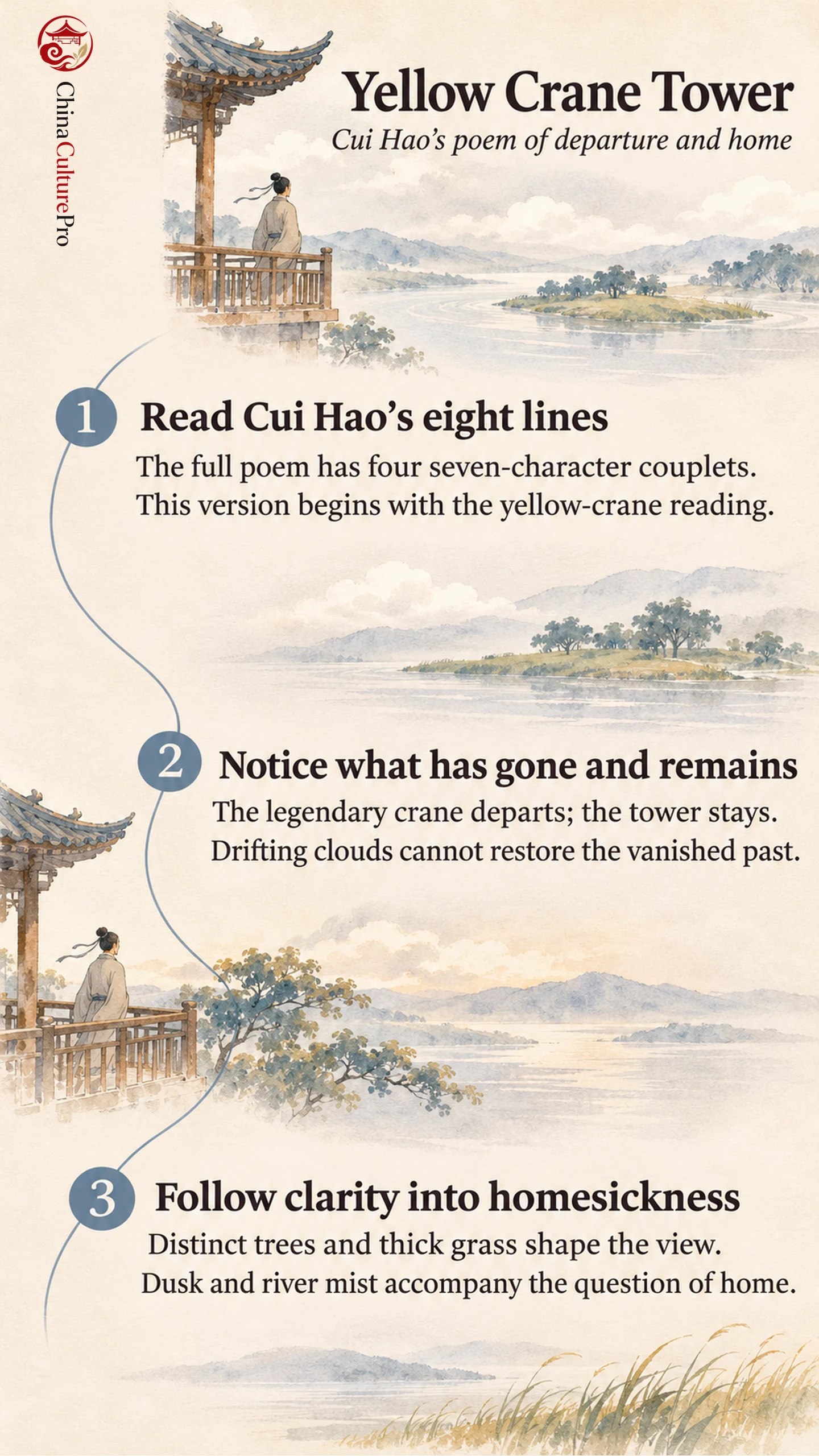
The tower gives the speaker a place to stand, but it cannot give back the vanished past. Nor can the view finally supply the one place he most wants to find: home.
Read Cui Hao’s Complete Yellow Crane Tower
The poem has eight seven-character lines. Although classed as regulated verse, its opening moves more freely than a uniformly strict pattern; its later landscape pair becomes more tightly balanced. [2]
Hanyang (汉阳, Hàn Yáng) and Parrot Islet (鹦鹉洲, Yīng Wǔ Zhōu) are the landscape names in the third couplet. The latter is a place name, not a statement that parrots fill the scene. This original English rendering follows the first-line reading “yellow crane.” [1]
| Chinese text | Original English rendering |
|---|---|
| 昔人已乘黄鹤去,此地空余黄鹤楼。 | A figure of old has ridden away on a yellow crane; here only Yellow Crane Tower remains. [1] |
| 黄鹤一去不复返,白云千载空悠悠。 | The yellow crane, once gone, does not return; white clouds drift emptily through a thousand years. [1] |
| 晴川历历汉阳树,芳草萋萋鹦鹉洲。 | Across the sunlit river plain, Hanyang’s trees stand distinct; fragrant grasses grow thick on Parrot Islet. [1] |
| 日暮乡关何处是?烟波江上使人愁。 | At dusk, where is my homeland? The misty waves upon the river make me grieve. [1] |
The first line also survives with “white clouds” in place of “yellow crane.” That is a textual variant, not an extra line to insert into this version. [1]
For the form and its usual paired construction, see the regulated verse guide.
Distinguish the Departed Crane from the Remaining Tower
The opening draws on stories of an immortal departing on a crane. Those stories have different named figures in the tradition; the poem itself calls the person simply a figure of old. There is no need to choose one legendary biography as an established historical fact. [2]
What matters immediately is the division between “has gone” and “remains.” The tower’s presence is defined against the figure’s absence. Its survival does not make that absence less powerful.
Repeating the crane in the next line prolongs the departure. The poem does not let the creature fly back to provide a comforting reunion. Clouds can continue to drift, but their duration is not the same as recovering what has vanished. [1]
“A thousand years” stretches the imagined time. It does not date an actual crane sighting or establish the age of a particular surviving building. The language opens the present scene toward a past too distant to retrieve.
The first half therefore gives the view a memory before describing its trees and grass. Looking from the tower is already a way of noticing what cannot be seen there anymore.
Follow Clear Trees into Dusk and Homesickness
The third couplet changes the kind of attention. Instead of the departed figure and immense time, it offers trees that stand distinct and grass that grows densely. Named places give the view a local shape. [1]
That clarity makes the final question sharper. The speaker can recognize the surroundings, yet the place of belonging remains out of reach. Knowing where a tree or islet lies is different from feeling able to return home.
Dusk and mist then enter the ending. The poem does not need to state that every tree has disappeared behind fog. It changes the conditions of looking while bringing the traveler’s sorrow into the open.
The tower is also linked to a later story about Li Bai (李白, Lǐ Bái), who supposedly held back from writing after seeing Cui Hao’s poem. Literary criticism treats this as a tradition that may have been embellished, rather than secure evidence for the exact event. [2]
For a useful comparison, read Ascending Phoenix Terrace, where an elevated view also brings past and present into relation. The friendship and farewell poetry guide helps distinguish parting poems from this scene of homesickness; the Chinese poetry guide supplies the wider context.
FAQs About Yellow Crane Tower
Is this the same poem as Li Bai’s farewell at Yellow Crane Tower?
No. Cui Hao’s poem begins with a departed figure and ends with homesickness. The famous farewell by Li Bai is a separate poem associated with the same tower.
Why do some versions begin with white clouds?
The first line has a received variant using white clouds instead of yellow crane. The text printed here consistently follows the yellow-crane reading.
Did Li Bai definitely refuse to write after seeing this poem?
That is a later literary story, not a securely established eyewitness account. It illustrates the poem’s reputation without proving the event happened exactly as told.
Sources
[1] Cui Hao, via Wikisource. Yellow Crane Tower: Complete Poem and First-Line Variant
[2] Cai Yijiang, via Aisixiang. An Appreciation of Cui Hao’s Yellow Crane Tower