


Quick Answer: What Is Clear Peace Village Life About?
Clear Peace Village Life (村居, Cūn Jū) by Xin Qiji (辛弃疾, Xīn Qì Jí) portrays a small rural household beside a stream. An elderly couple converse, two sons work, and the youngest lies shelling lotus seed pods. The ending turns a potentially critical word into affection.
- Read all eight lines: The elderly couple belong to the complete lyric, not an optional addition.
- Follow the stream: It connects the cottage, bean field and youngest child.
- Hear the fondness: The final child is playful, not condemned as worthless.
The lyric offers a warmly selected scene. It is not proof that every rural household enjoyed the same conditions.
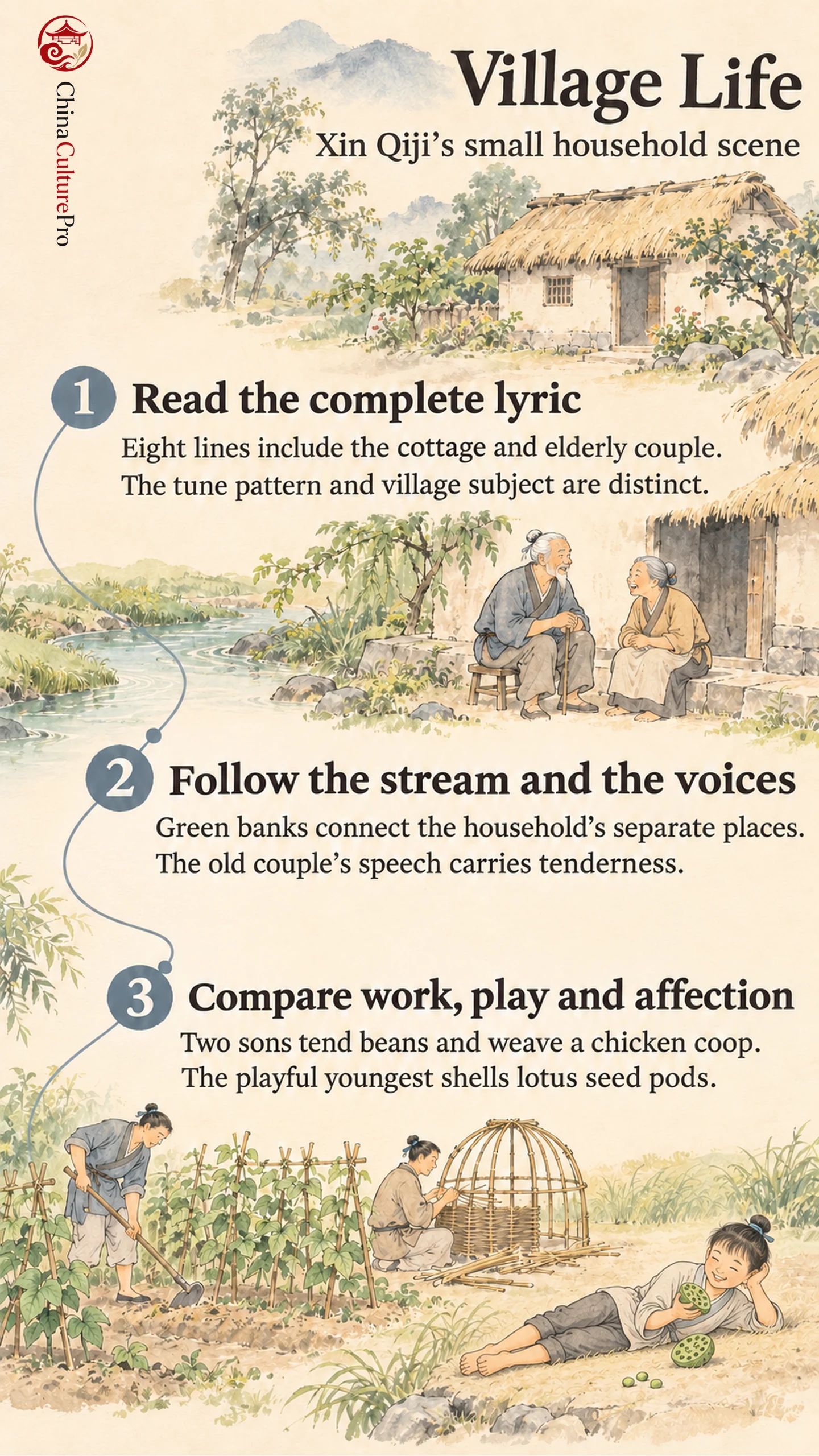
A low roof, green grass and ordinary work might seem unremarkable materials for a poem. Their arrangement gives each person a distinct place, then lets the smallest child take the final focus.
Read the Complete Village-Life Lyric
Qing Ping Yue (清平乐, Qīng Píng Yuè) names the tune pattern; Village Life (村居, Cūn Jū) names the subject. The final character of the pattern name is read yuè in the educational convention used here. This is ci (词, Cí), a song lyric, rather than an eight-line regulated poem with equal line lengths. [3]
The complete text contains forty-six Chinese characters across eight lines. Wu speech (吴音, Wú Yīn) refers to regional speech associated with the historical Wu area; it need not be pinned to one present-day city’s pronunciation. [1][2]
| Chinese text | Original English rendering |
|---|---|
| 茅檐低小,溪上青青草。 | Low and small are the thatched eaves; beside the stream the grasses grow green. [1] |
| 醉里吴音相媚好,白发谁家翁媪? | Amid tipsiness, the Wu speech sounds tender and affectionate. Whose household has this white-haired old man and woman? [1] |
| 大儿锄豆溪东,中儿正织鸡笼。 | The eldest son weeds the bean field with a hoe east of the stream; the middle son is weaving a chicken coop. [1] |
| 最喜小儿无赖,溪头卧剥莲蓬。 | Most delightful is the youngest, a little rascal: lying beside the stream, he shells lotus seed pods. [1] |
The English keeps the tipsiness within the scene without forcing its grammatical owner. What the passage clearly brings forward is the affectionate sound of speech and the elderly pair. The question about their household creates a moment of interested discovery.
For the form, continue with the Song ci poetry guide.
Follow the Stream to the Elderly Couple
The opening gives the cottage few details: its eaves are low and small. The grass beside the water supplies the strongest color. The scene feels inhabited before the people have been individually introduced. [1]
Sound then moves the focus from setting to relationship. The couple’s regional speech is presented through tenderness, not through a phonetic transcript. Translating it as generic drunken noise would miss the warmth that leads into their appearance.
The white hair places old age within that warmth. The poem does not need a long account of the pair’s marriage to suggest ease between them. Equally, it does not identify them as the poet’s parents or as members of his own household.
The stream organizes what follows. It is first beside the grass, then located in relation to the eldest son’s field, and finally beside the youngest. This repeated feature joins the separate activities into one compact scene. [2]
That organization is part of the pleasure: the eye can move while the household remains coherent. Compare other relationships between inhabited landscapes and feeling in the Chinese nature poetry guide.
Compare Three Sons and the Affectionate Ending
The eldest son works among beans, hoeing weeds rather than pulling up the crop. The middle son weaves a coop for chickens. These are two kinds of useful work, agricultural and domestic, placed beside each other without a speech explaining their importance. [2]
The youngest breaks their rhythm. He lies down and shells seed pods. His posture gives the final image its particular ease: he has not merely been listed as the third child.
The word wulai (无赖, Wú Lài) can sound harsh when detached from its setting. Here it is an affectionate description of mischievousness. The delight expressed before it and the seed-pod activity afterward guide the tone. [2]
The contrast need not become a lesson condemning play or ranking the children’s moral worth. The two older sons’ activity helps the youngest’s leisure stand out; the observer’s fondness gives that leisure the last word.
The lyric’s close attention also has limits. A pleasant household moment does not supply a complete account of agricultural labor, wealth or Song society. Read the scene closely before turning its peace into a universal historical claim.
For another lyric that finds meaning in ordinary physical experience, read Su Shi’s Calming the Waves. The Chinese poetry guide provides the wider literary context.
FAQs About Clear Peace Village Life
Is this Xin Qiji’s own family?
The lyric does not establish that. Its question asks whose elderly couple this is, presenting a household encountered through interested attention.
Does the youngest son’s description mean he is a criminal?
No. In this affectionate context, it means mischievous or playfully naughty. The speaker explicitly delights in him.
Is the child peeling lotus flowers?
He is opening lotus seed pods, not stripping petals from blossoms. That small, leisurely activity completes the household scene.
Sources
[1] Xin Qiji, via Wikisource. Qing Ping Yue: Village Life, Complete Text
[2] Nantong University Poetry Society. Appreciation of Xin Qiji’s Qing Ping Yue: Village Life
[3] Lianyi Foreign Language Primary School, Futian Education. Chinese Textbook Selection: Qing Ping Yue, Village Life