

Quick Answer: Where Should You Start with Wang Zengqi?
Wang Zengqi (汪曾祺, Wāng Zēng Qí; 1920–1997) was a Chinese writer of short stories and essays whose attention to ordinary people, places and daily life makes a rewarding starting point for modern literature.
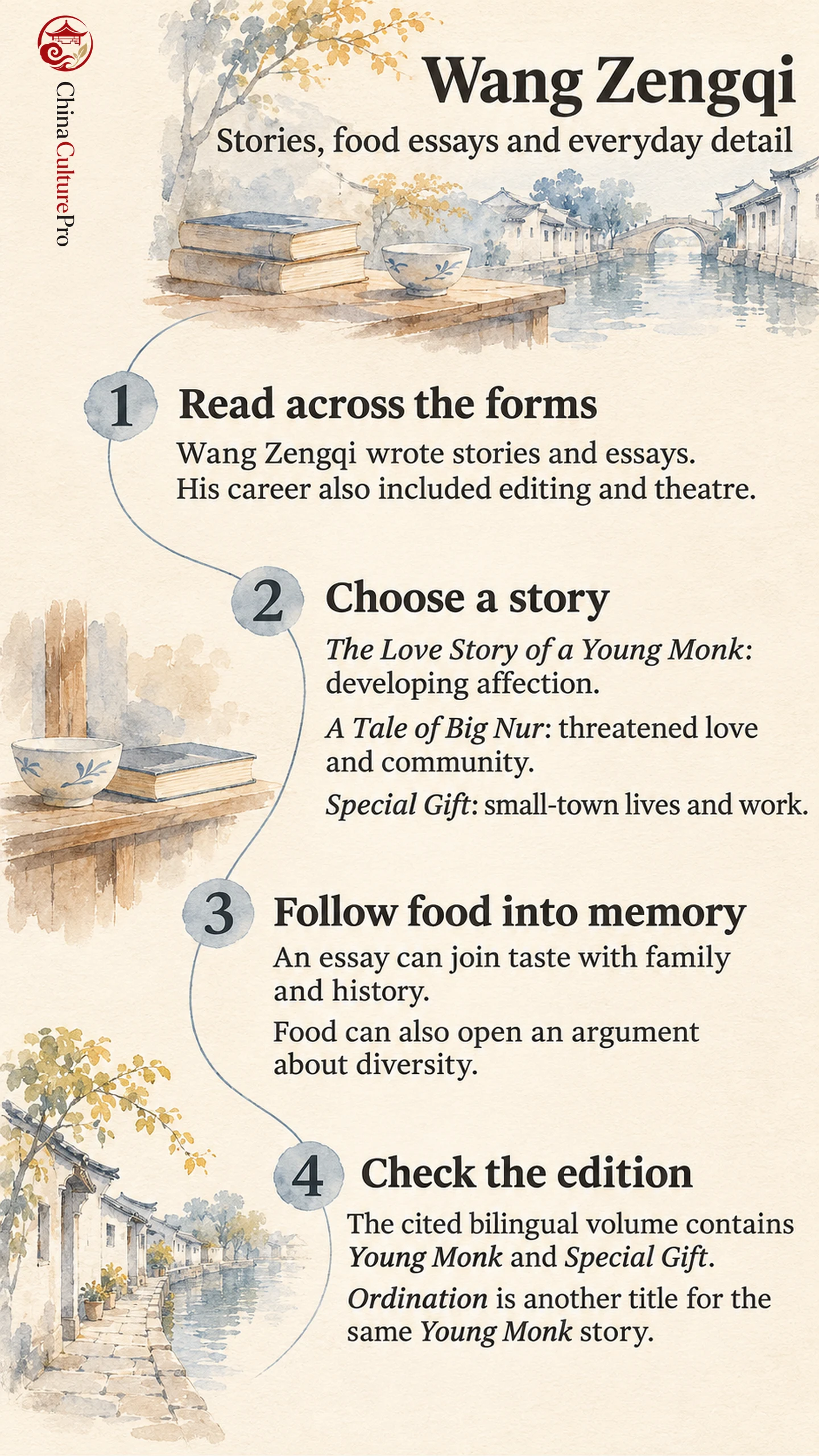
- For a first story: Try the young monk’s developing affection for a village girl.
- For community and conflict: Choose the waterside story of workers and a threatened relationship.
- For essays: Follow how remembered food connects taste with family, place and time.
Read these as different literary forms. A quiet surface can hold affection, hardship or an argument about how people should live.
A craft, a small shop or a familiar meal may seem to delay the main story. In Wang Zengqi, such details often establish the world in which a relationship becomes possible and a choice acquires meaning. The people around a central character deserve attention too.
Locate Wang Zengqi in Modern Chinese Writing
Born in Gaoyou, Jiangsu, Wang studied Chinese at the wartime National Southwestern Associated University. He was closely associated with Shen Congwen (沈从文, Shěn Cóng Wén). He later edited literary magazines and became a playwright with the Beijing Opera Troupe in 1962. His career therefore reaches beyond either fiction or food writing alone. [1]
His renewed production of stories and essays after the Cultural Revolution belongs within the changing landscape of modern Chinese literature. [1] A useful pair of landmarks is the 1980 short story about ordination and the 1981 waterside tale. [6]
Use those dates to place the works, then follow a relationship, a community or a remembering narrator.
Choose Three Stories and Follow Their Details
| Story | Starting interest | A question to carry into the reading |
|---|---|---|
| The Love Story of a Young Monk (受戒, Shòu Jiè), also translated as Ordination | Young affection | How does daily life foster closeness? [2] |
| A Tale of Big Nur (大淖记事, Dà Nào Jì Shì) | Waterside workers and a threatened relationship | How does the community respond to coercion? [3] |
| Special Gift (异秉, Yì Bǐng) | Town life | What does work reveal? [2] |
The story follows Minghai (明海, Míng Hǎi) and Xiaoyingzi (小英子, Xiǎo Yīng Zǐ), a young monk and village girl, as affection develops through rural life. [2]
Read the surrounding lives alongside the young pair. Their relationship grows within a social environment, rather than in isolation from it. This gives you a way to follow descriptions that might otherwise seem incidental.
A Tale of Big Nur asks for a different attention. Qiaoyun (巧云, Qiǎo Yún) and the young tinsmith Shiyizi (十一子, Shí Yī Zǐ) face coercion and violence. The craftspeople and laborers around them form part of the response. In critic Zhang Lijun’s account, the waterside setting develops with the characters’ experience instead of remaining a decorative background. [3]
Keep that conflict in view when describing Wang’s writing as gentle. Concern for ordinary lives includes people whose attachment is threatened, and solidarity matters because there is something to resist.
Special Gift depicts the thrifty Wang Er and his small-town social world. [2]
Across the three stories, look for what a detail does: it may establish a routine, locate a person among neighbors or reveal another character’s judgment. Connect an object to what someone does with it or what another person thinks of it.
Critics Zhang Wenxin and Wang Chengxia emphasize the care behind Wang’s apparently plain language and the closeness between his fiction and essay writing. Their discussion points toward ordinary characters and precise observation, rather than elaborate language for its own sake. [4]
Read Food Essays as Memory and Argument
Food writing offers another route, especially for readers interested in Chinese food culture. Approach it as remembered experience shaped into prose, with a narrator selecting what to describe and what a taste means.
In her study of Wang’s culinary essays, Rui Kunze discusses Potatoes (马铃薯, Mǎ Líng Shǔ) in relation to his years at an agricultural research institute in Zhangjiakou. Varieties of the crop and the pleasure of sharing food with family sit within a history that includes deprivation and political displacement. [5]
Kunze also reads Five Flavors (五味, Wǔ Wèi) as connecting diversity in culinary taste with diversity in literature. Food can become a way of arguing for openness to forms and preferences beyond one’s own. This is a critical reading of the essay’s argument, rather than a universal rule inferred from eating. [5]
When reading an essay, keep three things together: the food itself, the occasion of remembering it and the social relationship around it. Ask who grows, prepares, shares or recalls it. That makes a familiar meal part of a particular life and history.
Find an English Edition and Compare the Forms
The cited FLTRP bilingual edition, published in December 2011, contains The Love Story of a Young Monk and Special Gift. [2]
Use the Chinese titles to track translations. Ordination and The Love Story of a Young Monk refer to the same Chinese work; they are not two separate stories to add to a reading list. [6]
The guide to Chinese classic books and translations offers broader edition-selection questions. Check the contents and translator credits in the edition you obtain, particularly when a collection’s English title resembles one story within it.
After a story, try an essay and compare the narrator’s work. How does a fictional relationship organize the details? How does an essay’s remembering voice connect details across time? The comparison helps explain why descriptions of daily life can do more than provide atmosphere.
FAQs About Wang Zengqi
Which Wang Zengqi story should I read first?
The Love Story of a Young Monk offers a compact introduction to his attention to affection, rural surroundings and ordinary lives.
Are Ordination and The Love Story of a Young Monk different works?
No. They are different English titles for the short story Shoujie.
Does Wang Zengqi write only comforting stories?
No. A Tale of Big Nur includes coercion and violence as well as affection and community support. A gentle narrative manner does not eliminate conflict.
Does the bilingual Young Monk volume include A Tale of Big Nur?
The cited FLTRP edition lists The Love Story of a Young Monk and Special Gift. Look for A Tale of Big Nur in another selection’s contents.
Sources
[1] Chinese University of Hong Kong, Renditions. Wang Zengqi
[2] Foreign Language Teaching and Research Press. The Love Story of a Young Monk: Chinese-English Edition
[3] Zhang Lijun, China Writers Association. Wang Zengqi: An Exceptional Presence in Contemporary Chinese Literature
[4] Zhang Wenxin and Wang Chengxia, China Writers Association. Wang Zengqi’s Writing: Influence, Language and the Essay-Like Story
[5] Rui Kunze, Ex-position, National Taiwan University. Stakes of Authentic Culinary Experience: Food Writing of Tang Lusun and Wang Zengqi
[6] Foreign Language Teaching and Research Press, Key Concepts in Chinese Thought and Culture. Wang Zengqi