


Quick Answer: Where Should You Start with Wang Han?
Wang Han (王翰, Wáng Hàn) was a Tang poet whose best-known work brings wine, music and the prospect of death in battle into a single quatrain. Read it alongside his second poem under the same title, then try his spring poems for another view of his writing.
- For the famous frontier scene: Begin with the wine-and-cup poem.
- For longing at a distance: Continue with the second frontier quatrain.
- For a wider introduction: Compare the spring poems’ images of beauty, home and passing time.
These texts offer different voices and situations. A vivid soldier’s speech need not be treated as a record of the poet’s own experience.
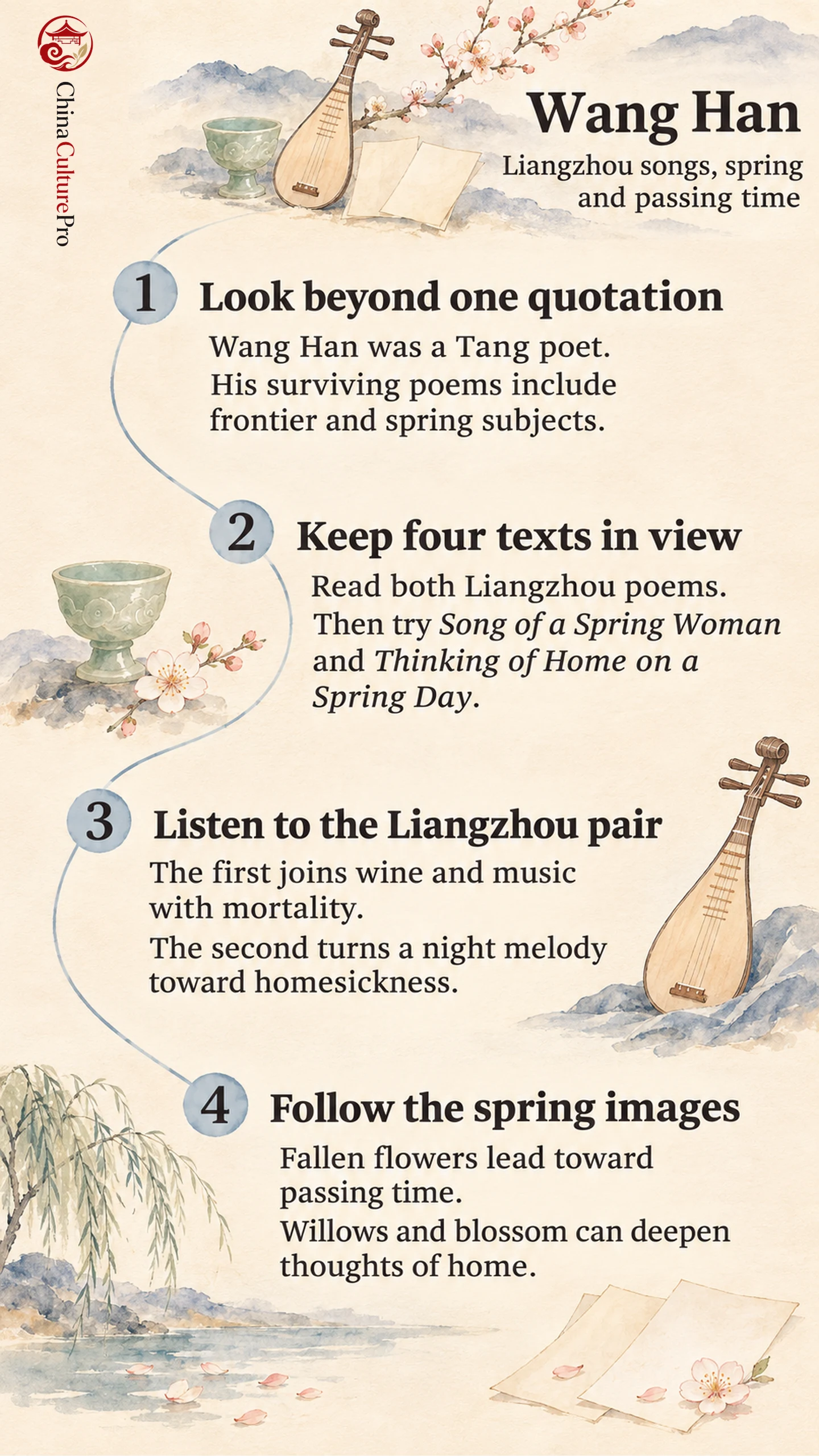
Wang Han’s fame can make his surviving poetry seem smaller than it is. The often-quoted question about returning from war deserves close attention, but another frontier poem turns toward homesickness, while spring scenes raise different questions about pleasure and loss.
Locate Wang Han and His Surviving Poetry
The Tang poet Wang Han came from Jinyang, in the area of present-day Taiyuan. His anthology biography records an official career, later demotion and a collection of ten volumes; the anthology presents his surviving poetry in one volume. Its contents include court occasions and spring subjects as well as frontier writing. [2]
His birth and death years are uncertain. Hong Kong’s Education Bureau identifies him particularly with seven-character quatrains and frontier poetry. That literary setting is a sound starting point without fixing an unsupported lifespan. [1]
Use the Tang-poetry overview for the broader landscape, then distinguish the individual works. The familiar frontier title also appears under other poets’ names, including Wang Zhihuan.
Choose Four Texts to Read
The English labels here identify reading choices; translated editions may use different wording. Match the Chinese title and opening line when looking up a text.
| Text | Form and identifying image | What to follow |
|---|---|---|
| Song of Liangzhou (凉州词, Liáng Zhōu Cí), I | Four seven-character lines; grape wine and a luminous cup | Festivity meets the thought of death in war. [1] |
| Second Liangzhou Song (凉州词, Liáng Zhōu Cí), II | Four seven-character lines; flowers in the heartland and cold beyond the frontier | A night melody awakens longing for Chang’an. [3] |
| Song of a Spring Woman (春女行, Chūn Nǚ Xíng) | A longer poem; spring clothes and fallen flowers | Beauty leads into the brevity of life. [4] |
| Thinking of Home on a Spring Day (春日归思, Chūn Rì Guī Sī) | Four seven-character lines; willows, apricot blossom and boats | Spring intensifies a traveler’s thoughts of home. [5] |
Begin with the pair, because their shared title makes the differences especially clear. The longer spring poem then changes the scale of the reading, while the final quatrain lets you compare a different use of the same short form. The guide to regulated verse explains the surrounding formal vocabulary.
Read the Two Liangzhou Poems Together
In the first poem, the pipa (琵琶, Pí Pá), a plucked lute, sounds as the drinkers are about to raise their cups. What its urging means affects the scene: the Education Bureau notes both a call to departure and an encouragement to drink. Keep that interpretive choice visible. The last question brings mortality into the revelry, allowing bravado and sorrow to coexist. [1]
Read the closer guide to Wang Han’s Song of Liangzhou for a line-by-line approach. Try reading the final question in two tones: as an outwardly bold challenge and as a quieter recognition of danger. Then return to the opening’s attractive objects and hear what has changed.
The second poem places contrasting seasons beside one another. Flowers and birds in the heartland may already be past their height, while wind and sand beyond the frontier remain cold. At night, the sound of a reed instrument playing a willow-associated melody prompts thoughts of Chang’an. [3]
Compare what listening makes possible in each poem. The first poem brings sound into an immediate social moment; the second makes listening a route toward somewhere absent. Neither reading requires turning the landscapes into an exact military itinerary.
The first poem’s question about how many return is rhetorical. It carries the risk of campaigning into the speaker’s present moment; it does not supply a numerical survival rate.
Follow Spring from Pleasure to Passing Time
Song of a Spring Woman begins with an ornate setting and a woman visible through curtains. A bird’s call, spring clothing and fallen flowers draw attention to beauty. The poem then insists that fallen blossoms do not receive another spring and turns toward the vanished beauties of an earlier royal world. The call to enjoy life comes after the warning that a fallen blossom cannot recover its spring. [4]
Notice the change of scale: a woman beside a mirror becomes part of a reflection on lives already gone. Read the final image back into the earlier scene. Bright clothing and flowers can now suggest the difficulty of holding a moment still. This is an interpretation of the poem’s constructed scene, not a documented woman’s biography. [4]
Thinking of Home on a Spring Day makes the season work differently. Willows are green and apricots bloom, yet the passing season deepens a traveler’s homesickness. The ending imagines singing women and spring boats at Ruoye. The outwardly lively scene belongs to a place held in thought. [5]
Follow the distance between what the traveler sees and what the ending imagines. Where the longer poem turns beauty toward mortality, this quatrain turns seasonal beauty toward home. Comparing them gives spring a different emotional task in each work. [5]
When selecting an English edition, keep the Chinese title and opening line with your notes. The guide to Chinese classic books and translations offers broader questions for choosing a text and comparing translation choices.
FAQs About Wang Han
Is Wang Han the same poet as Wang Zhihuan?
No. They are different Tang poets, and both wrote poems known as Liangzhou songs. Identify the author and opening line along with the title.
Does Wang Han’s famous poem simply celebrate drinking?
No. The wine scene also contains an awareness of death in battle. Its bold voice can carry sorrow as well as exuberance.
What else by Wang Han can I read?
Try the second Liangzhou poem, Song of a Spring Woman and Thinking of Home on a Spring Day for different treatments of longing, beauty and time.
Sources
[1] Hong Kong Education Bureau. Song of Liangzhou: Text and Reading Notes
[2] Qing imperial anthology editors, via Wikisource. Complete Tang Poems, Volume 156
[3] Wang Han, via Wikisource. Two Liangzhou Songs
[4] Wang Han, via Wikisource. Song of a Spring Woman
[5] Wang Han, via Wikisource. Thinking of Home on a Spring Day