


Quick Answer: What Does A Guest Arrives Mean?
A Guest Arrives (客至, Kè Zhì) by Du Fu (杜甫, Dù Fǔ) turns a modest household welcome into a poem of friendship. Its pleasure lies in opening the home and sharing what is available.
- The setting: A waterside cottage usually visited by gulls.
- The welcome: An opened gate and an unpretentious meal.
- The ending: An invitation to include the elderly neighbor, if the guest agrees.
Read the limited provisions as part of this particular encounter, rather than a rule that Chinese hospitality requires poverty or drinking.
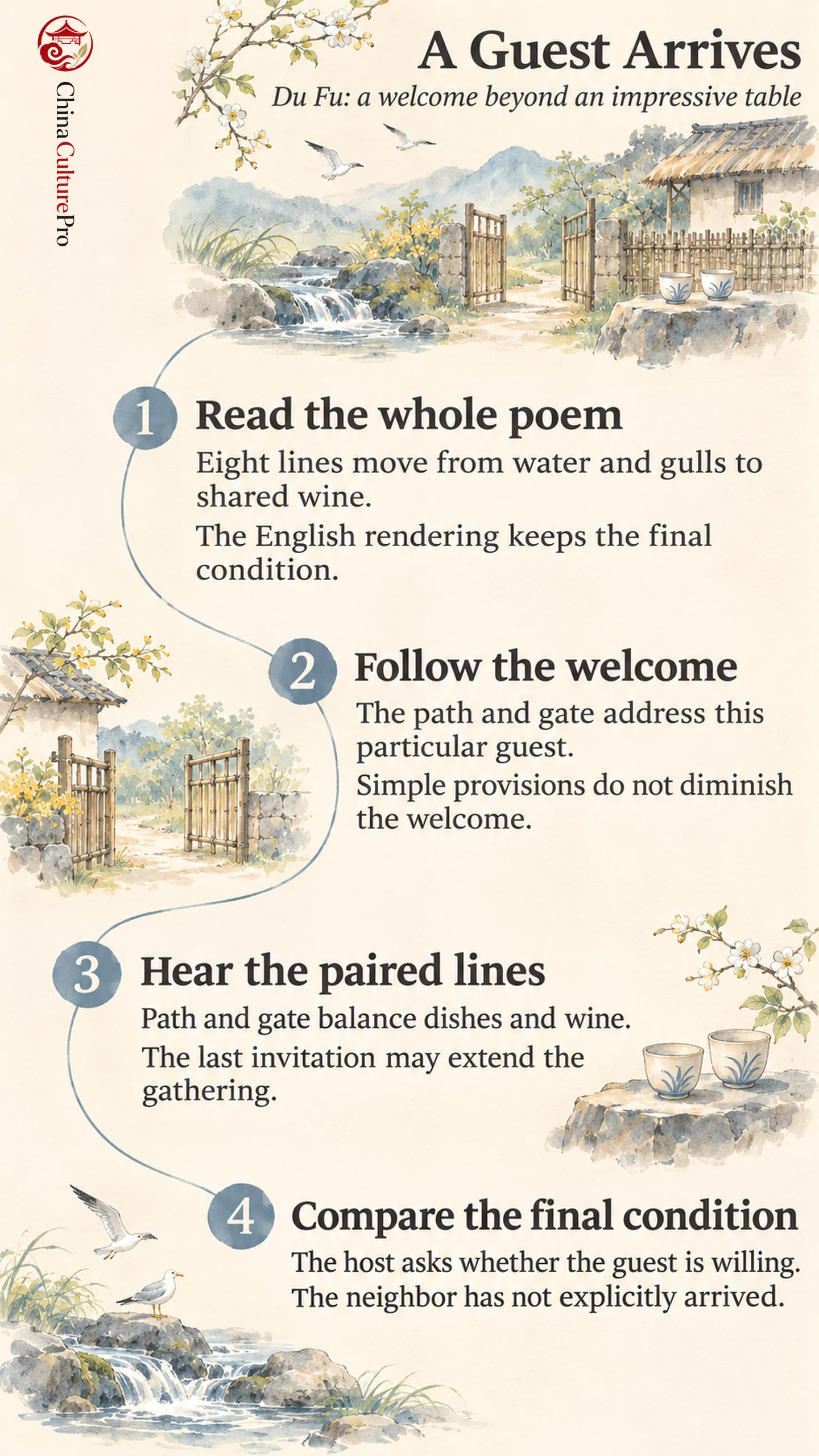
The poem moves from a quiet exterior into conversation. Its host does not deliver a speech about friendship: the path, gate, dishes and final call across a fence make the relationship visible.
Read the Poem with a Plain English Rendering
The table pairs the complete Chinese poem with an original, unrhymed English rendering. [1]
| Chinese couplet | Plain English rendering |
|---|---|
| 舍南舍北皆春水,但见群鸥日日来。 | Spring waters lie south and north of my house; day after day, I see only flocks of gulls arrive. [1] |
| 花径不曾缘客扫,蓬门今始为君开。 | The flower-lined path has not been swept for visitors; today, for you, the humble gate opens for the first time. [1] |
| 盘飧市远无兼味,樽酒家贫只旧醅。 | The market is far, so the dishes offer little variety; the household is poor, so there is only old, unfiltered wine. [1] |
| 肯与邻翁相对饮,隔篱呼取尽余杯。 | If you would drink with the old man next door, I will call him across the fence to finish the remaining cups. [1] |
Follow the Welcome from Water to Wine
The poem belongs to Du Fu’s cottage life in Chengdu. Its daily gulls establish quiet before the welcome changes the scene. The path and gate work together: preparations and an opening are directed toward this guest in particular. [2]
The host explains the simple provisions through distance from the market and a poor household. That frankness suggests ease between companions. The poem’s welcome does not depend on presenting an impressive table. [2]
Try reading the middle couplets as spoken words at the threshold and table. How would an apologetic tone differ from a warm, familiar one? The Chinese hospitality guide supplies broader context, while this poem preserves the intimacy of a particular visit.
Notice the Paired Lines and the Final Invitation
The eight lines each contain seven characters: this is lüshi (律诗, lǜshī), regulated verse. The middle pairs balance path against gate, then dishes against wine; each pair brings parallel wording to different parts of the welcome. [1][2]
For the formal background, see Chinese regulated verse. Notice how a tightly organized poem can still sound conversational. Structure supports the encounter without making the host’s voice stiff.
The last couplet expands the gathering through a proposed invitation. Keeping the guest’s agreement in view preserves the courtesy inside that informality. [2] Read the ending aloud with a pause after the condition: the gathering is still open to another participant.
Compare English Versions at the Last Couplet
W. J. B. Fletcher’s A Guest Comes, in More Gems of Chinese Poetry, offers a historical rhymed English version. Its final couplet retains the guest’s willingness before the host calls over the fence. [3]
When comparing translations, check that small relationship before judging which version sounds most poetic. Does the translator preserve an offer, or turn it into an action already completed? Use the Chinese classic books guide to assess annotation, then explore Du Fu’s wider poetry or other Tang poems.
FAQs About A Guest Arrives
Who is the guest?
The traditional identification is an official surnamed Cui, addressed as Mingfu, an honorific for a county magistrate. His precise identity and possible family relationship to Du Fu are uncertain. [2]
Has the neighbor already joined the meal?
The ending proposes calling him over if the guest is willing. It does not explicitly report his arrival.
Does the English rendering reproduce the Chinese rhyme?
No. The table uses unrhymed English to make the sense clear. Fletcher’s historical version shows a different choice: an English verse arrangement.
Sources
[1] Du Fu, via Wikisource. A Guest Arrives
[2] Hong Kong Education Bureau, via Chinese Classical Literature Close Reading. A Guest Arrives: Text, Notes and Commentary
[3] W. J. B. Fletcher, via Hong Kong Baptist University Library. More Gems of Chinese Poetry: A Guest Comes