


Quick Answer: What Does Mooring at Guazhou Express?
Mooring at Guazhou (泊船瓜洲, Bó Chuán Guā Zhōu) by Wang Anshi (王安石, Wáng Ānshí) joins a nearby home landscape to an uncertain return. Its famous green verb makes the spring wind visible through the changed riverbank.
- The opening: Water and hills make the home region seem close.
- The turn: The bank changes color, but the speaker’s return remains a question.
- The text: Both “again” and “of itself” occur before the green verb in transmitted versions.
Read the wording of your edition before attaching the poem to one precise political journey.
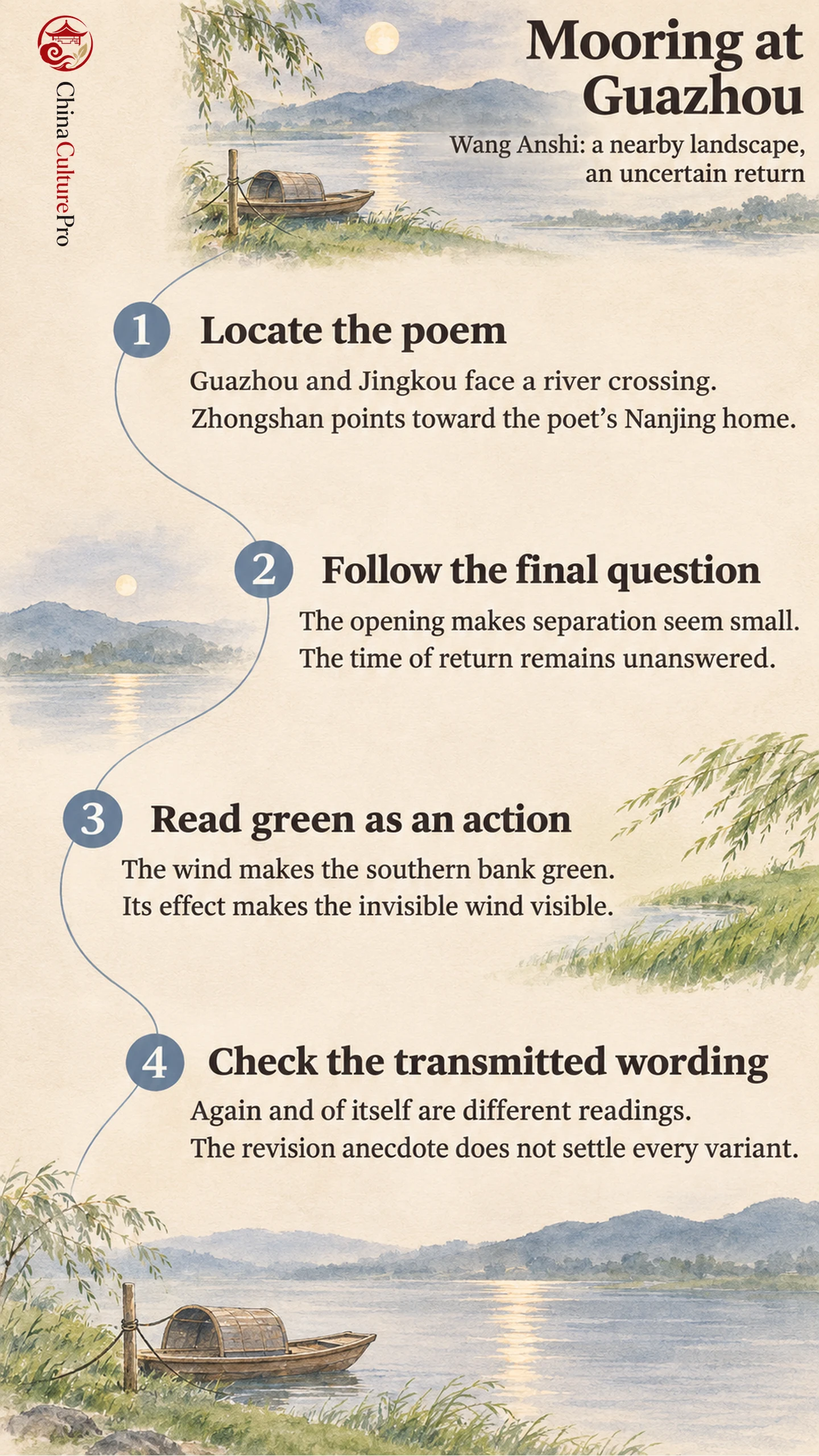
The last question changes the opening distances. What looks like a small separation on the landscape becomes an unanswered question about time: not merely how far home lies, but when returning will be possible.
Read the Four Lines and Locate the Place Names
The familiar “again” version appears below with an original, unrhymed English rendering. The reference text also supplies Mandarin pinyin. [1]
Guazhou lies by the Yangtze near Yangzhou. Jingkou (京口, Jīng Kǒu) refers to present-day Zhenjiang across the river; Zhongshan (钟山, Zhōng Shān) is Purple Mountain in Nanjing, associated with the poet’s home there. [2]
| Chinese line | Plain English rendering |
|---|---|
| 京口瓜洲一水间, | Jingkou and Guazhou are separated by a single stretch of river. [1] |
| 钟山只隔数重山。 | Only a few layers of hills stand between here and Zhongshan. [1] |
| 春风又绿江南岸, | The spring wind has made the southern riverbank green again. [1] |
| 明月何时照我还。 | Bright moon, when will you shine upon my return? [1] |
The four seven-character lines form a quatrain. The Chinese regulated verse guide explains its place among short classical forms.
Follow the Turn from Nearness to an Unanswered Return
The opening reduces distance to one stretch of water and a few hills. Those small measures make the homeward direction feel accessible. The closing question gives that apparent nearness a different emotional weight: a place can feel close while the date of return remains unknown. [2]
Read the first two lines once as geography, then again after the last line. Does “only” now sound reassuring, wistful or both? The poem leaves room for that mixture instead of naming a single emotion at every step.
The Chinese moon poetry guide offers related uses of moonlight and separation. Here the moon is addressed with a question; it supplies no answer and guarantees no completed journey.
See What the Green Verb Changes
Green functions as a verb: the wind makes the bank green. Instead of describing the wind’s arrival alone, the line shows its effect. This use of a color word as an action had earlier poetic precedents, so Wang need not be credited with inventing the device. [2]
Try replacing it in a plain English paraphrase with “reaches” or “passes.” Those verbs track movement; “makes green” puts the changed landscape before the reader. This comparison helps explain the word’s force without requiring accepting the revision anecdote as a verified drafting record.
For the language context, see Chinese characters and writing. A word’s familiar dictionary category need not exhaust its function inside a poetic sentence.
Keep the Revision Story Separate from the Textual Choice
The later Song writer Hong Mai (洪迈, Hóng Mài) records a revision story in Rongzhai Xubi (容斋续笔, Róng Zhāi Xù Bǐ). A household was said to possess a draft in which alternatives meaning reach, pass, enter and fill preceded the choice of green. This is a transmitted account, rather than a manuscript inspected for this guide. [3]
A separate question concerns the preceding character. The “again” reading emphasizes recurrence; the “of itself” reading can suggest nature continuing independently of human concerns. Collected-text traditions support the latter, while the former is familiar from the anecdote and many teaching texts. [4]
The poem’s dating is also contested, including proposals for 1068 and 1075. Avoid treating the spring wind as an unquestioned code for one appointment or political program. [4] The Song dynasty guide supplies broader context; an annotated edition should explain its own textual choice. The Chinese classic books guide helps compare that kind of annotation.
FAQs About Mooring at Guazhou
Was this poem certainly written in 1075?
No. That is a common dating, but 1068 has also been argued. The exact year should remain qualified when interpreting the poem’s political circumstances.
Does green mean that the wind itself is green?
No. It describes the wind making the riverbank green. The visible result gives the otherwise invisible wind a concrete presence.
Why do some editions use a different third line?
They follow different transmitted readings. Check whether the character before green means “again” or “of itself”; the distinction affects how seasonal change relates to the speaker’s longing.
Sources
[1] Hong Kong Education Bureau. Mooring at Guazhou: Reference Text with Pinyin
[2] Chinese Classical Literature Close Reading. Mooring at Guazhou: Text, Notes and Commentary
[3] Hong Mai, via Wikisource. Rongzhai Xubi, Volume Eight: Changing Words in Poetry
[4] Liu Chengguo, via China Writers Association. The Spring Wind Greens Again or Greens of Itself: Reexamining Mooring at Guazhou