


Quick Answer: Who Was Luo Binwang?
Luo Binwang (骆宾王, Luò Bīnwáng) was a seventh-century writer from Yiwu, remembered among the leading literary figures of the early Tang dynasty. His reputation includes short poems and politically forceful prose.[1]
- For a first poem: Begin with the familiar verse about a swimming bird.
- For a more demanding reading: Follow the insect imagery in his prison poem.
- For public rhetoric: Turn to the proclamation written for a rebellion.
His uncertain later fate should be distinguished from the works that survive under his name.
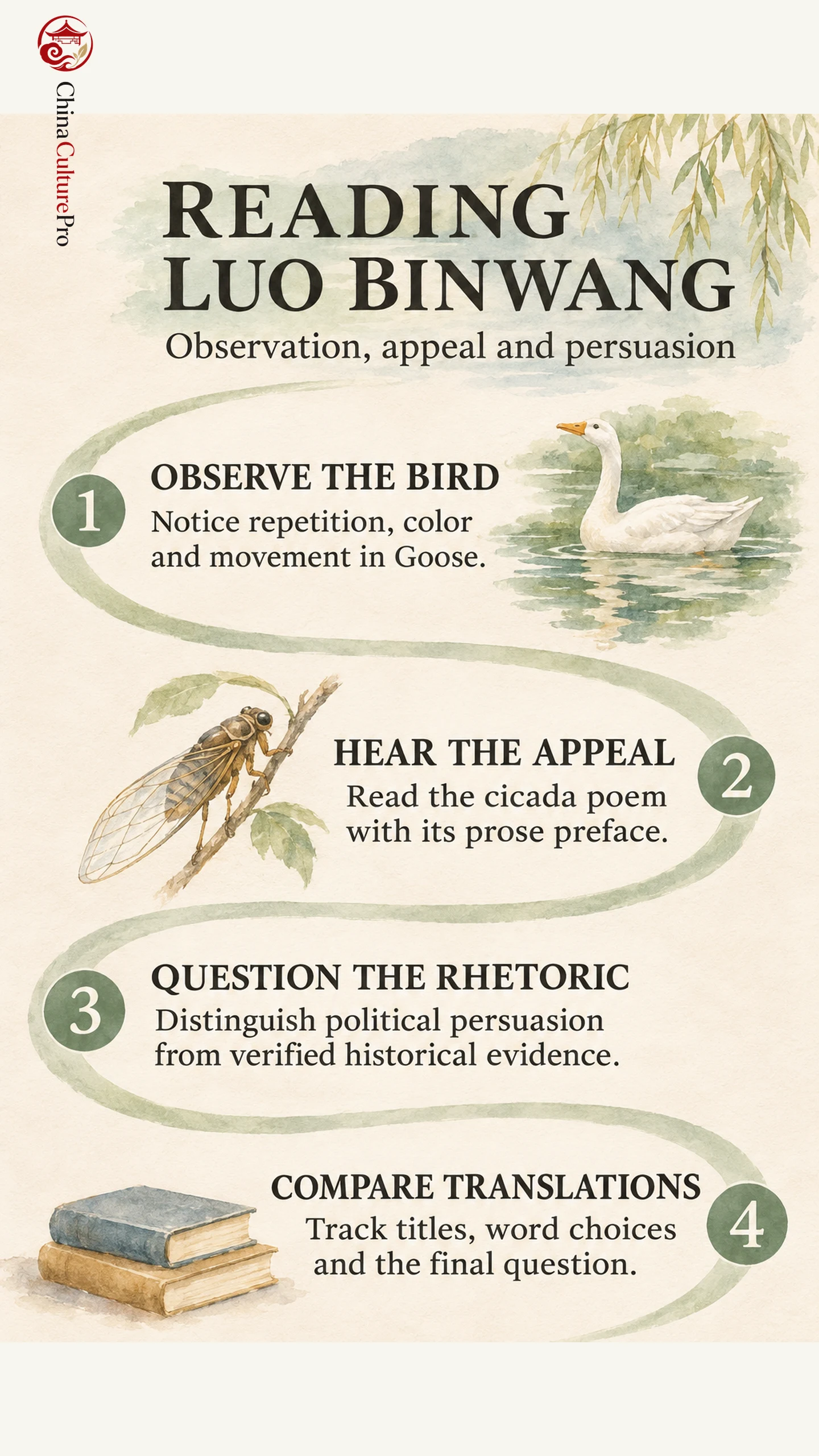
Three different questions make a useful introduction: how does a poem make an animal visible, how can an animal carry a speaker’s claim about himself, and how does public writing try to recruit an audience? Read one work for each question before combining them into a portrait of the author.
His Place Among the Early Tang Writers
He belongs to the Four Paragons of the Early Tang (初唐四杰, Chū Táng Sì Jié), alongside Wang Bo (王勃, Wáng Bó), Yang Jiong (杨炯, Yáng Jiǒng) and Lu Zhaolin (卢照邻, Lú Zhàolín). The grouping recognizes literary reputation rather than a single shared style.[1]
In 684, Xu Jingye (徐敬业, Xú Jìngyè) rebelled against Wu Zetian (武则天, Wǔ Zétiān), and Luo wrote the movement’s famous proclamation. This places the prose in a struggle over political authority, not in the setting of an impartial biography.[6]
For reading purposes, keep a distinction between the author, the speaker of a poem and the position adopted in a commissioned public text. They can be connected without being interchangeable.
Three Works and Three Kinds of Voice
The following English titles are identifying labels; translators may use different wording.
| Work | Main reading question |
|---|---|
| Goose (咏鹅, Yǒng É). | How do repetition, color and swimming movement work together?[2] |
| Singing of the Cicada in Prison (在狱咏蝉, Zài Yù Yǒng Chán). | How does an insect become a figure for the speaker’s predicament?[3] |
| Proclamation Against Wu on Behalf of Xu Jingye (为徐敬业讨武曌檄, Wèi Xú Jìngyè Tǎo Wǔ Zhào Xí). | How is an audience pressed to choose a political side?[4] |
Goose pairs white feathers and green water with red feet stirring clear ripples. Its opening repeats the bird’s name.[2]
How the Cicada Becomes a Plea for Recognition
The cicada poem connects obstructed flight and a voice weakened by wind with the speaker’s difficulty in having his integrity recognized. Its prose preface explicitly associates the insect with virtuous human conduct. The analogy is more than a hidden meaning supplied by later readers.[3]
Read the poem first without the preface, then with it. What did you already infer from the images, and what does the prose make explicit? Keep the two kinds of evidence separate in your notes.
The final question deserves particular attention. Does the speaker ask for sympathy, a witness, an explanation or some combination of these? Compare your answer with the beginning: has the natural sound remained an outside observation, or has the act of listening changed its significance?
A wider guide to Chinese poetry can help with form and allusion, but the first task is to follow this particular sequence rather than assign a fixed meaning to every cicada in Chinese verse.
Reading the Proclamation as Persuasion
The proclamation moves from attacks on Wu to the rebel leader’s credentials, claims of military strength and an appeal to officials backed by promised rewards and threatened consequences. Its arrangement builds pressure toward a choice.[4]
Mark those changes of function in the text. A sentence can be doing several things at once: accusing an opponent, establishing loyalty, invoking precedent and making hesitation seem dangerous. Ask what sort of audience the argument imagines at each stage.
Read the attacks on Wu twice: first to identify the allegations that would need independent historical checking, then to examine their placement in the appeal. A forceful accusation can reveal an opponent’s strategy without proving its own truth.
This distinction lets you appreciate rhythm, parallel phrasing and escalation while still asking who benefits from the account being told.
English Translations to Compare
Witter Bynner’s The Jade Mountain presents the prison poem as “A Political Prisoner Listening to a Cicada,” under the older spelling “Lo Ping-wang.” Its ending asks about continued singing and listening, giving particular prominence to the problem of being heard.[5]
Which part of the Chinese ending is most explicit in Bynner’s version, and which part needs a note? A translation can make one relationship vivid while giving another less explicit space. Identify the exact shift before deciding whether the English version feels persuasive to you.
Wong May’s In the Same Light: 200 Tang Poems for Our Century was published by Carcanet in 2022. A Poetry Foundation discussion identifies her neighboring versions of the cicada poem and Goose. These offer a later English route to locate alongside Bynner’s version.[8][9]
Keep the translator’s name attached to a quotation or title. Different English wording does not necessarily indicate a different Chinese work.
FAQs About Luo Binwang
Did he write Goose when he was seven?
That is the traditional account attached to the poem. The dynastic biography records his ability to compose verse at seven; that statement and the poem’s later attribution are related but distinct evidence.[1][2]
Did he certainly die in 684?
His biography in the New History of the Tang (新唐书, Xīn Táng Shū) says that he fled after the rebellion’s defeat and that his whereabouts were unknown. Later accounts offer different endings, including survival traditions. An exact death narrative should be presented with its source identified.[1][7]
Does the prison poem tell us exactly what happened to him?
No. Its images and preface express a speaker’s situation and self-understanding; they are not a complete record of a legal case or proof of every later biographical story. The distinction between history and legend remains useful when reading author anecdotes.
Sources
[1] New History of the Tang, via Wikisource. Volume 201: Selected Biographical Passages
[2] Luo Binwang, via Wikisource. Goose
[3] Luo Binwang, via Wikisource. Singing of the Cicada in Prison, With Preface
[4] Luo Binwang, via Wikisource. Proclamation Against Wu
[5] Witter Bynner, via Wikisource. A Political Prisoner Listening to a Cicada
[6] Gao Chunduan, Whampoa: An Interdisciplinary Journal. The Proclamation Against Wu in Historical Context
[7] Ou Yang, Beijing Morning Post, via Beijing Language and Culture University. Different Accounts of Luo Binwang’s Fate
[8] Carcanet Press. In the Same Light
[9] Poetry Foundation. A Bird Translates Silence