

Quick Answer: What Should You Read by Wang Bo?
Wang Bo (王勃, Wáng Bó) was an Early Tang writer known for both poetry and prose. Begin with his farewell to Official Du for friendship across distance, or compare the Pavilion of Prince Teng preface with its accompanying poem to see how different forms treat one place.
- For a short first reading: Choose In the Mountains (山中, Shān Zhōng).
- For friendship: Read the farewell to Official Du.
- For prose and poetry together: Read both pavilion texts, keeping them distinct.
The four readings below connect each work’s form to the feeling it develops, without requiring a full biography first.
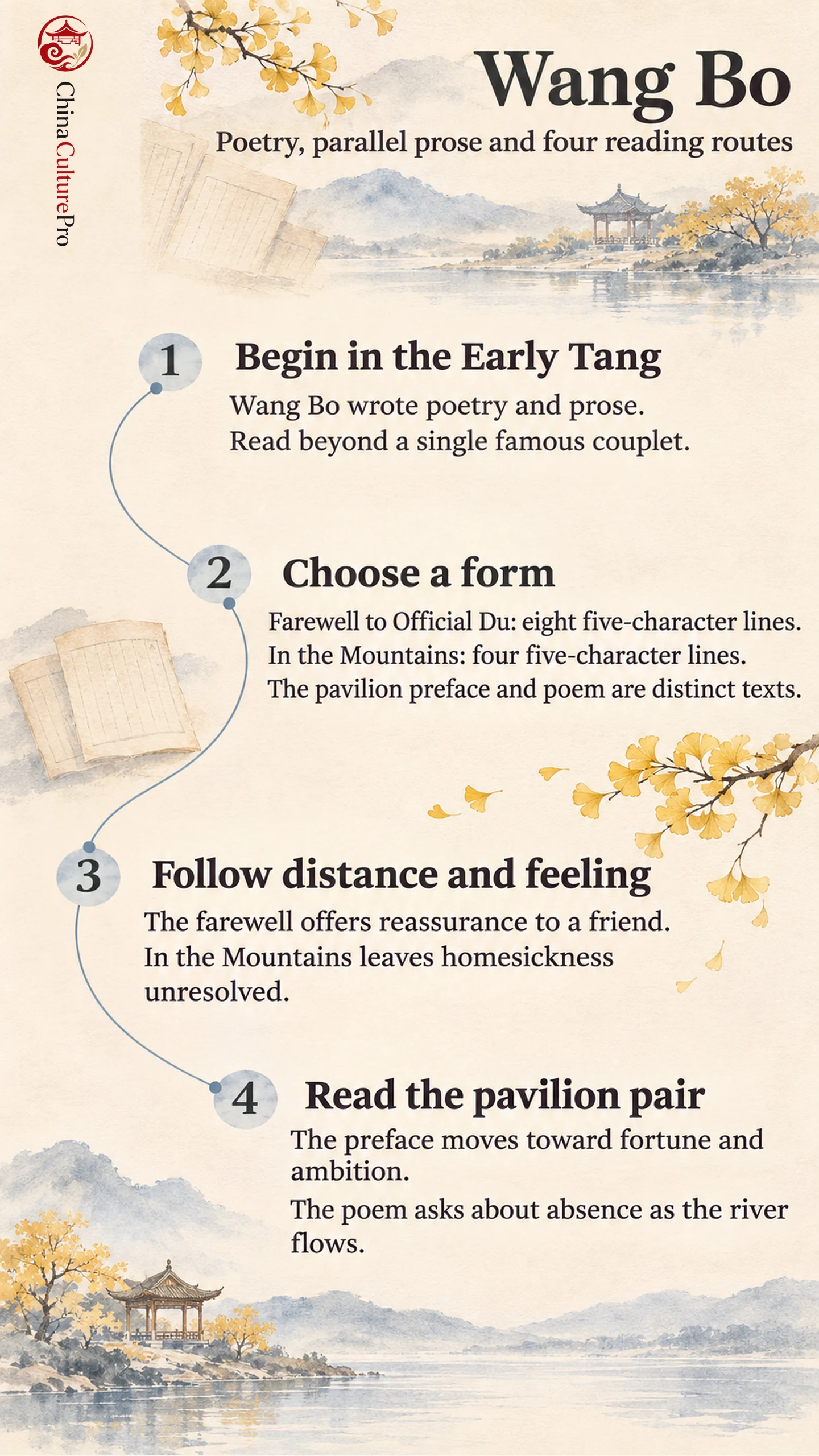
A famous couplet can make Wang Bo seem immediately familiar. Reading beyond that couplet reveals a more varied writer: he can offer reassurance to a departing friend, linger over homesickness, or turn an impressive gathering into a reflection on frustrated ambition.
Place Wang Bo in the Early Tang
Wang Bo belongs to the seventh-century literary world of the Tang dynasty. He is counted among the Four Paragons of the Early Tang (初唐四杰, Chū Táng Sì Jié), a group associated with literary distinction in the dynasty’s early period. His place in literary history therefore extends beyond a single famous poem. [1]
That double identity matters when choosing what to read. A short lyric and an elaborate preface offer different experiences, even when both organize feeling through carefully balanced language.
For broader context, the guide to Tang poetry places individual poems within a larger range of forms and periods. Begin here with the texts themselves: their length, their speaker’s situation and the direction in which each ending moves.
Choose among Four Major Works
These four works provide a manageable introduction. Their different forms are part of the choice, rather than technical details to postpone until after reading.
| Work | Form | What to follow |
|---|---|---|
| Farewell to Official Du Leaving for Shu (送杜少府之任蜀州, Sòng Dù Shào Fǔ Zhī Rèn Shǔ Zhōu) | Eight lines of five characters | Shared experience answers the pain of separation. [2] |
| In the Mountains (山中, Shān Zhōng) | Four lines of five characters | Longing for home meets an autumn landscape. [3] |
| Preface to the Pavilion of Prince Teng (滕王阁序, Téng Wáng Gé Xù) | Parallel prose, or pianwen (骈文, Pián Wén) | An expansive gathering gives way to thoughts about fortune and ambition. [4] |
| Poem on the Pavilion of Prince Teng (滕王阁诗, Téng Wáng Gé Shī) | Eight lines of seven characters | A splendid place prompts a question about the people who have gone. [5] |
The farewell is an example of Chinese regulated verse. Its eight lines form four couplets, giving the reader a compact sequence to follow. [1] In the longer prose work, look instead at paired clauses and changes of scale: a region, a building, a view and a person’s place in the world.
Read Distance in the Farewell and Mountain Poems
The farewell’s speaker recognizes a shared condition: both he and his friend are away from home through official service. That common experience prepares the best-known couplet, “海内存知己,天涯若比邻。” My English rendering is: “With a friend who knows us, the distant horizon can feel like next door.” The reassurance is emotional, rather than a claim that separation has ceased to matter. [2]
Follow the progression from a distant destination to a shared feeling, then to that affirmation of friendship. The ending discourages a tearful parting. The poem speaks to a friend, not a departing lover. [2]
In the Mountains offers another response to being far away. A traveler longs to return; the closing scene brings evening wind and yellow leaves flying across the mountains. Unlike the farewell’s reassurance, the closing scene offers no answer to the wish to return. [3]
Read its four short lines slowly. The scale moves between a long river, the great distance from home and the surrounding mountains. Wind and leaves make the final scene active, even as the traveler remains delayed. This is a reading of the poem’s images, rather than evidence of an exact itinerary or date. [3]
For comparison, explore other Chinese poems of friendship and farewell. Ask whether a poem consoles another person, addresses an absent friend, or lets the landscape carry its speaker’s longing.
Separate the Pavilion Preface from the Poem
The preface’s famous scene pairs sunset clouds with a lone wild duck, then autumn water with the sky. Its balanced clauses create a wide, unified view. Yet the piece does more than celebrate scenery: it moves from a distinguished gathering toward difficult fortune, unrecognized ability and continuing ambition. [4]
Read the changes of mood as carefully as the celebrated sentence. The gathering creates an occasion for self-presentation; historical references place personal hopes beside earlier lives. The guide to Chinese literary allusions explains how such references can compress a larger story into a few words.
The accompanying poem uses a different movement. Clouds, rain, days and returning autumns establish time passing around the pavilion. At the end, the prince’s whereabouts become a question, while the river continues to flow. Splendor is set against human absence. [5]
Place the two endings side by side. The prose presents a writer seeking recognition in a social setting; the poem leaves the reader facing the persistence of a landscape after its former occupants. Reading both makes the pavilion more than a scenic backdrop.
FAQs About Wang Bo
What is Wang Bo best known for?
His major works include the Pavilion of Prince Teng preface and his farewell to Official Du, especially its affirmation of friendship across distance.
Is the Pavilion of Prince Teng a poem or an essay?
There are two distinct texts: an extended parallel-prose preface and an accompanying eight-line poem. Check which one an edition provides.
Is Wang Bo’s farewell poem about romantic love?
No. Its speaker addresses a friend leaving for an official post and emphasizes their shared experience and enduring friendship.
Sources
[1] Ching Chung-shan, Hong Kong Education Bureau. Rereading the Classics: Wang Bo and Other Tang Poets
[2] Wang Bo, via Wikisource. Farewell to Official Du Leaving for Shu
[3] Wang Bo, via Wikisource. In the Mountains
[4] Wang Bo, via Wikisource. Preface to the Pavilion of Prince Teng
[5] Wang Bo, via Wikisource. Pavilion of Prince Teng