

Quick Answer: Where Should You Start with Wang Anyi?
Wang Anyi (王安忆, Wáng Ān Yì) is a contemporary Chinese writer whose fiction gives sustained attention to ordinary lives, relationships and the spaces people inhabit.
- For a long Shanghai narrative: Choose The Song of Everlasting Sorrow (长恨歌, Cháng Hèn Gē).
- For work, migration and personal choice: Choose Fu Ping (富萍, Fù Píng).
- For another scale or setting: Consider a shorter novella or a village-centered work.
Her Shanghai fiction is a strong starting point, while other works offer different settings and narrative perspectives.
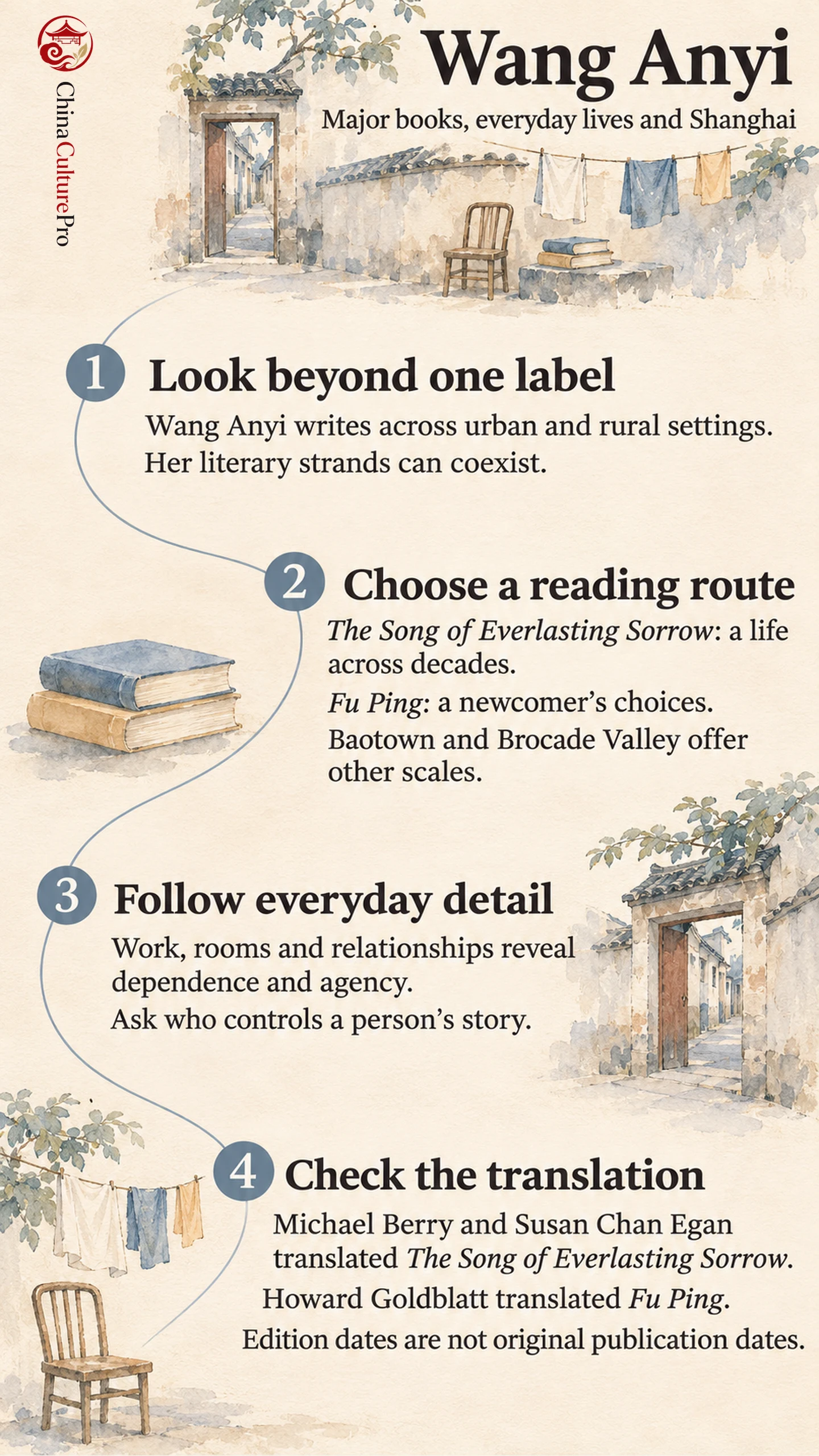
A neighborhood, a household or a village can contain more than one account of a person’s life. Reading Wang Anyi means attending to those overlapping accounts: what someone wants, what others see and how a story is later remembered.
Locate Wang Anyi beyond a Single Literary Label
Born in 1954 and brought up in Shanghai, Wang Anyi experienced rural life and worked in a performing-arts troupe before returning to the city in 1978. She became a professional writer in 1980. These different settings help locate her career within modern Chinese literature. [1][7]
In an interview, she explained that critics had successively categorized her writing through rural experience, cultural roots and Shanghai. She regarded these strands as coexisting and complementary, rather than as identities that simply replaced one another. [7]
That is a useful principle for selecting a first book. Start with a setting or form that interests you, then use another work to test the impression it creates.
Comparisons with Eileen Chang can open a conversation about realistic depictions of Shanghai. Wang acknowledged the connection while distinguishing her own outlook. The comparison is a starting question about technique and attitude, rather than a substitute for reading either writer. [7]
Compare Four Works Available in English
This selection offers two extended city narratives and two different shorter reading routes. It is a set of entry points, not a complete bibliography.
| Work | Form and English translator | A useful reading focus |
|---|---|---|
| The Song of Everlasting Sorrow | Novel; Michael Berry and Susan Chan Egan | One woman’s life across decades of changing Shanghai. [2] |
| Fu Ping | Novel; Howard Goldblatt | A young rural woman encounters urban labor and considers her future. [3] |
| Baotown (小鲍庄, Xiǎo Bào Zhuāng) | Short novel; Martha Avery | Village relationships and the transformation of an event into a public story. [5] |
| Brocade Valley (锦绣谷之恋, Jǐn Xiù Gǔ Zhī Liàn) | Novella; Bonnie S. McDougall and Chen Maiping | Desire, self-understanding and the telling of a woman’s own story. [4] |
For a first city novel, choose between the scale of a life unfolding over decades and the close attention to a newcomer’s changing options. For a smaller initial commitment, the novella provides a bounded story; the village work broadens the geographical frame.
Keep the form and translator with the title when looking for an edition. A short novel and a novella may both be manageable starting points, but their narrative designs need not resemble one another.
Follow Everyday Detail into Questions of Agency
The Song of Everlasting Sorrow follows Wang Qiyao (王琦瑶, Wáng Qí Yáo) from a 1940s Shanghai beauty contest through the 1980s. Follow how her public image outlasts that earlier moment. [2]
The city’s longtang (弄堂, Lòng Táng), its residential lanes, provide an intimate setting for that life. In thinking about Shanghai culture, distinguish a city’s fashionable public image from the homes and relationships behind its streets. Follow how a person’s movements and relationships make the neighborhood legible. [2]
Fu Ping approaches urban life through a different position. An orphaned young woman arrives as a prospective bride for Nainai’s adopted grandson, then encounters the lives of nannies, handymen and garbage collectors. As she learns about urban lives, she increasingly questions the future marriage arranged for her. [3]
Read work and movement together. Who enters whose home? Who serves another household, and who can decide where to remain? The details become ways of seeing choices and dependence, rather than a catalogue of old objects.
Baotown shifts to an isolated farming village. A friendship between a boy and an old man becomes the basis for an event that is retold as public heroism. Track the distance between a relationship as lived and a story as it circulates among other people. [5]
Brocade Valley turns toward a married editor’s affair and the self-understanding that emerges through its narration. Its shifting perspectives invite attention to who is describing an experience and how that description gives it meaning. A personal story can be shaped through the act of telling it. [4]
These are different uses of ordinary experience. Compare the public image, the available choice and the remembered account in each work, rather than expecting all four stories to reach the same judgment.
Read the English Edition as a Particular Translation
An English title is also a collaboration with a translator. The Song of Everlasting Sorrow appeared in the cited English edition in 2008. [2] Fu Ping’s cited translation appeared in 2019. [3] These dates identify English editions, rather than the original Chinese publication of each work.
In discussing translation, Howard Goldblatt emphasized that individual works by the same author can retain distinct styles. He also questioned attempts to reproduce Chinese regional speech by imposing a supposedly equivalent English dialect. These are his stated translation principles, not rules that every translator follows. [6]
Use that perspective when comparing books. Notice differences in rhythm, narrative distance and dialogue, while keeping both the original work and the translator’s choices in view.
The guide to Chinese classic books and translations provides broader edition-selection questions, while the Chinese-literature overview places these contemporary works in a larger reading landscape.
For each book, begin with a simple question tied to its design: how does a public image endure, how does a newcomer learn her options, or how does a private event become someone else’s story? That gives you something specific to follow without reducing the characters to historical examples.
FAQs About Wang Anyi
Which Wang Anyi book should I read first?
Choose The Song of Everlasting Sorrow for a life-spanning Shanghai narrative, or Fu Ping for a newcomer’s encounter with work, community and personal choice.
Is Wang Anyi’s writing only about Shanghai?
No. Shanghai is important to her fiction, but works such as Baotown explore village life, and her writing spans several settings and literary approaches.
Who translated The Song of Everlasting Sorrow and Fu Ping?
Michael Berry and Susan Chan Egan translated The Song of Everlasting Sorrow. Howard Goldblatt translated Fu Ping.
Are Baotown and Brocade Valley available in English?
Yes. Baotown was translated by Martha Avery; Brocade Valley by Bonnie S. McDougall and Chen Maiping.
Sources
[1] Chinese University of Hong Kong, Renditions. Wang Anyi
[2] Columbia University Press. The Song of Everlasting Sorrow: A Novel of Shanghai
[3] Columbia University Press. Fu Ping: A Novel
[4] New Directions Publishing. Brocade Valley
[5] OCLC WorldCat. Baotown
[6] Howard Goldblatt, Columbia University Press Blog. Q&A: Translating Literary Works and the Fiction of Wang Anyi
[7] Wang Anyi and Cao Kefan, China Writers Association. Wang Anyi: Other People’s Labels Are Not So Important