


Quick Answer: Who Was Li Ruzhen?
Li Ruzhen (李汝珍, Lǐ Rǔzhēn; c. 1763–1830) was a Qing writer from Daxing, near present-day Beijing, who spent much of his life in the Haizhou region of Jiangsu. He is best known for Flowers in the Mirror (镜花缘, Jìnghuā Yuán), a novel combining imaginary travel with social criticism and wide-ranging learning.[1]
- Follow the overseas encounters as experiments with familiar social rules.
- Continue into the women’s examinations and learned gatherings.
- Check whether an English edition translates, summarizes or omits a passage.
The book’s shifting forms are part of its interest: a voyage alone cannot convey its whole design.
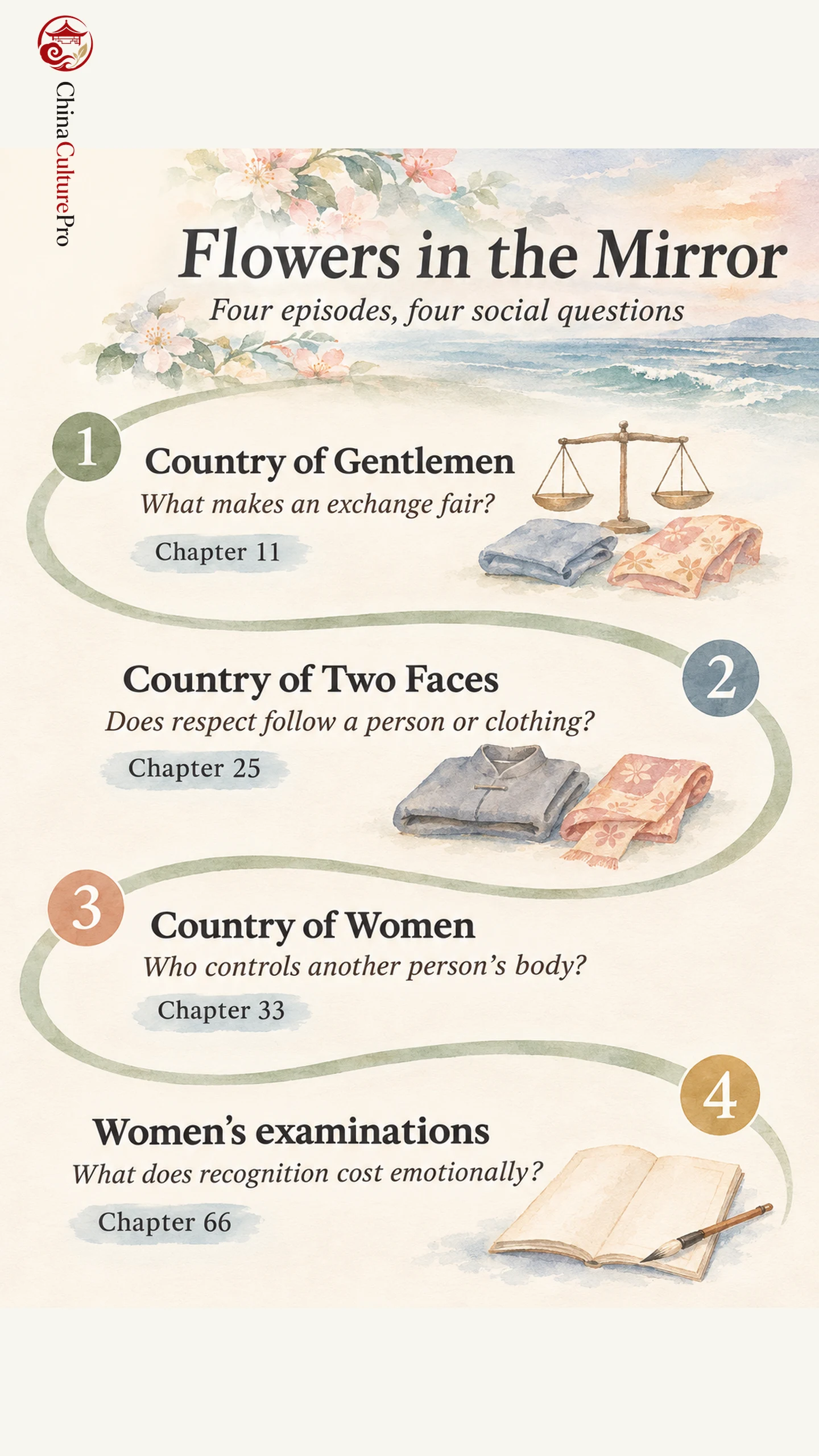
This novel asks readers to judge rules as well as characters. Track an episode’s immediate problem, the custom used to justify it and the person who bears its costs. These questions help connect an adventure or a comic argument to the society it imagines.
Major Works and a Life of Wide Learning
Li moved south with his elder brother in 1782 and later held a minor official position. His studies included classical learning and phonology, the investigation of speech sounds.[1]
Three works help place the novelist’s range. The two scholarly titles below use descriptive English labels:
- Flowers in the Mirror is his major work of fiction, with imaginary overseas societies and criticism of familiar customs.[1]
- Li’s Guide to Sounds (李氏音鉴, Lǐ Shì Yīnjiàn) is a work of phonological scholarship.[1]
- Collected Go Games (受子谱, Shòuzǐ Pǔ) records his interest in the study of board play.[2]
The Go tradition offers context for the third work. These different genres help explain why his fiction gives intellectual activities so much room: knowledge itself becomes something characters display, debate and judge.
Set this career within the Qing dynasty. The novel’s earlier imperial setting belongs to its imaginative construction, rather than the author’s own lifetime.
The Novel’s Shape: Beyond the Overseas Journey
The hundred-chapter novel links a celestial flower narrative, overseas travel, women’s examinations and learned gatherings. Flower spirits descend into the human world; Tang Ao (唐敖, Táng Áo) joins the merchant Lin Zhiyang (林之洋, Lín Zhīyáng) at sea.[3][10][11]
Use the contents page as a map of changing activities. A chapter of travel, a debate about language and an account of examination anxiety ask for different kinds of attention. Do not expect every part to move like an adventure story.
When the pace slows for an intellectual exchange, ask who is allowed to speak and what counts as convincing knowledge. A digression may be doing social work even when it delays the next journey.
Four Episodes and Their Reading Questions
These selected passages expose different rules of behaviour. They are not descriptions of actual foreign nations.
| Episode | What changes | A reading question |
|---|---|---|
| Chapter 11: Country of Gentlemen (君子国, Jūnzǐ Guó). | Buyers want to pay more; sellers accept less. | What would fair exchange require? [4] |
| Chapter 25: Country of Two Faces (两面国, Liǎngmiàn Guó). | Swapping rich and plain clothes changes how visitors are treated. | Is respect attached to the person or the costume? [5] |
| Chapter 33: Country of Women (女儿国, Nǚ’ér Guó). | A male merchant is coerced into a consort’s role and footbinding. | Who controls another person’s body? [6] |
| Chapter 66: Women’s examinations. | Candidates await results in an anxious mixture of laughter and tears. | What does official recognition cost emotionally? [7] |
Read the exchange or conversation around the reversal, not just its unusual premise. Note the arguments used to defend a custom. A claim about propriety, fairness or beauty may sound very different when the person making it bears the consequences.
Women, Knowledge and Social Judgment
The opening invokes conventional teachings about women’s conduct. That matters when reading the novel’s challenges to familiar gender arrangements: criticism of a custom does not automatically remove every inherited moral standard.[2]
Frederick P. Brandauer’s 1977 study notes the novel’s encyclopedic range and the variety of interpretations it has attracted, including entertainment, displays of learning and social criticism. No single label accounts for every change of tone or narrative purpose.[8]
For a reading centred on women, keep access and standards separate. Who gets the opportunity to study or compete? What qualities must they demonstrate to earn recognition? A story may expand access while still valuing established forms of learning and exemplary conduct. Test that distinction against the dialogue instead of deciding the answer in advance.
The women in Chinese history guide supplies a broader historical setting. The imperial examinations guide helps distinguish real institutions from the novel’s imagined examination world. Fictional success is evidence of what a narrative makes possible, not proof that the same opportunity existed historically.
Read the English Translation with Its Scope in Mind
Lin Tai-yi’s Flowers in the Mirror was published by the University of California Press in 1965. Older catalogues identify its author as Li Ju-chen.[9]
This is an edited, abridged route through the novel. Brandauer observes that Lin covers the entire work but presents much of it as brief synopsis rather than translation. Reaching the story’s end therefore does not mean every chapter has been translated in full.[8]
For a first encounter, that scope can make a large book manageable. For close reading, check whether the passage before you is a translated scene or a summary. A synopsis preserves events more readily than the pace of a quarrel, a joke’s wording or the accumulation of a learned argument.
If you read Chinese, use chapter numbers to compare the original episode. Keep a small record of what the English version includes and how it handles the change in narrative form. That is more useful than assuming a familiar English title guarantees an unabridged text.
FAQs About Li Ruzhen
Is Li Ju-chen the same author as Li Ruzhen?
Yes. Li Ju-chen is an older romanization used in the English translation and library catalogues.[9]
Is Flowers in the Mirror a record of real foreign countries?
No. Its imaginary overseas world provides a setting for satire and social ideals; it should not be used as a geographical travel account.[1]
Can I stop after the overseas adventures?
You can read those episodes selectively, but the later examinations and gatherings show another side of the novel. Continue if you want to understand its treatment of learning and recognition.[3]
Sources
[1] Daxing District People’s Government. Li Ruzhen: a novelist of wide learning
[2] Huaxia Publishing House. Flowers in the Mirror: author, contents and opening excerpt
[3] Li Ruzhen, Wikisource transcription. Flowers in the Mirror: contents
[4] Li Ruzhen, Wikisource transcription. Chapter 11: Country of Gentlemen
[5] Li Ruzhen, Wikisource transcription. Chapter 25: Country of Two Faces
[6] Li Ruzhen, Wikisource transcription. Chapter 33: a coerced consort
[7] Li Ruzhen, Wikisource transcription. Chapter 66: women’s examinations
[8] Frederick P. Brandauer, Journal of Asian Studies. Women in the Ching-hua yüan: Emancipation toward a Confucian Ideal
[9] National Institute of Informatics, CiNii Books. Flowers in the Mirror: Lin Tai-yi’s 1965 edition
[10] Li Ruzhen, Wikisource transcription. Chapter 6: flower spirits enter the human world
[11] Li Ruzhen, Wikisource transcription. Chapter 8: departing overseas