
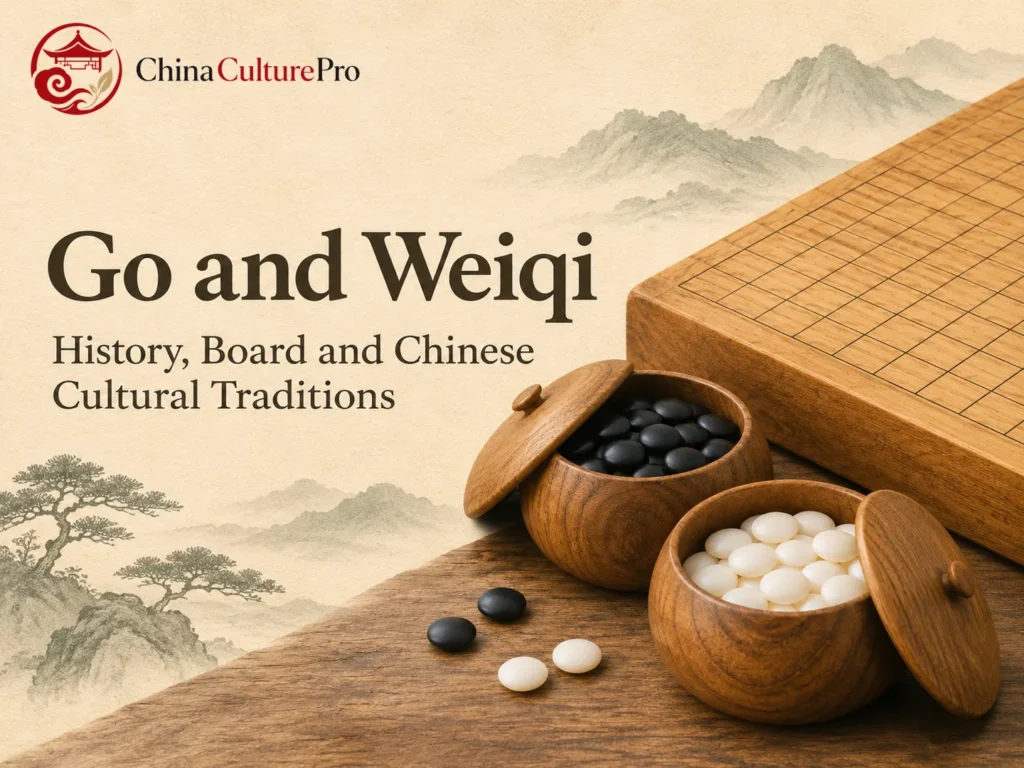

Quick Answer: What Is Weiqi?
Weiqi (围棋, wéiqí), known internationally as Go, is a two-player game of black and white stones placed on a grid. It originated in China and developed long histories across East Asia. Its cultural associations include artistic cultivation, skilled competition and ordinary social play.[1][2]
- Equipment: the full-size board has nineteen lines in each direction, with stones placed on intersections.
- History: ancient references and excavated pieces support a long record; they do not establish one secure invention date.
- Culture: the refined scholar’s game is an influential image, alongside other ways people have played and understood it.
A cultural introduction explains the setting; the companion rules guide covers how to play a complete game.

A Go board offers few visual clues about hierarchy: there are no generals, horses or named armies. The position emerges as players add stones. That simple appearance has supported many interpretations, from cultivated conversation to professional competition.
Ancient Origins and the Evidence for Them
Go is securely ancient, but its founding story remains uncertain. Marc Moskowitz’s historical account, summarized by his academic publisher, identifies written references reaching back to the fourth century BCE. Such references establish an early history, rather than a complete record of how every modern rule developed.[3]
The story that the legendary Emperor Yao invented the game to educate his son is one traditional explanation. It should be identified as a legend, not used to assign a documented founding year.[2]
Archaeology provides another kind of evidence. A 2025 study examined Go pieces excavated from a Tang-dynasty tomb at Lafuqueke Cemetery in Xinjiang. Laboratory analysis identified the black pieces as primarily clinochlore and the white pieces as primarily calcite, two different minerals. The researchers used those findings, comparison with other artifacts and historical records to discuss possible material sources and distribution.[4]
The distinction is useful when looking at an old set: color and shape may suggest a material, but scientific identification can revise an earlier visual guess. A surviving object, an old text and a legend each answer different historical questions.
The Board, Stones and Smaller Formats
A full-size board has nineteen horizontal and nineteen vertical lines, creating 361 intersections. One player uses black stones and the other white. In an ordinary even game, Black plays first; once placed, a stone stays on its point unless it is captured and removed.[1]
The goal concerns surrounding space and the relationships between groups, rather than capturing a royal piece. In Chinese area scoring, occupied points and surrounded empty points contribute to the result. Exact counting and end-of-game procedures belong with the rules you are learning.[1]
Smaller grids offer a manageable introduction:
| Board format | Number of intersections | Common learning use |
|---|---|---|
| 9 by 9 | 81 | Short introductory games |
| 13 by 13 | 169 | A larger space for practice |
| 19 by 19 | 361 | Full-size play |
Teaching guidance recommends beginning with small boards before moving to full-size play. The format changes the amount of space to manage, while the basic placement-and-capture ideas remain recognizable.[5]
This differs from Chinese chess, or xiangqi, whose differentiated pieces move after setup. Go’s stones acquire their significance through position and connection.
Weiqi and the Four Arts
The Four Arts (琴棋书画, qín qí shū huà) combine music, board play, calligraphy and painting. In this cultural grouping, the board game is weiqi. The association presents play as part of cultivated life, alongside activities concerned with expression, judgment and appreciation.[6]
A mid-sixteenth-century pair of Japanese screens by Kano Motonobu illustrates the ideal through Chinese gentlemen in a landscape. The museum identifies scenes alluding to the four pursuits. This is Japanese art adapting a Chinese cultural theme, not a documentary view of every Chinese player.[6]
The theme also appeared in Chinese family imagery. A Qing-dynasty set of prints titled Women Teaching Children the Four Accomplishments, dated to the Qianlong period, connects these pursuits with women and children. Such imagery shows how the ideal could be represented beyond a gathering of male scholars.[7]
Reading the subject carefully means asking who made the image, whom it depicts and what kind of cultivated life it proposes. An artistic ideal is evidence of cultural meaning; it is not a census of participation.
Beyond the Scholar’s Ideal
Scholar Zach Berge-Becker’s study of Song, Yuan and Ming sources treats gentlemanly weiqi as one playing culture among several. His account also discusses occupational players seeking prestige through wins, lower-status participants playing for profit and educated critics who considered the game a distraction.[8]
That range complicates a familiar picture of serene scholars playing only for self-cultivation. Respect for a game, enjoyment of competition, pursuit of income and criticism of wasted time could coexist around the same board.
Weiqi is sometimes called shoutan (手谈, shǒután), or conversation through the hands. The expression captures the idea that moves can form an exchange. It remains a metaphor used within particular understandings of the game, rather than proof that every match expresses one shared philosophy.[8]
Modern accounts are similarly varied. Moskowitz’s research examines the game through masculinity, class and national identity, while interviews with professionals and amateurs explore their personal experiences and ideas about learning. These are perspectives to study, not universal traits automatically acquired by playing.[3][9]
Across East Asia and into Modern Competition
Go spread beyond China and became deeply established in Korea and Japan. Its names preserve that wider history: weiqi in Chinese, baduk in Korean and go in Japanese. In Japan, organized schools supported by shogunal stipends developed from the early seventeenth century, creating an important institutional setting for professional play.[2]
The international game consequently carries several histories at once. Chinese origins do not erase later Korean and Japanese contributions; the internationally familiar Japanese name does not relocate the game’s origins.
A recent technological milestone brought Go to a wider audience. In March 2016, AlphaGo defeated Lee Sedol by four games to one in Seoul. Its developer’s account documents that match as a landmark in computer Go. The event belongs to the modern history of competition and analysis, alongside the much longer histories of human play.[10]
A museum object, a club game and a professional match provide complementary views. They show different relationships between material things, learned skills and the people who give the game meaning.
Reading the Culture and Beginning to Play
When you see a board in an artwork or collection, check the object’s date and place before treating it as a timeless scene. Notice whether the game is part of a social gathering, an image of cultivation or a specifically documented set of equipment.
When joining a real game, ask which rules and counting method the group uses. A short practice game on a small board can make the basic mechanics easier to discuss before you try the full nineteen-line format.[5]
Our beginner’s guide to playing Go explains placement, capture and the steps needed to finish a game. The wider guide to Chinese traditional games places weiqi beside other forms of intellectual and social play.
FAQs About Weiqi and Go
Are weiqi and Go the same game?
Yes. Weiqi is the Chinese name, while Go is the internationally familiar Japanese name. Regional rules and counting conventions can still differ.
Did a legendary emperor invent weiqi?
That is a traditional origin story, not a securely documented invention. Ancient references and excavated objects support the game’s long history without establishing a single founder.
Do the stones move like chess pieces?
No. A stone remains on the intersection where it was played unless captured and removed. Players build the position by adding stones.
Must a beginner start on a nineteen-line board?
No. A nine-line board is a common teaching format, and thirteen-line boards provide another practice size before full-size play.
Sources
[1] Chinese Weiqi Association, translated by Guo Juan. The Chinese Rules of Weiqi (Go), 2002
[2] British Go Association. A Brief History of Go
[3] Marc L. Moskowitz, University of California Press. Go Nation: Chinese Masculinities and the Game of Weiqi in China
[4] Yu An and colleagues, npj Heritage Science. Scientific analysis of Tang Dynasty Go pieces excavated from the Lafuqueke Cemetery in Xinjiang
[5] British Go Association. Sets and Advice on What to Buy: Advice for Beginners
[6] The Metropolitan Museum of Art. Kano Motonobu, The Four Accomplishments
[7] Cleveland Museum of Art. The Cleveland Museum of Art and the Metropolitan Museum of Art Jointly Acquire Important Chinese Prints
[8] Zach Berge-Becker, University of Washington Press. Groups on the Grid: Weiqi Cultures in Song-Yuan-Ming China
[9] Steve Moyer, National Endowment for the Humanities. Go Figure
[10] Google DeepMind. AlphaGo