

Quick Answer: What Is Chinese Chess?
Xiangqi (象棋, xiàngqí), usually called Chinese chess in English, is a two-player strategy game with sixteen pieces per side. The central objective is to checkmate the opposing general (帅/将, shuài/jiàng). A player with no legal move also loses, even when the general is not in check.[1][2]
- Board: pieces occupy the intersections of nine files and ten ranks, making ninety points.
- Space: a central river divides the board, and two palaces (九宫, jiǔgōng) restrict particular roles.
- Pieces: seven types have different movement and capture rules; an apparently open destination may still be illegal.
The basic moves are approachable, while repeated-check and chasing disputes require the rules used by your club or event.
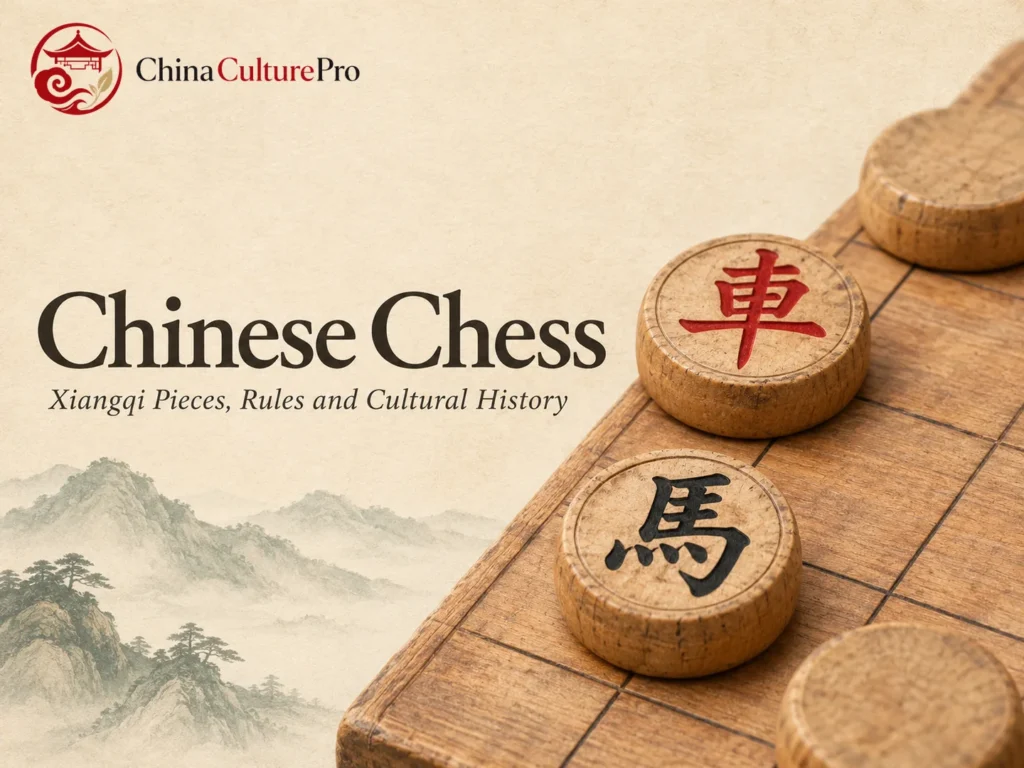
The disc-shaped pieces can look unfamiliar at first, but their written labels become manageable once you connect each with a role. The larger adjustment is spatial: river boundaries, blocked paths and restricted areas matter alongside the destination. Learn those together with the names rather than treating the pieces as direct substitutes for Western chessmen.
The Board, River and Two Palaces
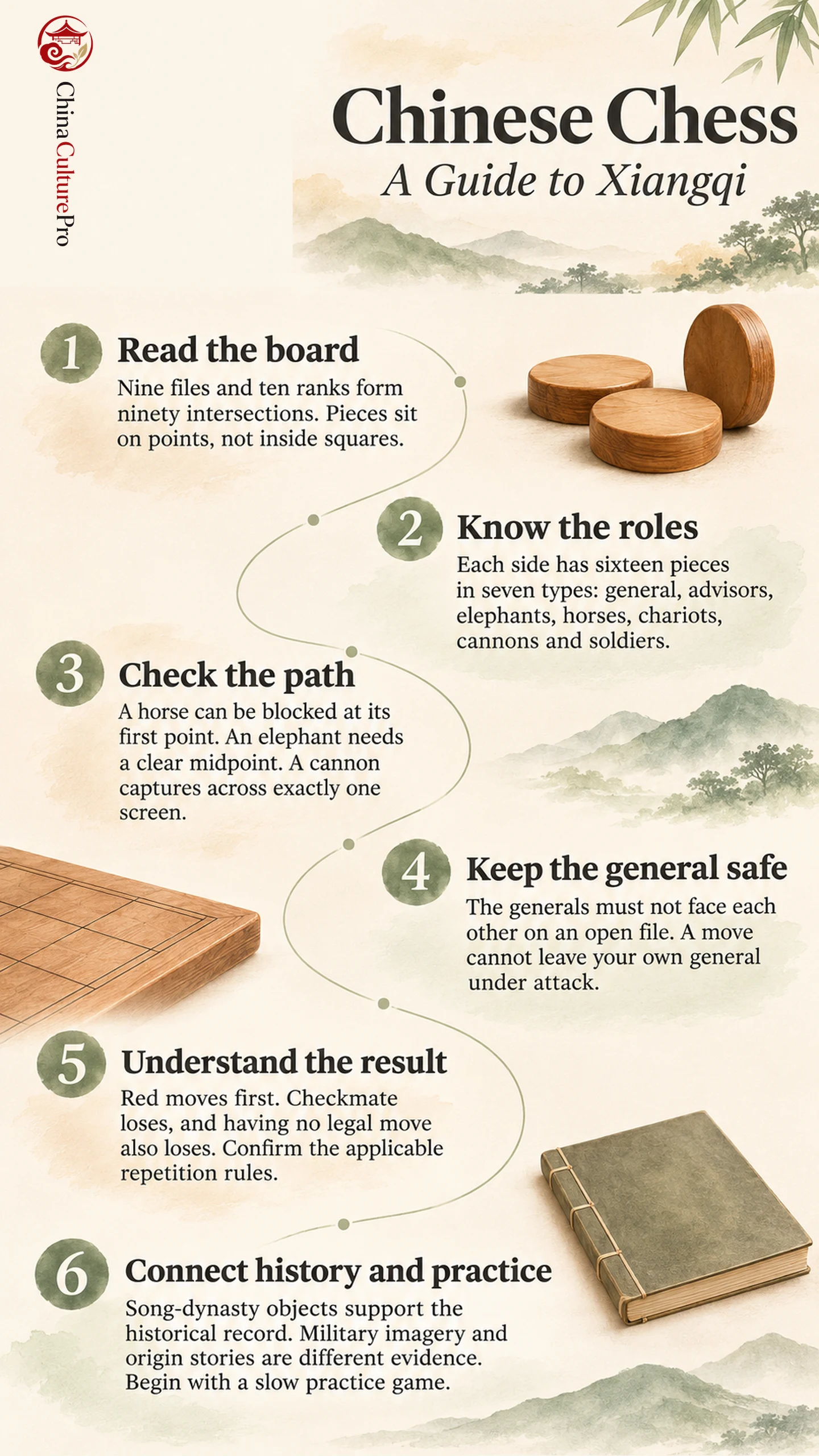
The board has nine vertical files and ten horizontal ranks. Place pieces on the line intersections, including the outermost points. Each palace is a three-by-three group of points at the center of one end, marked with diagonal lines. The river runs across the middle, between the fifth and sixth ranks.[1]
Those features are functional. Some roles remain inside the palace; another cannot cross the river; another gains sideways movement after crossing. Read the movement table before assuming that a line on the board is merely decoration.
The Seven Xiangqi Piece Types
Red and black each begin with the same number of roles, although the characters printed on corresponding pieces may differ. Simplified and traditional character forms also vary between sets. The table gives familiar labels and Mandarin readings.[3]
| Piece and Chinese label | Per side | Basic movement and restriction |
|---|---|---|
| General (帅/将, shuài/jiàng) | 1 | One point horizontally or vertically within its palace |
| Advisor (仕/士, shì) | 2 | One point diagonally within its palace |
| Elephant (相/象, xiàng) | 2 | Two points diagonally; midpoint must be empty; stays on its own side of the river.[5] |
| Horse (马/馬, mǎ) | 2 | One point straight, then diagonally outward; the first point must be empty.[4] |
| Chariot (车/車, jū) | 2 | Any distance horizontally or vertically through an unobstructed line |
| Cannon (炮/砲, pào) | 2 | Moves through an empty straight line; captures across exactly one intervening piece.[6] |
| Soldier (兵/卒, bīng/zú) | 5 | One point forward; after crossing the river, may also move one point sideways; never backward |
To set up either side, use this back-rank order: chariot, horse, elephant, advisor, general, advisor, elephant, horse, chariot. Place the two cannons on the third rank from that side, one on the second file from each edge. Place the five soldiers on the fourth rank from that side, on alternating files beginning at the edge.[1]
The setup is mirrored across the river. Count sixteen pieces on each side before playing. When using a diagram with unfamiliar symbols, match its key to these seven roles before setting up the pieces.
Three Movement Rules Beginners Often Miss
The horse’s “leg” is the first, orthogonally adjacent point of its move. If a piece of either color occupies that point, the two destinations reached through that direction are blocked. For example, a blocker immediately in front of a horse prevents both forward-leading L-shaped moves, even if their final points are empty.[4]
The elephant’s “eye” is the midpoint of its two-point diagonal. A piece there blocks that diagonal move. Its river restriction still applies when the midpoint is clear: the elephant cannot move onto the opposing half of the board.[5]
The cannon has separate moving and capturing rules. To move to an empty point, it needs a clear horizontal or vertical path. To capture, exactly one piece of either color must stand between it and the enemy target. That intervening piece is the screen; it remains where it is. Zero screens or two screens make the capture illegal.[6]
These examples concern paths, not piece values. Before making a move, trace the required route and count intervening pieces. Your own army can obstruct a move just as effectively as the opponent’s.
Taking Turns, Check and Winning
Red moves first, then players alternate one move at a time. A capture removes the enemy piece on the landing point; there is no obligation to capture merely because one is available. You may not finish a move with your own general under attack.[2]
The generals must not face each other along the same file with no piece between them. Moving away the only intervening piece can therefore be illegal even when that piece’s own movement would otherwise be allowed.[10]
When in check, make a legal response that removes the threat. Checkmate means that no such response exists. Stalemate is different—the player is not in check but has no legal move—and also loses in xiangqi. Games may also end by resignation or a draw under the applicable rules.[2]
Repeated checks and prolonged chasing are not safely summarized as “repeat three times and draw.” Organized play has detailed adjudication rules. Agree on the governing code or platform before a serious game rather than importing a Western chess repetition rule.
History, Objects and Cultural Meaning
Xiangqi’s origins are debated, and an early mention of a similarly named game does not automatically establish the modern rules. Singapore’s Asian Civilisations Museum places the establishment of the modern form in the Southern Song period. Its account also connects the board’s river-and-palace imagery with the Chu–Han conflict.[7]
A concrete example comes from Chengdu Museum: bronze Chinese chess pieces dated to the Song dynasty, excavated near Huayang in 2016. Thirty pieces survive. The museum compares their roles with a modern set and identifies both missing pieces and an extra soldier. It does not present the surviving group as an intact modern thirty-two-piece kit.[8]
Such objects help distinguish historical evidence from familiar origin stories. A story associating a hero with the invention of the game may be culturally influential without establishing when every modern rule appeared.
The palace and military roles also give the game a recognizable cultural language. China’s national intangible cultural heritage record interprets the arrangement through rulers, attendants and soldiers, and lists xiangqi in the second national batch announced in 2008. That is a Chinese national designation, rather than a UNESCO inscription.[9]
Alongside weiqi, or Go, xiangqi belongs to a broader landscape of Chinese traditional games. Their different boards and objectives should be learned on their own terms.
A Useful Way to Begin Learning
Start with a correctly arranged board and play a slow practice game. Before each move, check the role’s movement, its path or screen, its river or palace limit, and the safety of your general. Ask your partner to explain an illegal move while the position is still on the board.
Afterward, revisit one missed threat or blocked move. A specific position gives you something to test; you can replay the move and see which constraint changed its legality.
If you already play Western chess, the Chinese chess and Western chess comparison can identify useful connections. Keep the differences visible: the horse can be blocked, soldiers do not promote, and stalemate is a loss.
FAQs About Chinese Chess
Can the two generals face each other?
They cannot face each other on the same open file with no intervening piece. A move that leaves that condition is illegal.
Can a horse jump over another piece?
No. A piece on the first orthogonal point of the horse’s route blocks the moves through that direction, even if the destination is empty.
Does a soldier become another piece at the far end?
No. A soldier gains sideways movement after crossing the river, but it never moves backward and does not promote when it reaches the last rank.[3]
Is stalemate a draw in xiangqi?
No. A player with no legal move loses, even if their general is not currently in check.
Sources
[1] Xiangqi.com. How to Start a Chinese Chess Game
[2] Xiangqi Master. How to Play Chinese Chess (Xiangqi)
[3] Xiangqi.com. Learning the Xiangqi Pieces and Moves
[4] Xiangqi Master. How the Horse Moves in Xiangqi
[5] Xiangqi Master. How the Elephant Moves in Xiangqi
[6] Xiangqi Master. How the Cannon Moves in Xiangqi
[7] National Heritage Board, Singapore. Let’s Play: The Art and Design of Asian Games at the Asian Civilisations Museum
[8] Chengdu Museum. Bronze Chinese Chess Pieces
[9] China Intangible Cultural Heritage Network. Xiangqi, National Representative Project 791
[10] Xiangqi Master. The Flying General Rule