

Quick Answer: What Is Shuai Jiao?
Shuai jiao (摔跤, shuāijiāo) is the Chinese term for wrestling. In martial-arts settings, it commonly refers to Chinese-style wrestling (中国式摔跤, Zhōngguóshì shuāijiāo), a modern sport centered on standing grips, balance and throwing an opponent down.[6]
- Watch how a wrestler establishes control before attempting a throw.
- The landing and the thrower’s own balance affect the score.
- Jacket grips are important, while the rules define which other holds are allowed.[1]
This guide focuses on modern jacket wrestling and its cultural setting. Historical wrestling, regional schools and ethnic traditions should not all be assigned one unchanged rulebook.[7]
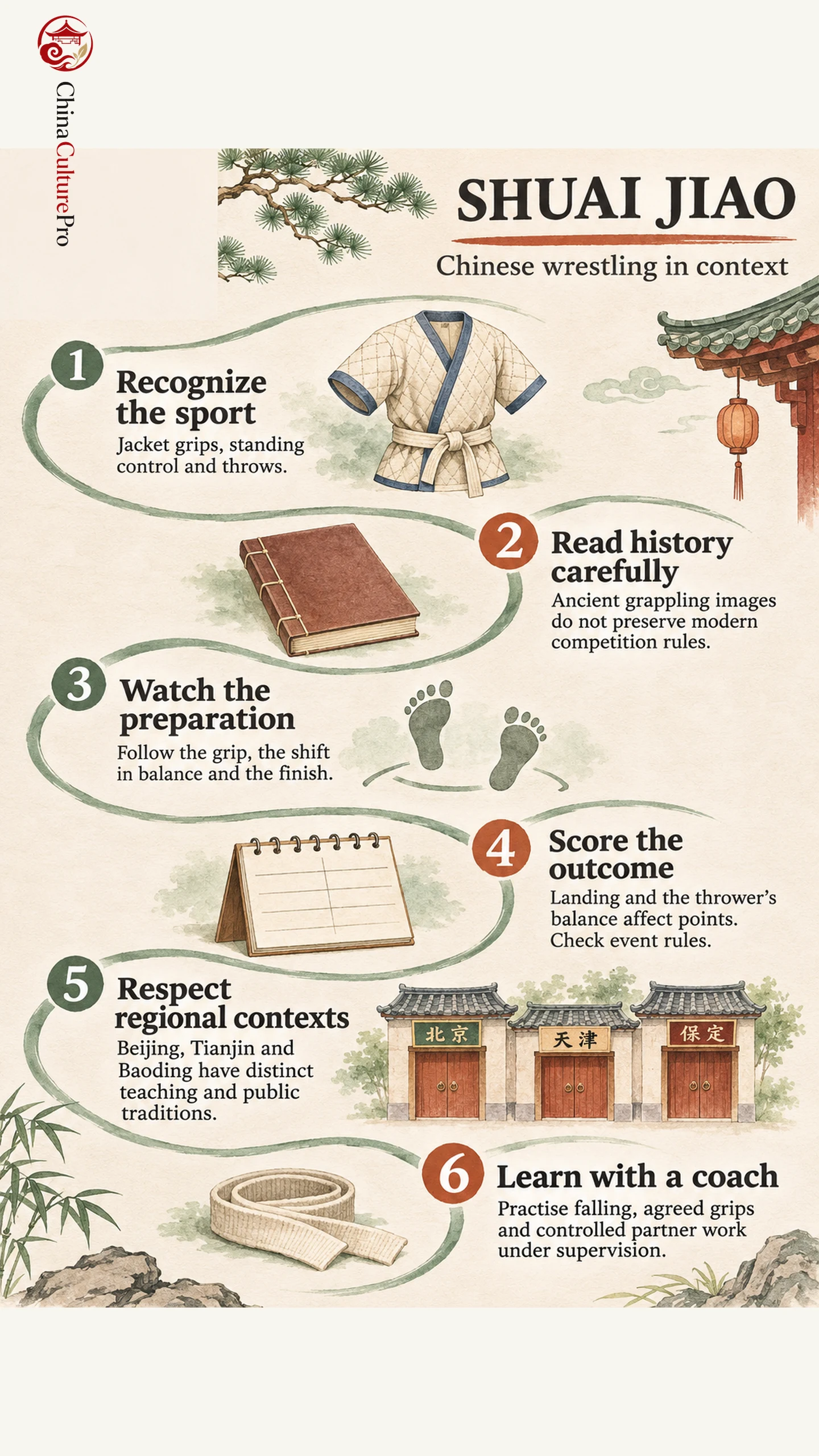
The decisive moment can look sudden. The preparation is often less conspicuous: a grip changes, a foot shifts and the opponent loses a stable position. Understanding that preparation makes the exchange easier to follow than watching only the fall.
Historical Wrestling and the Modern Sport
Material evidence gives a firmer starting point than a legendary first battle. A Western Han copper seal depicts two figures in a wrestling-like contest, one seeking a low opening while the other evades. The activity was known as jiaodi (角抵, jiǎodǐ), a historical term used in accounts of physical contests and entertainments.[2]
That object establishes a historical representation of grappling. It does not preserve the scoring rules of a present-day match, nor prove that every later school practiced an identical system.
Under the Qing, the Shanpuying (善扑营, Shànpūyíng) organized skilled wrestlers for the imperial court. Court wrestling also belonged to ceremonial entertainment, rather than existing solely as a battlefield technique.[2]
The modern sporting name and rule development belong to a later stage. In the 1950s, Chinese-style wrestling was distinguished from international wrestling through a process of sporting codification. Earlier practices supplied an inheritance; modern competition organized it into a defined event.[6]
Keeping those layers separate allows both histories to remain visible: old images, court institutions, public wrestling grounds and contemporary tournaments contribute different evidence.
Jacket Grips, Balance and Standing Throws
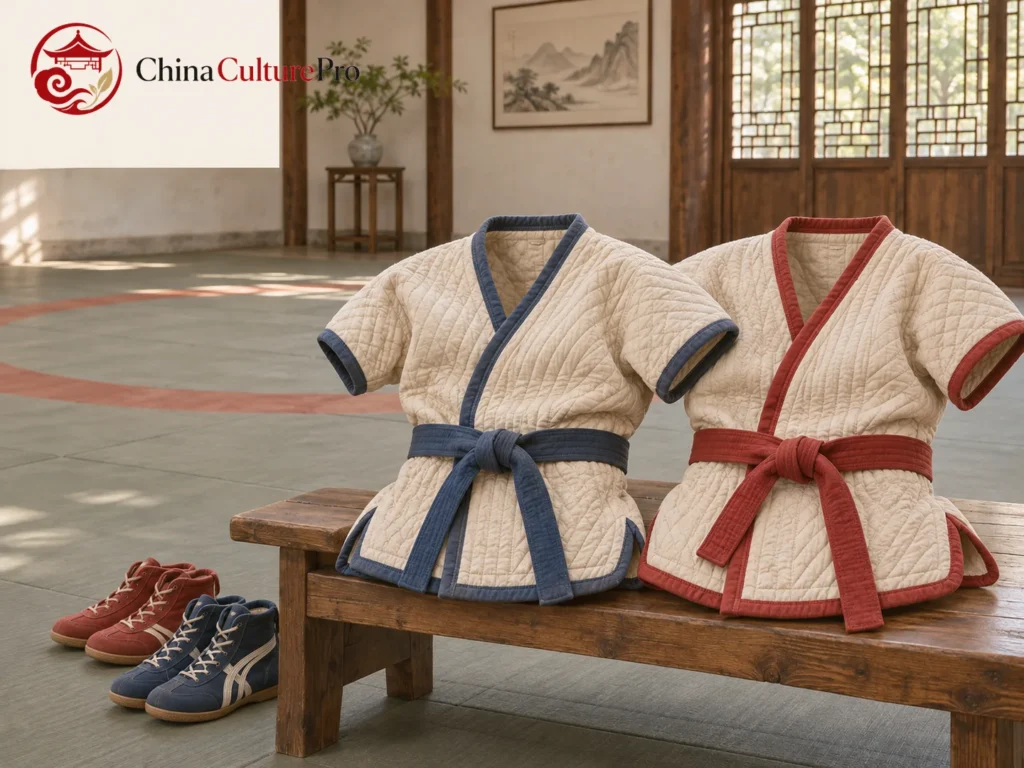
A typical training jacket is sturdy, close fitting and short sleeved, secured with a belt. Its construction supplies useful gripping surfaces. Clothing supports control, but the essential problem remains directing another person’s body while maintaining your own position.[4]
In the competition framework illustrated below, legal actions include throws, sweeps and standing grappling, using permitted grips on the jacket, belt or limbs. Striking and attempts to injure joints are prohibited, and a throw is not an invitation to continue wrestling on the ground.[1]
For a spectator, follow the sequence rather than searching for a single secret technique:
- Control: which grip or body position limits the opponent’s movement?
- Balance: does a step or turn leave the opponent unable to recover?
- Outcome: who touches the mat, and does the attacker remain standing?
These are observation cues, not instructions for applying a throw. The same-looking movement may produce a different result when the opponent steps, counters or changes the available grip.
How a Modern Match Is Scored
Scoring rewards the result of a controlled action. The following examples come from one published U.S. tournament code; they illustrate its conditions rather than define every regional competition.[1]
| Example outcome | Points in this code |
|---|---|
| Opponent touches with one hand, elbow or knee; attacker remains standing | 1 |
| Opponent touches with both hands, both knees, or one hand and knee simultaneously; attacker remains standing | 2 |
| A throw rotates the opponent at least 180 degrees onto the back; attacker remains standing and balanced | 3 |
The attacker’s finish matters as well as the opponent’s fall. A collision in which both simply lose balance is not equivalent to the controlled, standing finish described in the table.
Round timing, tie-breaks, boundaries and any technical-superiority limit belong to the specific event rules. Check those details before competing; a points example cannot supply a complete match procedure.
Beijing, Tianjin, Baoding and Wider Traditions
Regional names point to teaching communities, public settings and lineages. Three northern Chinese contexts help orient a reader without turning local traditions into rigid technical stereotypes.
| Context | What to recognize |
|---|---|
| Beijing’s Tianqiao wrestling (天桥摔跤, Tiānqiáo shuāijiāo) | Public performance combines wrestling with commentary, humor and showmanship.[3] |
| Tianjin’s Nanshi wrestling tradition | An urban public-wrestling setting associated with the development of modern Chinese-style wrestling.[6] |
| Baoding’s kuai jiao (快跤, kuài jiāo) lineage | A “fast wrestling” label emphasizing quick application of throwing technique.[4] |
Tianqiao wrestling entered China’s national intangible cultural heritage list in 2008 as project VI-21. Its performance tradition includes verbal skill and audience engagement. That designation identifies a particular tradition; it is not a UNESCO label for every form of shuai jiao.[3]
China also has distinct Mongolian, Uyghur, Yi and other ethnic wrestling traditions. Official sporting classifications recognize that diversity. Their clothing, contest conventions and community histories should be understood on their own terms, rather than treated as interchangeable versions of a single jacket-wrestling match.[7]
A modern club may teach material from more than one lineage while preparing athletes for a common tournament code. Ask which tradition informs the lesson and which rules govern sparring; the answers need not be identical.
Learning Through Controlled Partner Practice
Throwing involves a partner’s balance and landing, so preparation matters. Participation guidance treats competitive Chinese-style wrestling as a demanding contact sport requiring an established training foundation. A first class and a tournament entry are different stages.[5]
Before joining partner work, ask the coach about:
- How beginners learn to fall and stop an exchange.
- Which grips and actions are permitted in that class.
- How partners are matched and intensity is increased.
- What the club requires before sparring or entering an event.
Learn under supervision on suitable training surfaces, with agreed signals and controlled progression. A cooperative partner who can repeat an exercise reliably is more useful to a beginner than a contest over who can force the first fall.
The cultural lesson includes how people train together. Chinese martial arts etiquette offers a related introduction to teachers, schools and respectful practice. For wider context, the Chinese traditional games guide places wrestling alongside other forms of play and physical skill.
FAQs About Shuai Jiao
Is shuai jiao simply another name for all wrestling in China?
The general Chinese word means wrestling. In an English-language martial-arts class, it often identifies Chinese-style jacket wrestling; other ethnic and regional traditions retain their own identities.[6][7]
Does a match continue with groundwork?
The tournament code described here prohibits continuing to grapple after an opponent has been thrown. Read the adopted rules rather than assuming a ground phase from another sport.[1]
Are all regional styles governed by one rulebook?
No. Local performance traditions and modern tournaments have different purposes. Competitors must follow their event’s adopted code, regardless of their training lineage.[3][6]
Can beginners learn throws from a written guide?
A guide can explain the aim and vocabulary. Learning to throw and land requires supervised partner practice; reading alone does not supply that preparation.[5]
Sources
[1] World Fighting Martial Arts Federation. Shuai Jiao: U.S. Open competition rules
[2] Fang Bin, Palace Museum. Western Han copper seal with a jiaodi design
[3] China Intangible Cultural Heritage Network. Tianqiao wrestling: national representative project VI-21
[4] British Shuai Jiao Union. Shuai Jiao history and regional styles
[5] General Administration of Sport of China. Chinese-style wrestling: participation guidance
[6] China Sports Daily, hosted by the General Administration of Sport of China. Chinese-style wrestling: rules, tradition and modern development
[7] General Administration of Sport of China. Reply on supporting traditional folk wrestling, 2019