
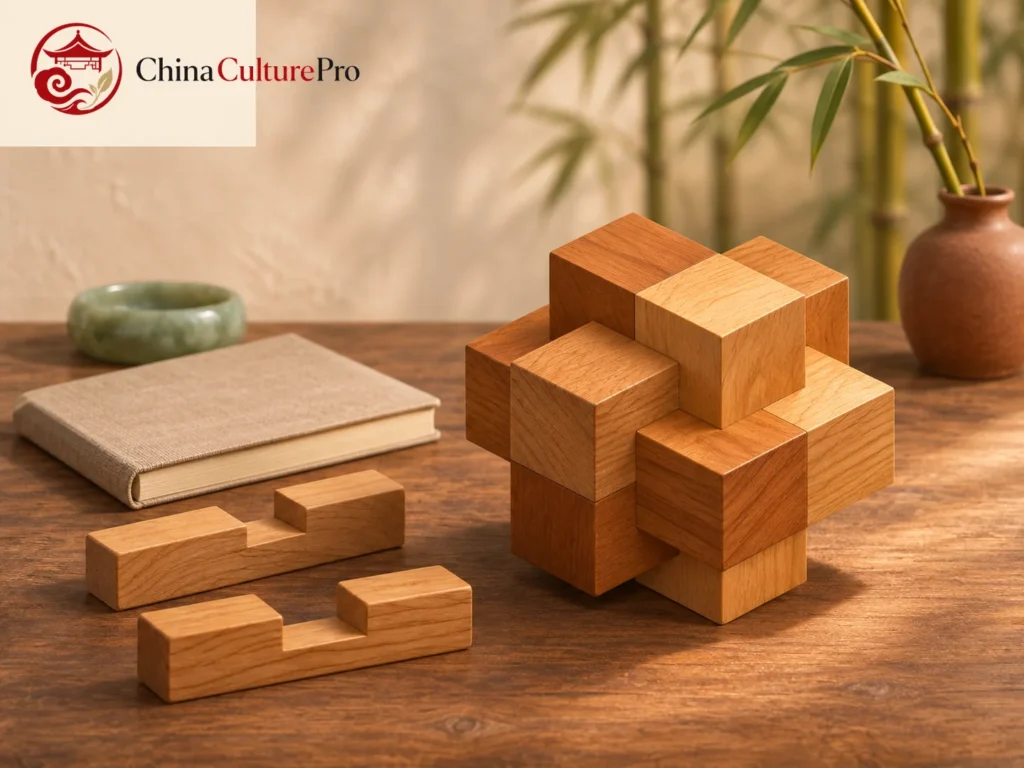

Quick Answer: What Is a Luban Lock?
A Luban lock (鲁班锁, Lǔbān suǒ) is an interlocking mechanical puzzle, commonly made from notched wooden bars. Its pieces support and block one another without needing nails or adhesive. The challenge is to discover a permitted sequence of movements, then understand how to reverse it.[2]
- The familiar six-piece form uses bars arranged along three perpendicular directions.[2]
- The outside shape does not reveal every internal cut.[1]
- A larger piece count does not automatically mean a harder solution.[3]
The word “lock” describes the interlocking effect. A wooden puzzle and a working padlock with a concealed opening mechanism are different objects.[2][5]

A successful attempt is more than pulling something apart. You need to remember orientations, recognize clearances and keep track of the order in which movement becomes possible. Those small discoveries make these objects a distinctive part of Chinese traditional toys.
Names and History: Craft Association, Uncertain Inventor
The same puzzle family is also called the Kongming lock (孔明锁, Kǒngmíng suǒ). The names connect it with Lu Ban (鲁班, Lǔ Bān), the celebrated craftsman, and Zhuge Liang (诸葛亮, Zhūgě Liàng), whose courtesy name was Kongming. Those associations do not prove that either man invented the puzzle.[1]
The craft connection is easier to explain. Traditional sunmao (榫卯, sǔnmǎo), or mortise-and-tenon joinery, fits shaped wood components together. A puzzle makes the engagement between projecting and recessed parts into a challenge for the hands.[6]
A concrete published example appears in Tang Yunzhou’s 1889 magic manual: a six-piece wooden puzzle secured by a final unnotched piece. Its publication shows that the design was described then; it does not establish 1889 as the year of invention.[1]
Separate three questions when reading a label: whom the name honors, what construction it resembles, and when a surviving example or description can be dated. A story can be culturally meaningful while leaving the historical inventor unidentified.
How Interlocking Pieces Hold Together
In the familiar six-bar form, three pairs cross along perpendicular axes. Cuts in the bars make room for neighboring pieces, while the remaining wood prevents movement in other directions. Correct engagement produces a compact structure; mismatched cuts or orientations can stop it closing.[2]
One simple exhibit model uses a final locking bar: withdrawing it allows the remaining structure to come apart. That is a useful demonstration of interdependence, rather than a rule that every mechanical puzzle must release after one straight pull.[2]
The assembled object hides information. Two bars may expose similar square ends while carrying different cuts at the center. Reversing one end-for-end can therefore change how it meets its neighbors, even when the visible wood grain seems unimportant.[3]
Compared with a flat tangram puzzle, the extra problem is depth. You are tracking which piece lies above, below or through another, and whether its route is clear through the whole movement.
Why Similar Shapes Need Different Solutions
Two six-piece puzzles can have the same assembled outline and different internal locking arrangements. One may release through a sliding key piece; another may require a different movement. A solution for a look-alike is therefore not automatically a solution for yours.[1]
These three checks describe different aspects of a puzzle.[3]
| Check | What it tells you | What it does not establish |
|---|---|---|
| Piece count | Number of separate components | Difficulty by itself |
| Internal cuts and orientation | How components fit and obstruct others | A solution from the silhouette alone |
| Stated move level | Release under a counting convention | Guaranteed solving time |
Computer analysis distinguishes possible assembled configurations from the movement paths used to separate them. A shape that appears geometrically plausible still needs a legal route through the pieces’ constraints.[3]
Move counting also needs a definition. Several pieces moving together may be counted differently from the same pieces moved individually. A first-release level is useful within its stated convention, rather than a universal scale of difficulty.[3]
For example, a documented six-piece design has a level-10 solution. “Six” describes its components and “ten” describes its analyzed release level; neither number promises a ten-second or ten-minute solve.[4]
A Careful Way to Explore Your Puzzle
Use this inspection routine to preserve information while you investigate. It is a general method, not a complete solution for an unidentified model.
- Photograph the assembled shape from several sides and note any maker’s model name.
- Choose one orientation and test small movements gently, keeping the other pieces supported.
- Record which piece moved, its direction and whether another piece had to move first.
- As pieces separate, lay them out in order with their orientations preserved; reverse that recorded sequence when reassembling.
If a move stops, return to the last position you understand. Trying the same blocked movement harder will not tell you which neighboring piece creates the obstruction.
Once apart, compare the hidden cuts rather than treating all bars as interchangeable. Keep any original instructions with the exact set. Mixing components from two similar-looking puzzles can destroy the correspondence you are trying to learn.
Wooden Puzzles and Actual Puzzle Locks
Chinese mechanical puzzle culture also includes real locks that require more than simply possessing the right key. Studied examples include locks with an added obstacle, a maze-like key route, two opening sections or a hidden keyhole. Their cases, bolts, springs and keys create a different kind of mechanical problem from interlocking wooden bars.[5]
The distinction is useful in a collection or museum: ask whether the object comes apart as a toy, opens a locking mechanism, or performs another practical task. A shared word does not mean the internal designs are interchangeable.
For an old object, preserve its condition and follow the collection’s handling instructions. A historical mechanism is evidence of workmanship as well as a problem to be understood.
Learning Through Making and Reassembly
The joinery connection remains useful in teaching. A 2018 craft-museum workshop programme combined a Luban-lock structure with lantern-making and paper-cut decoration. That is a documented example of adapting interlocking construction to a new object, rather than treating the puzzle only as something to defeat.[6]
Reassembly makes the learning visible. Once a hidden notch explains why a bar could not move earlier, the sequence becomes a relationship you can describe. You can compare two attempts, explain an obstruction to another person, or rebuild the structure from your notes.
That is a practical reason to slow down. The result worth keeping is an understanding of the particular object’s structure; a memorized pull-and-turn sequence for a different model offers much less help.
FAQs About Luban Locks
Did Lu Ban or Zhuge Liang invent the puzzle?
The names associate the puzzles with those figures, but evidence does not securely identify either as their inventor.[1]
Does every Luban lock have six pieces?
No. Six-piece forms are familiar, while other interlocking puzzles use different counts and shapes.[1]
Is the first loose piece always a key?
No. A simple straight key is one locking arrangement; other designs use different internal structures and release movements.[1]
Do more pieces always mean a harder puzzle?
No. Internal constraints, misleading routes and the moves required before release also matter. Piece count alone cannot express those features.[3]
Sources
[1] The Classical Chinese Puzzle Project. Interlocking Burr Puzzles
[2] China Science and Technology Museum. Assembly Experience: Luban lock exhibit
[3] Bill Cutler. Holey 6-Piece Burr! Computer analysis and move conventions
[4] Bill Cutler. Computer’s Choice Unique-10: six-piece design record
[5] Kan Shi et al. Structural analysis of traditional Chinese complex puzzle locks
[6] Craft Museum of the China Academy of Art. Luban Lock Lantern: 2018 family workshop programme