

Quick Answer: Who Was Li Shangyin?
Li Shangyin (李商隐, Lǐ Shāngyǐn; c. 813–858) was a late Tang poet known for concentrated, allusive imagery. His poems often bring desire, memory and uncertainty together without naming a complete situation for the reader.[1][7]
- Begin with four different jobs: recalling, longing, imagining reunion and judging a ruler.
- Follow changes in time, voice and argument before choosing a biographical explanation.
- Identify a poem without a distinctive title by its opening line.
You can understand a poem’s movement while leaving the identity of a person or occasion unresolved.
A difficult poem need not become a contest to guess its secret. Start with what the words establish: an unanswered question, a repeated image, a change from present experience to imagined recollection. Then ask what an interpretation explains, and what it has had to supply. This keeps uncertainty useful rather than making it a reason to stop reading.
Late Tang Poetry and the Problem of Context
The Tang dynasty supplies Li’s historical setting. Yet knowing the period is different from knowing the occasion of an individual poem.
Stephen Owen’s study The Late Tang explains how a title or an inherited interpretation can provide a context that makes a poem appear self-explanatory. Once that reading becomes familiar, readers may mistake the supplied context for something established by the text itself.[6]
Write down what a poem actually names before adding a proposed lover, patron or political event. That list lets you test what an interpretation supplies.
This also prevents a narrow selection from defining his whole achievement. A poem of historical judgment can make its turn quite sharply, while an intimate lyric may sustain uncertainty about its addressee.
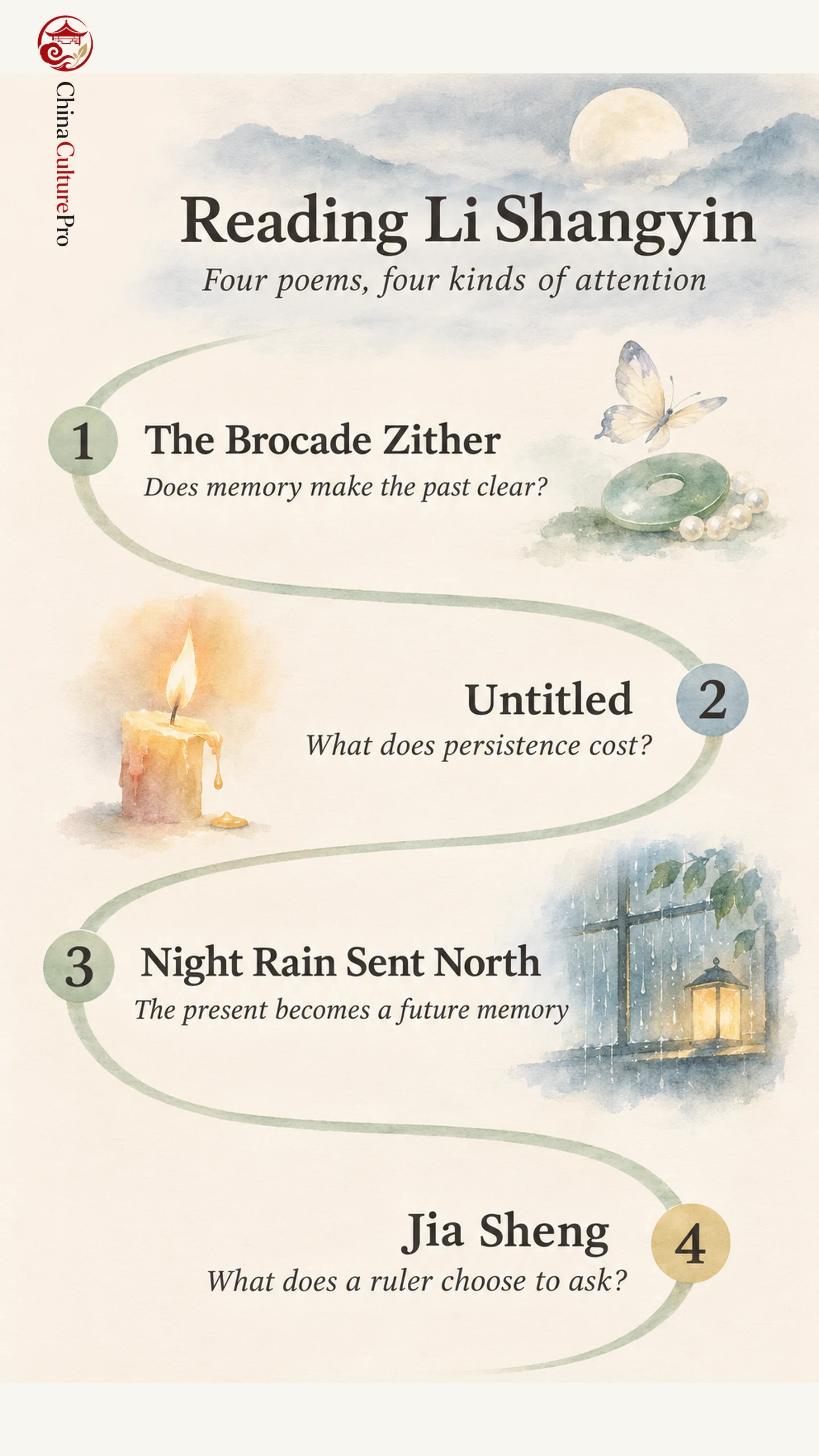
Four Major Poems and Their Reading Questions
These choices introduce different forms of poetic attention. English titles vary, so keep the Chinese title and opening words available when comparing editions.
| Poem | What to follow | A reading question |
|---|---|---|
| The Brocade Zither (锦瑟, Jǐnsè). | Remembered years pass through dream, birds, pearls and jade. | Does recollection clarify what was once felt? [2] |
| Untitled (无题, Wú Tí), opening “Meeting is difficult, parting also difficult.” | Withering spring, silkworm and candle intensify separation. | How does persistence acquire a cost? [3] |
| Night Rain Sent North (夜雨寄北, Yè Yǔ Jì Běi). | Present separation becomes a future story told together. | How can an imagined memory change the present? [4] |
| Jia Sheng (贾生, Jiǎ Shēng). | A ruler’s apparent interest in talent turns toward spirits instead of the people. | What is wrong with this attention? [5] |
Try reading the last couplet twice: once as an ending, and again as an instruction for reconsidering what came before it. The final turn may alter the value of an earlier image or gesture.
Allusion Is More Than a Hidden Answer
The dreaming butterfly in The Brocade Zither invokes Zhuangzi (庄子, Zhuāngzǐ). Read the butterfly-dream background alongside the poem’s other transformations, rather than making one allusion explain everything.[2]
A useful note identifies where an image comes from. Your next task is to ask why it appears here, beside these other images and at this point in the poem. Knowledge of the source and understanding of the new arrangement are related tasks, but they are not identical.
Sketch the image sequence in your notes. Mark where you see a connection and where a transition still needs explanation.
Night Rain and an Uncertain Recipient
The poem’s opening cannot give a date for returning. Its imagined reunion turns the present rainy night into something the separated pair might one day recall together.[4]
The familiar reading that makes the recipient Li’s wife has a long history. Owen discusses a variant title explicitly referring to a wife, but also the chronological difficulty: her death preceded the Sichuan service often linked to the poem. Proposals for an earlier journey do not make the identification certain.[6]
The repeated rainy night belongs first to present solitude, then to imagined shared recollection. Compare those two uses: the weather is the same, but the relationship to it has changed.
English Reading Choices
The 2018 NYRB Poets volume Li Shangyin is edited and newly translated by Chloe Garcia Roberts, with additional translations by A. C. Graham and Lucas Klein. It is a bilingual selection, with the original Chinese included, rather than a complete edition of all his poems.[7]
Where alternative versions are provided, compare one choice at a time. Does a translator name a speaker whom the original leaves implicit? Does a connection appear as a conjunction, a line break or an explanatory note? Such differences help show how translation also involves interpretation.
Title differences can be more straightforward. CUHK’s translation index lists The Brocade Zither and Jewelled Zither for the same Chinese title. Use that title to avoid mistaking two English renderings for different poems.[8]
The broader Chinese poetry guide supplies context on forms and periods. For Li himself, begin with one complete short poem and an edition whose notes distinguish an allusion from a proposed reading.
FAQs About Li Shangyin
Are all poems called Untitled the same poem?
No. Several poems share that heading. Identify the particular text by its opening words; numbering can depend on the edition.[3]
Does the Brocade Zither’s fifty strings give the poet’s age?
The line describes the instrument’s strings. It does not state the poet’s age, and should not be turned into a literal biographical date.[2]
Must every love poem hide a political message?
No. Owen distinguishes a possible figurative reading from proof of a specific reference. A female speaker’s complaint cannot automatically be identified with the poet’s relations with a patron.[6]
Sources
[1] New Directions. Li Shangyin: author profile
[2] Li Shangyin, Shidian Guji transcription. Jinse
[3] Li Shangyin, Wikisource transcription. Untitled poems, including Xiang Jian Shi Nan Bie Yi Nan
[4] Li Shangyin, Wikisource transcription. Ye Yu Ji Bei
[5] Li Shangyin, Shidian Guji transcription. Jia Sheng
[6] Stephen Owen. The Late Tang: Li Shangyin, Preliminaries, pages 351–352
[7] New York Review Books. Li Shangyin: 2018 bilingual selection
[8] Research Centre for Translation, CUHK. Authors index: Li Shangyin translations