

Quick Answer: Who Is Jia Pingwa?
Jia Pingwa (贾平凹, Jiǎ Píngwā; born 1952) is a Chinese novelist, short-story writer and essayist strongly associated with his home province, Shaanxi (陕西, Shǎnxī). His fiction follows ordinary lives through changing relations between village, town and city.[1]
- Choose a novel by its social world and narrative voice, rather than assuming all his books tell the same rural story.
- Read everyday transactions, gossip and self-presentation alongside larger economic and cultural changes.
- Use the Chinese title and translator’s name to distinguish an early sample, a new edition and a different novel.
His regional focus opens several kinds of fiction: village ensembles, urban satire, migrant experience and the work of remembering.
A person can move to a city before the city agrees that they belong there. A village can keep its familiar names while its relationships change. Jia’s novels let such tensions emerge through talk, ambition, affection and the details of daily life. The most useful starting question is which kind of narrator and social setting you want to spend time with.
Shaanxi as a Changing Social World
Jia’s Shaanxi is a lived and imagined region, not a single unchanging landscape. Our Shaanxi culture guide offers regional context, while the novels build particular communities with their own conflicts and points of view.
In the afterword to The Mountain Whisperer (老生, Lǎoshēng), he connects southern Shaanxi childhood memories with later life in Xi’an and social upheaval. These experiences supply material without making a fictional narrator identical with the author.[7]
Place him within modern and contemporary Chinese literature, while keeping the scale local enough to see differences between characters. A village family’s interests, a migrant’s self-image and a celebrated writer’s status can pull in different directions.
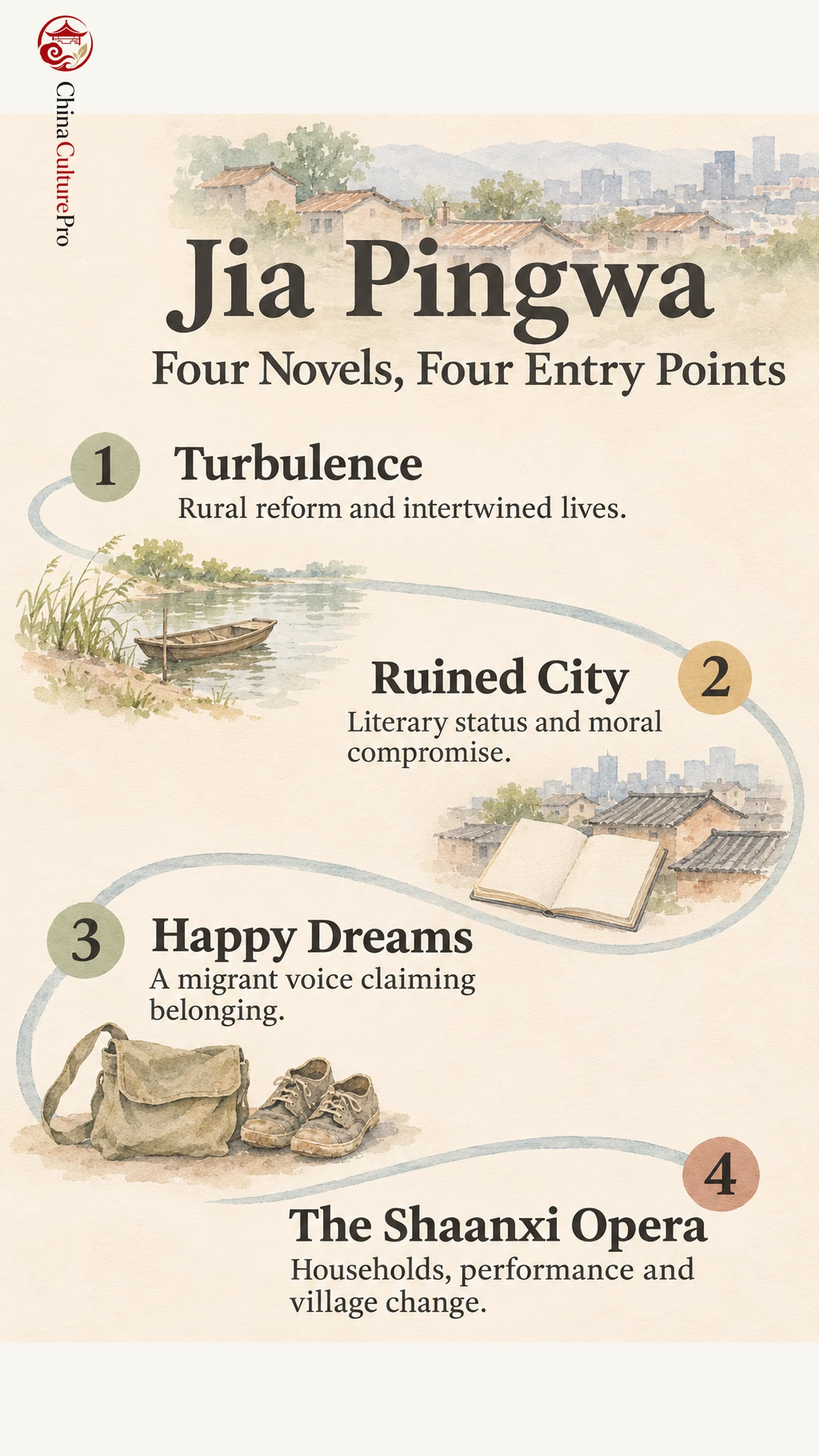
Four Novels and Four Entry Points
| Novel | Its main reading appeal | English translation |
|---|---|---|
| Turbulence (浮躁, Fúzào). | Rural reform, bureaucracy and the intertwined lives of Golden Dog and Water Girl. | Howard Goldblatt; a Grove edition appeared in 2003. [2] |
| Ruined City (废都, Fèidū). | Urban literary celebrity, desire, social connections and moral compromise. | Howard Goldblatt; University of Oklahoma Press, 2016. [3] |
| Happy Dreams (高兴, Gāoxìng). | Migrant experience in Xi’an, carried by a narrator determined to claim dignity and belonging. | Nicky Harman; published in English in 2017. [1][4] |
| The Shaanxi Opera (秦腔, Qínqiāng). | An extended village world in which households, love, status and performance traditions change together. | Nicky Harman and Dylan Levi King; the English edition appeared in 2023. [5][6] |
Choose Turbulence for a rural reform narrative or Ruined City for a socially compromised urban literary world. Happy Dreams offers a more concentrated route through one narrator’s aspirations; The Shaanxi Opera asks for sustained attention to an ensemble and its relationships.
Ruined City’s 1993 publication became controversial and was followed by a ban, which its English publisher associates with explicit sexual content. That history belongs to the book’s reception, but its satire also concerns cultural prestige, power and the entanglements of an urban writer. Read beyond the notoriety.[3]
The Shaanxi Opera is a novel, not a libretto or an introduction to opera technique. Its title invokes Qinqiang performance, while family and community life provide the larger setting.[5]
What the Opening of Happy Dreams Does
An early Nicky Harman translation opens with police questioning. The narrator insists on his adopted name, Happy, and tries to establish that he belongs to Xi’an, even as official questions expose the gap between his claim and his circumstances. The attempt to take a dead friend home gives the scene both urgency and vulnerability.[4]
He also tries to manage a reporter’s photograph, arranging his appearance, then resents the image the newspaper actually prints. Notice how the voice remains boastful, observant and funny under pressure. The difference between self-description and public classification becomes a storytelling engine.[4]
Read the exchange twice: first for events, then for who gets to define the speaker. Does a name, a place of origin, a photograph or a person’s own account carry authority? The scene lets those claims collide without requiring the reader to settle them immediately.
Memory, Voice and the Work of Making a Novel
Jia’s afterword to The Mountain Whisperer gives a different route into his craft. He describes difficulty turning history into literature and finding room within narration, alongside encounters with people whose ways of speaking and judging influenced him. One elderly mediator’s emphasis on speaking fairly becomes a model for the writer’s responsibility.[7]
Memory brings uncomfortable experiences as well as attachment. The afterword frames writing through relations among people, society and things; it offers the author’s account of making literature rather than a final instruction for interpreting every scene.[7]
When reading, note who tells an anecdote, who is absent from it and whose reputation it changes. A story passed around a community can create a social fact inside the novel, even when its truth remains unsettled. Keeping track of those speakers makes detailed fiction easier to follow without reducing it to a list of plot events.
English Editions and Free Reading
The table separates the novels by title and translator. A date on an English paperback identifies that edition; it need not be the year of the Chinese novel or its first translation. For example, Grove’s Turbulence page specifies its 2003 edition, while Oklahoma’s Ruined City page identifies Goldblatt’s 2016 translation.[2][3]
Paper Republic hosts an early sample titled Happy, translated by Nicky Harman and first published in the St Petersburg Review in 2009. Try its voice before Happy Dreams, allowing for revisions between sample and book.[4]
Leeds also hosts the authorized English afterword to The Mountain Whisperer, translated by Christopher Payne, alongside its Chinese original. It offers a short reading on memory and writing rather than a substitute for the complete novel.[8]
FAQs About Jia Pingwa
Is Jia Pingwa only a writer of village life?
No. These novels include rural communities, migrant life and urban literary society. Read their different settings and narrators as connected parts of a wider body of work.
Is The Shaanxi Opera a stage script?
No. It is a novel about a changing village world. A regional performance tradition matters within the narrative, but the book is not a manual or script for staging an opera.[5]
Does Happy mean the same novel as Happy Dreams?
Here, the early Harman sample Happy refers to the novel published in English as Happy Dreams. The Chinese title and translator’s credit identify it.[1][4]
Sources
[1] The Leeds Centre for New Chinese Writing. Jia Pingwa: author and translation context
[2] Grove Atlantic. Turbulence: synopsis and edition details
[3] University of Oklahoma Press. Ruined City: publication and reading context
[4] Jia Pingwa, translated by Nicky Harman. Happy: early English sample
[5] Brilliance Publishing. The Shaanxi Opera: synopsis and English publication details
[6] The Open University. Book-club event: Nicky Harman and Dylan Levi King translation credits
[7] Jia Pingwa, The Leeds Centre for New Chinese Writing. The Mountain Whisperer: Chinese afterword
[8] Jia Pingwa, translated by Christopher Payne. The Mountain Whisperer: English afterword