


Quick Answer: Who Was Li Shen?
Li Shen (李绅, Lǐ Shēn; 772–846) was a Tang poet and senior official, brought up in the Wuxi area of present-day Jiangsu. His fame rests especially on two short poems about farming, but his surviving work also includes travel, recollection, friendship and religious themes.[1]
- Read the two farmer poems together: abundant production and unrecognized labour raise different questions.
- Continue with a family-letter poem and a poem praising a friend’s collected writing.
- Keep a poem’s ethical appeal separate from a complete judgment of its author’s political conduct.
These reading choices widen the familiar schoolroom image of a poet known for a single meal of grain.
Familiar lines can feel settled before you return to the whole poem. Set aside the lesson you remember for a moment and ask how the ending works. Then compare the kinds of response the two poems invite from their readers.
An Official with More Than Two Poems
Li’s career unfolded within the political conflicts of the Tang dynasty. He studied and travelled before entering official life, eventually reaching high office. His writing extends across several subjects and verse forms.[1]
A short, readily memorized poem can dominate an author’s reputation. Here, use that familiar entrance to reach other kinds of writing. A poem addressed to a friend, a family letter received far from home and a retrospective collection each create a different relationship between speaker, occasion and reader.
Major Works and New Yuefu
The pair is transmitted as Pitying the Farmers (悯农, Mǐn Nóng), or Ancient Airs (古风, Gǔ Fēng).[2]
His collection In Search of Past Travels (追昔游集, Zhuī Xī Yóu Jí) arranges a life through poems and extensive annotations. The notes were added when the collection was assembled; individual poems may also involve later recollection rather than simply recording an event as it happened.[4]
Li was an early contributor to new yuefu (新乐府, Xīn Yuèfǔ), newly framed song-style poetry with a critical social purpose. His lost works helped inspire friends including Bai Juyi (白居易, Bái Jūyì). The Bai Juyi guide introduces this wider literary relationship.[4]
The loss matters for reading: an influential work need not survive in full. Distinguish what later writers say about a literary initiative from the texts you can actually inspect.
Four Reading Entries
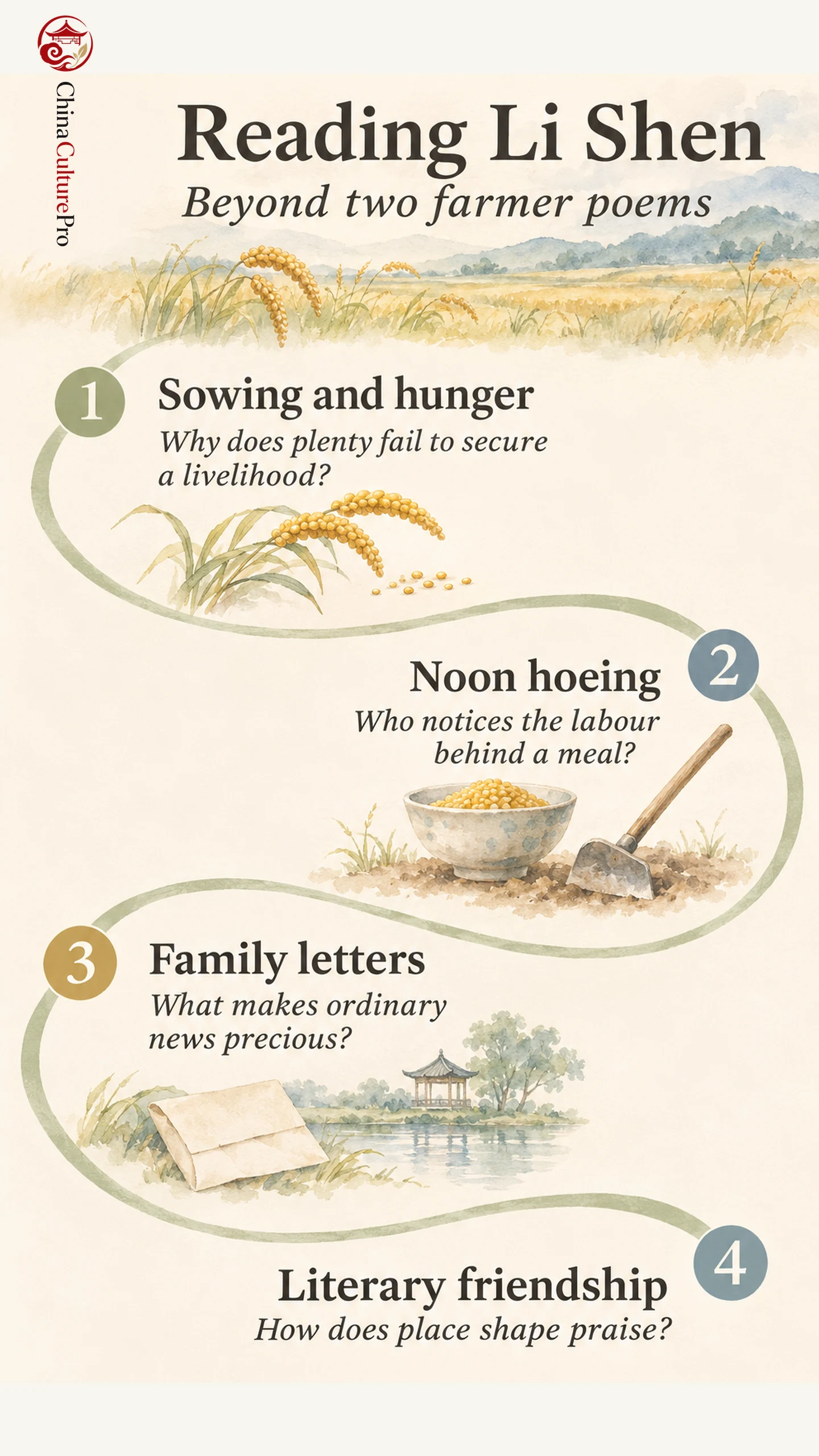
Use opening lines to distinguish the two farmer poems; editions can arrange them differently. The other English titles below are descriptive reading labels.
| Reading entry | What to follow | A reading question |
|---|---|---|
| Farmer poem opening with spring sowing. | One seed becomes many, yet cultivators starve. | Why does abundance fail to secure a livelihood? [2] |
| Farmer poem opening with noon hoeing. | Sweat in the field leads to food on a plate. | Who notices the labour behind a meal? [2] |
| Receiving Family Letters at the Riverside Pavilion in Duanzhou (端州江亭得家书, Duānzhōu Jiāngtíng Dé Jiāshū). | A distant letter becomes more valuable than gold. | What makes ordinary news precious? [2] |
| On Bai Juyi’s Literary Collection (题白乐天文集, Tí Bái Lètiān Wénjí). | A friend’s writing joins a monastery’s treasury of texts. | How does place shape literary praise? [2] |
Notice the form of the address. Is the poem asking a diner to recognize labour, imagining communication across distance, or praising a literary friend? The same poet can place his reader in very different positions.
What the Farmer Poems Ask of a Reader
The sowing poem overturns an expectation of plenty without specifying every cause of hunger. The hoeing poem turns toward the diner, asking for recognition of labour.[2]
Keep these tasks distinct when discussing the pair. Gratitude can answer a question about awareness, but it does not by itself explain a failure of livelihood. Conversely, a social reading should still attend to the individual acts and physical effort that make the second poem immediate.
A useful comparison is to ask whom each ending addresses. What response would satisfy its demand, and what would remain unanswered? This preserves the force of both poems without making either carry the whole argument alone.
Attribution and the Poet’s Political Life
The hoeing poem is conventionally read under Li Shen’s name, but its transmission includes attribution to Nie Yizhong (聂夷中, Niè Yízhōng). Yan Zhengdao’s 2012 study argues for Li’s authorship using earlier literary records. The familiar attribution therefore has textual support, alongside a history of disagreement.[3][5]
Political biography requires other evidence. Thomas J. Mazanec’s 2026 research identifies Li as a senior participant in the suppression of Buddhism in the 840s, while also examining his sympathetic Buddhist poems and support for monasteries. These activities do not fit a simple equation between poetic language and personal policy.[4]
Read the work closely, then consult historical evidence for the career. Neither admiration for a poem nor disapproval of an official is a substitute for establishing what the relevant sources actually say.
English Reading Routes
Victor H. Mair’s The Shorter Columbia Anthology of Traditional Chinese Literature, published in 2001, lists Li Shen’s Pitying the Farmer among its selections. This is an anthology route into the poet, not a complete collection of his work.[6]
For the spring-sowing quatrain, Andrew W. F. Wong’s published English version includes notes explaining his word choices and revisions. His discussion of idle land and of the connection between abundance and hunger shows how even a very short poem requires interpretive decisions.[7]
Compare how a version handles the turn into the final line. Does it add a connective that makes the contrast explicit? Does it specify a crop or a cause of hunger beyond the original wording? Such choices can clarify a reading while also narrowing it.
The Chinese poetry guide provides a wider introduction to verse forms. Start here with each complete quatrain, rather than an isolated famous couplet.
FAQs About Li Shen
Is Pitying the Farmers one poem or two?
It is a pair of short poems, also transmitted as Ancient Airs. Identify each by its opening rather than relying only on numbering.[2]
Do both poems describe rice farming?
The first names millet; the second mentions grain and a meal. Neither requires an exclusively rice-based reading.[2]
Is memorizing the famous lines enough to understand them?
Memorization helps you retain their rhythm and phrasing. Understanding also means following the whole argument, especially how an ending changes the lines before it.
Sources
[1] Lin Jiaying, Chinese Culture University. The Study of Li Shen’s Poetry: thesis abstract
[2] Li Shen, Shidian Guji transcription. Collected Tang Poetry, volume 483
[3] Ji Yougong, Shidian Guji transcription. Records of Events Concerning Tang Poetry: Li Shen
[4] Thomas J. Mazanec. Buddhist Poetry by Its Persecutors: The Cases of Li Shen and Li Deyu
[5] Yan Zhengdao, Journal of Xihua University. Three disputed questions about Li Shen’s Ancient Airs
[6] Columbia University Press. The Shorter Columbia Anthology of Traditional Chinese Literature: contents
[7] Andrew W. F. Wong. Pity the Peasants / Ancient Air, 1 of 2: translation and notes