


Quick Answer: What Is Chinese Traditional Makeup?
Chinese traditional makeup covers changing practices of coloring and decorating the face. Huadian (花钿, huādiàn), decorative facial ornaments, and rouge (胭脂, yānzhī), red cosmetic color, are recognizable elements rather than a complete, unchanging look.
- Features: Powdered faces, colored cheeks and lips, shaped brows and applied ornaments.
- Evidence: Dated figures, paintings, cosmetic containers and analyzed residues.
- Variation: Different combinations across periods, communities, social settings and individual images.
A red forehead flower is not a universal symbol worn by every woman. Historical makeup is best understood through particular evidence, not one modern face chart assigned to an entire dynasty.[1]
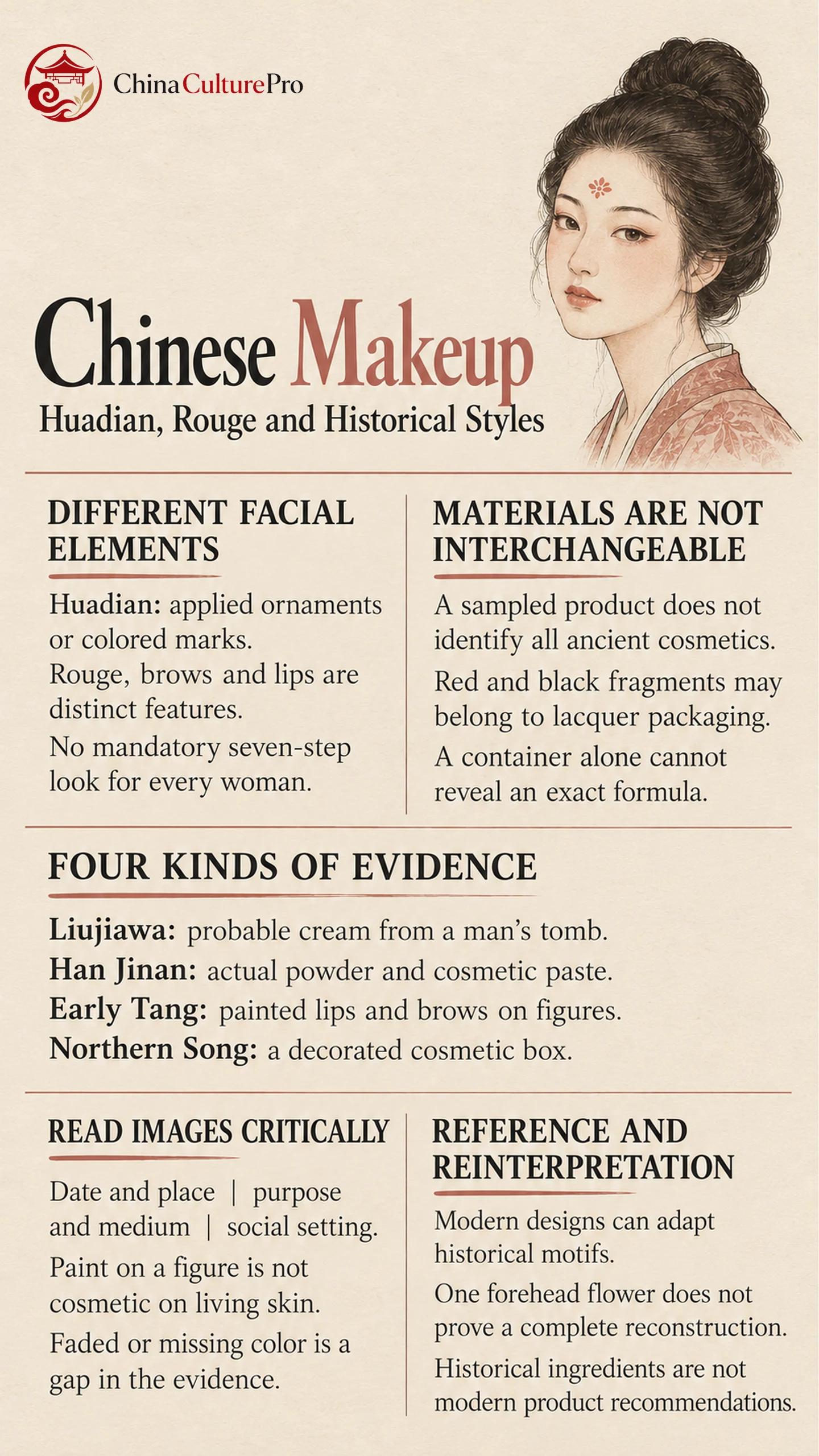
A red forehead ornament can dominate a modern image of historical Chinese beauty. The surviving evidence is more varied: small painted lips, changing brows, cosmetic boxes and traces of actual products. Each reveals something different about appearance, materials and the people who used them.
Huadian, Rouge, Brows and Lip Color
Huadian refers to decorative facial additions, especially familiar as forehead ornaments. Applied pieces and colored marks belong to this history; the name should not be restricted to one red, five-petaled sticker. Designs drawn from Dunhuang donor images demonstrate a broader decorative vocabulary.[3]
Rouge colors the cheeks; dark brows and colored lips define other areas of the face.[2] These elements need not appear together as a mandatory sequence.
Tang-dynasty imagery makes these distinctions particularly visible. Surviving figures and descriptions show attention to powder, rouge, eyebrows, facial ornaments and lips, alongside changing fashions in dress and hair.[1] The construction of buns and arrangements belongs to traditional hairstyles; a hairpin is not the same kind of object as a forehead applique.
Historical Examples and What They Show
These four cases illustrate different kinds of evidence, rather than standard faces worn in succession.
| Context | Evidence | What it can establish |
|---|---|---|
| Spring and Autumn period, Liujiawa | Residue in a container from an aristocratic man’s tomb, interpreted as face cream | Cosmetic use was not necessarily confined to women. |
| Han-period Jinan | White powder and a flesh-colored paste from a non-elite burial | Actual materials can be investigated beyond elite portraiture. |
| Early to mid-seventh-century Tang | Painted entertainer and dancer figures with red lips and black brows | Specific facial details contributed to the appearance of a dated group. |
| Northern Song | A Yue-ware cosmetic box with floral and bird decoration | Containers document the material culture of the dressing table. |
The Liujiawa interpretation is based on residue analysis, not a portrait of the man applying cream.[5] The Han-dynasty burial preserves materials for analysis.[4] The Tang figures preserve a represented appearance.[2] The Song-dynasty box adds an object associated with cosmetics rather than a complete facial style.[6]
This approach also improves the reading of Chinese clothing history. A figure’s robe, hairstyle and painted face can be considered together without turning one surviving representation into a national uniform.
Cosmetics, Containers and Material Evidence
“White powder” does not identify one substance across all periods. In the Jinan Han burial, scientific analysis identified lead carbonate in a white powder. A separate flesh-colored material contained finely processed mica with animal fat and plant-derived components, and was interpreted as a possible concealing cosmetic.[4]
Red and black fragments on that paste were identified as remnants of its lacquer container. Their presence does not by itself prove that the cosmetic was red or black. Material analysis can separate the product from the packaging around it.[4]
The earlier Liujiawa sample was different again, combining animal fat with a calcium-carbonate mineral. It supports a particular interpretation of one ancient cream, not a single recipe used throughout Chinese history.[5]
Containers require similar care. Porcelain, metal and lacquer boxes could hold cosmetic materials, but a box without surviving contents cannot disclose an exact formula. Song porcelain examples show varied shapes and decoration, and connect personal grooming with ceramic production and trade.[6]
How to Read Historical Makeup Images
An image’s date, place, purpose and medium all matter. A tomb figurine represents a person within a funerary setting; it is not a photograph of an entire population. Court or donor imagery may emphasize an idealized appearance and a particular social position.
Paint surviving on an object is also different from cosmetic surviving in a box. The early Tang entertainer figures have ceramic bodies with applied pigments: their red lips and dark brows tell us about the represented look. The pigment used to paint a figure does not automatically identify the substance someone applied to living skin.[2]
A careful description preserves that distinction: “red lip color on an early Tang figure” states visible evidence. Naming an exact product, declaring its universal popularity or assigning every similar brow to one precise year requires additional support. Missing or faded paint should remain a gap in the evidence.
Modern Interpretations and Historical Limits
A modern look may translate selected historical features into contemporary materials. Dunhuang-inspired temporary decorative designs, for example, explicitly adapt motifs from older donor images.[3] Such interpretation can make an image easier to recognize while remaining a new design.
The distinction is between documented reference and the completeness of the reconstruction. A flower selected from one image does not prove that the hairstyle, clothing and every other cosmetic feature in a modern ensemble belonged together. A historically inspired portrait can be described honestly without claiming to reproduce everyone’s daily appearance.
The same principle applies to traditional Chinese clothing: identify the reference and the changes. Historical ingredient evidence explains an object; it is not a recommendation to reproduce old cosmetic formulas or equate them with products made for use today.
FAQs About Chinese Traditional Makeup
Was huadian always a red five-petaled flower?
No. Decorative forms and materials varied. The familiar red flower is one recognizable design, not a universal shape for all periods and wearers.
Did every woman wear the same makeup in a dynasty?
No. A dynasty spans changing fashions and different settings. One painted figure or portrait cannot represent every woman’s appearance.
Was cosmetic use limited to women?
No. A probable face cream from an aristocratic man’s tomb at Liujiawa provides one archaeological example that complicates that assumption.
Are historical cosmetics the same as modern products?
No. Ingredients and preparation varied historically, and an analyzed ancient sample does not establish the formula or suitability of a modern product with a similar name.
Sources
[1] Zhao Yong, National Museum of China. Women of Tang Chang’an
[2] MIHO Museum. A Set of Ten Entertainers and Two Dancers
[3] Dunhuang Academy, Ministry of Culture and Tourism. Dunhuang Huadian Designs
[4] Wu Meng, Shandong University Institute of Cultural Heritage. Cosmetics for the Non-Elite in Han China: Research Report
[5] B. Han and colleagues. The Rise of the Cosmetic Industry in Ancient China: Insights from a 2700-Year-Old Face Cream
[6] Hangzhou Museum. Powder and Fragrance Boxes: Song Porcelain Cosmetic Containers