

Quick Answer: What Are Chinese Pankou Buttons?
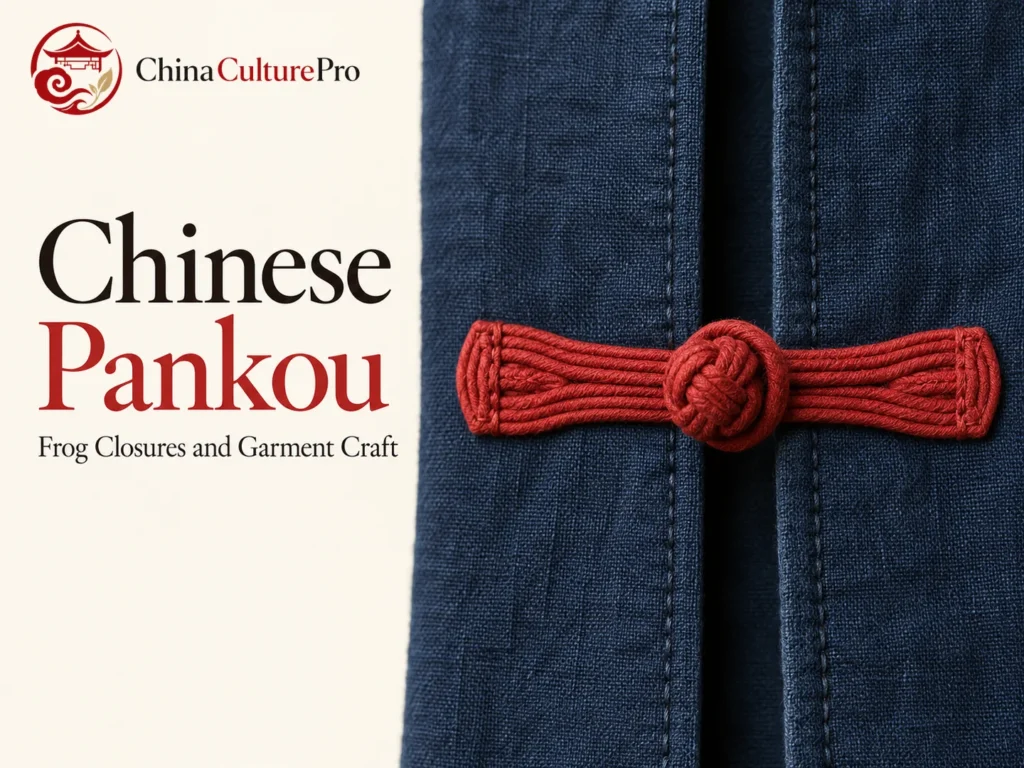
Pankou (盘扣, pánkòu) are Chinese garment fasteners formed from narrow fabric strips or cords. English descriptions often call them frog buttons or frog closures. Their decorative outlines can be elaborate, but the basic purpose is to hold an opening together.
- Structure: A button or knot on one side engages a receiving loop on the other.
- Appearance: Forms range from a simple straight fastening to coiled floral designs.
- Use: They combine practical closure with decoration on different Chinese garments.
“Frog” does not mean that the design must depict an animal. Nor is every decorative Chinese knot a working garment fastener.[6]
A small loop and a fabric knot can be easy to overlook beside a richly patterned robe. On a simpler jacket, the same detail may define the whole front. Understanding pankou means separating the part that closes the garment from the coils that give it shape and character.
The Parts of a Frog Closure
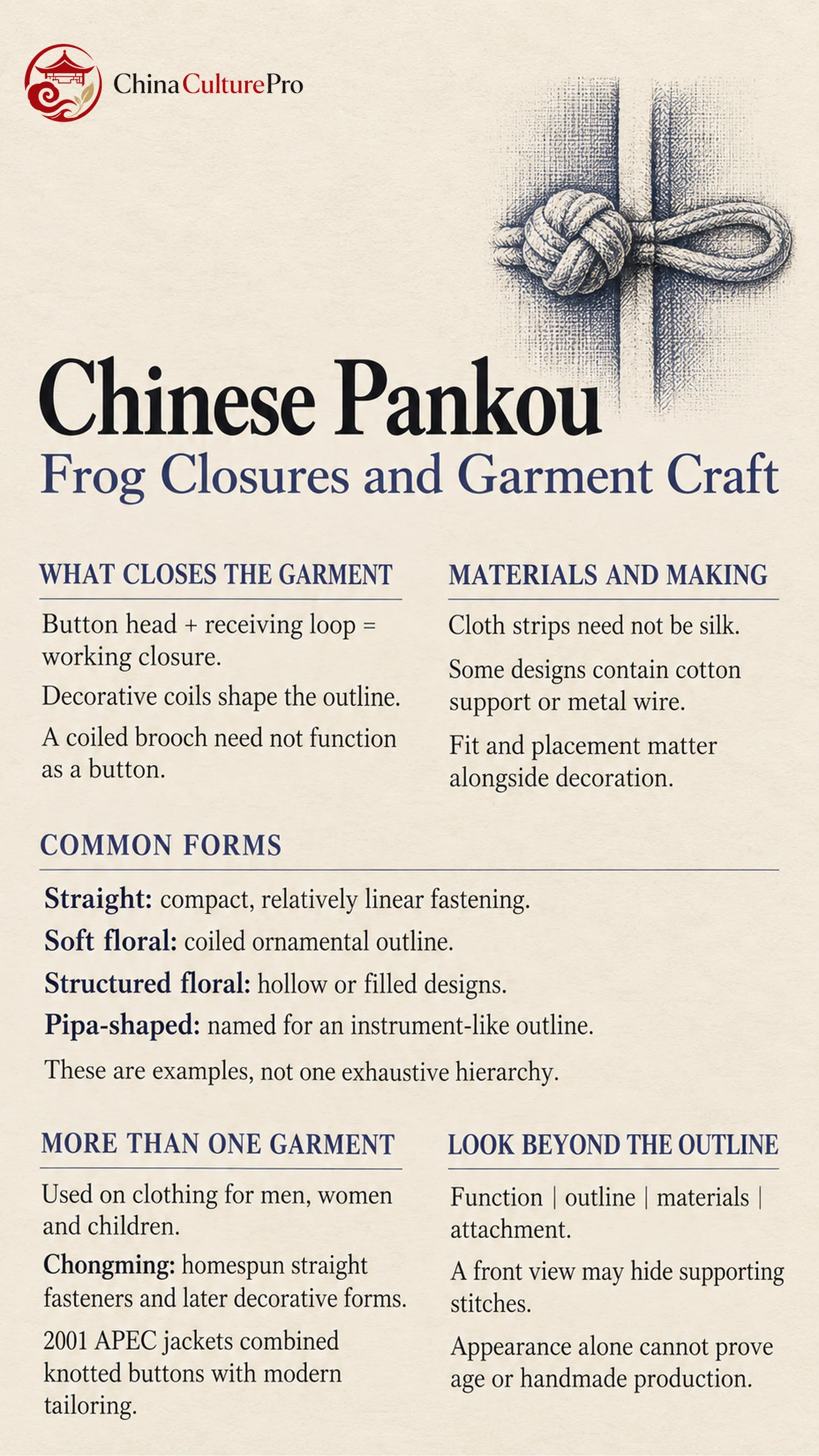
The functional center is the relationship between a projecting button head and a loop that receives it. Coiled fabric on either side can create the decorative outline. That outline may be compact or extend into an elaborate flower, but it should not be confused with the receiving loop itself.[1]
A metal hook, a zipper and a flat button passed through a cut buttonhole operate differently. They can coexist with decorative fabric fasteners on a garment, so appearance alone does not establish which component carries the main closure.
Coiled forms can also be mounted as brooches, preserving the decorative craft without functioning as button-and-loop fastenings.[2]
Common Pankou Forms
Names can describe outline, construction or a recognizable motif. Those are different kinds of classification, so the following forms should not be treated as a single exhaustive hierarchy.
| Form | Recognition feature | Keep in mind |
|---|---|---|
| Straight fastener (一字扣, yīzìkòu) | A compact head-and-loop arrangement with a relatively straight extension | Simple geometry can be visually deliberate, not unfinished decoration. |
| Soft floral form | Fabric strips coil into an ornamental outline | The outline and the working loop are different parts. |
| Structured floral form | A firmer coiled design may be hollow or include a filled center | Internal support cannot always be judged from a front view. |
| Pipa-shaped fastener (琵琶扣, pípákòu) | A coiled outline named for resemblance to the pear-shaped instrument | The name describes a form, not a musical function. |
The examples span straight, soft floral, structured and pipa-shaped forms.[2] Flower names do not impose one mandatory meaning on every wearer. A motif’s interpretation needs the context of the particular garment, maker or occasion.
Garments and Historical Change
Pankou are strongly associated with the qipao (旗袍, qípáo), also known as cheongsam, but they are not restricted to that dress. Clothing traditions include fasteners for men, women and children.[1] The qipao and cheongsam guide covers the whole garment rather than treating its buttons as a complete definition.
Local history also complicates a silk-eveningwear stereotype. In Chongming, straight fasteners appeared on homespun clothing. During the 1970s and 1980s, the local repertoire expanded into more decorative shapes used on padded jackets and other garments. This is a regional account, not a timetable that every Chinese workshop followed.[3]
Modern menswear provides another example. The Tang suit (唐装, tángzhuāng) jackets worn at the 2001 Shanghai APEC meeting retained knotted buttons while combining traditional details with modern tailoring.[5] A Tang-style jacket is therefore not evidence of an unchanged outfit from the ancient Tang dynasty. The wider history of Chinese clothing provides the period distinctions.
Materials and the Tailor’s Craft
Pankou need not be silk. Cotton, silk, linen, synthetic fabrics and other cords can supply the narrow strips. Some constructions include internal cotton support, while decorative forms may use metal wire to help retain their shape.[1] The visible surface and the internal structure are separate material questions.
Fabric choice also affects the relationship with the garment: a matching strip can blend into the cloth, while a contrasting one makes the fastening conspicuous. Chinese silk clothing explains the fabric context; it does not imply that every button on a silk garment has an identical construction.
The fastener is part of tailoring rather than an isolated decorative purchase. In documented cheongsam-making, a fitting takes place before adornments are added, and frog closures require skilled finishing of their own.[4] Placement must be considered with the opening and the garment’s shape. An intricate motif cannot compensate for an opening that does not sit correctly.
Looking at Pankou on a Garment
Function, outline, materials and attachment are complementary details to examine. A front view may show the motif clearly while concealing the supporting stitches or another fastening underneath. A close photograph cannot prove an exact production date or whether every stage was completed by hand.
A useful description identifies what is visible: a straight fabric closure, a floral coiled pair, or a structured decorative form at the collar. Within traditional Chinese clothing, pankou are a craft detail shared by different garments, not a test that one outfit must pass to count as Chinese.
FAQs About Chinese Pankou Buttons
Do frog buttons depict frogs?
Usually the English term identifies a fastening type. A particular design can depict an animal, but a frog shape is not required.
Are pankou only used on women’s qipao?
No. They also appear on menswear, children’s clothing and other garments. The qipao is a familiar setting, not their only use.
Is every Chinese knot a garment fastener?
No. A decorative knot or coiled brooch need not close clothing. A working pankou has a button-and-loop relationship serving the garment opening.
Sources
[1] Shanghai Municipal Administration of Culture and Tourism. Chinese Clothing Pankou-Making Skills
[2] Zhang Xinli, China National Silk Museum. One Skill, Vol. 47: Pankou
[3] Chongming District Culture and Tourism Bureau. Pankou Making
[4] Hong Kong Memory. Cheongsam-Making: Steps (2)
[5] Ministry of Foreign Affairs of China. Modern Tang Suits Unveiled at the Bank of Huangpu River
[6] Hong Kong Intangible Cultural Heritage Office. ICH Inventory: Flower Button, Item 5.71.1