


Quick Answer: What Is a Changshan?
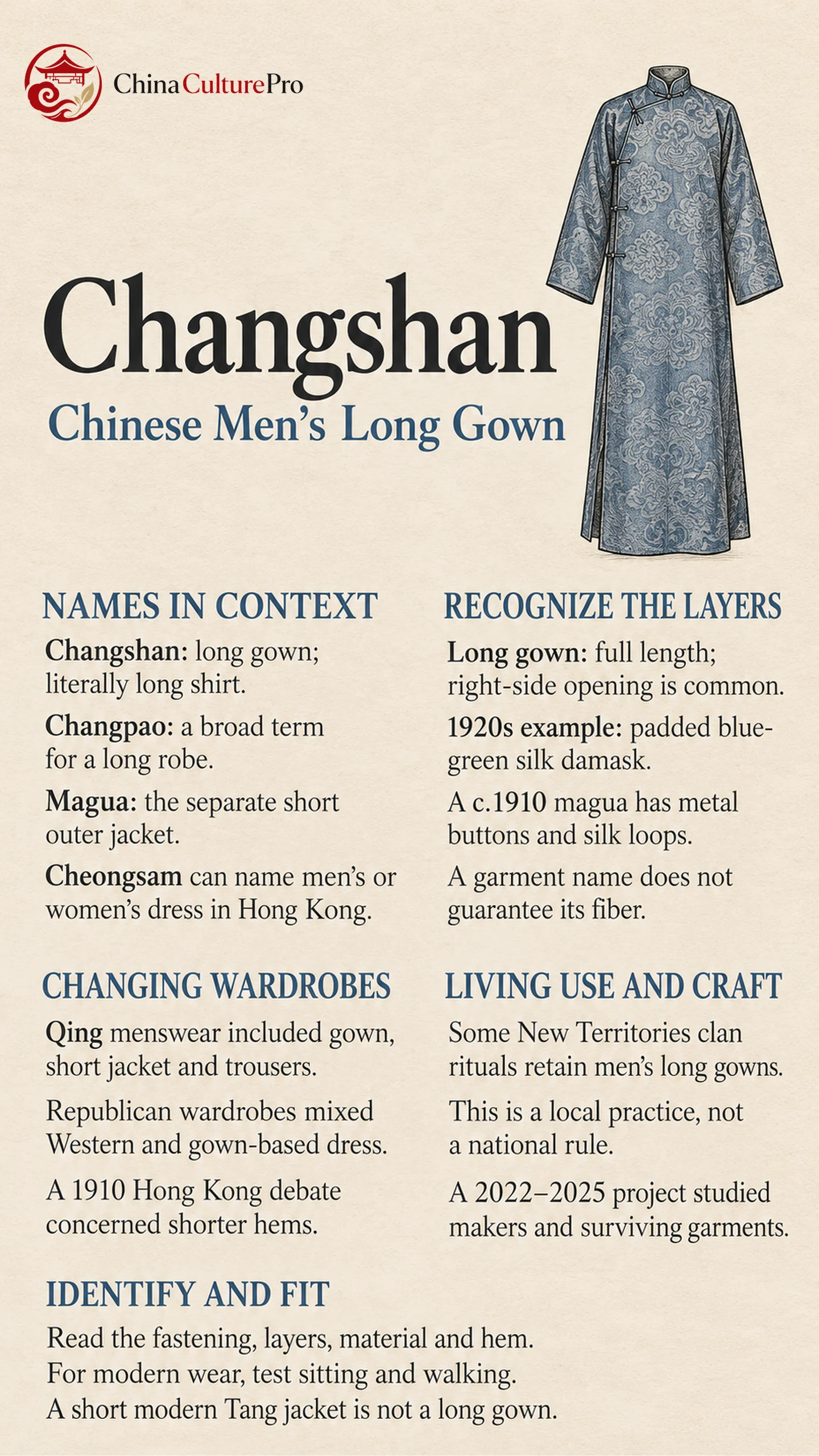
A changshan (长衫, chángshān), literally “long shirt,” is a Chinese long gown. In this article, the name refers to the men’s garment associated with late Qing and Republican-era wardrobes and continued ceremonial use, rather than every long robe in Chinese history.
- Form: A long upper garment extends over trousers, commonly with a right-side opening.
- Layers: It can be worn alone or beneath a separate short jacket.
- Names: English “cheongsam” comes from the Cantonese reading of the same characters and can have different gender associations in different contexts.
Material, padding, length and occasion help identify a particular example more precisely than the English label alone.[3]
In an early twentieth-century photograph, a dark short jacket can conceal much of a man’s longer gown. That layered outfit is easy to mistake for a single garment. Separating the pieces also clarifies why a museum might call a man’s robe a changshan while a Hong Kong speaker calls it a cheongsam.
Changshan, Changpao and the Word Cheongsam
The same garment family can appear under different names in catalogues and conversation. The table separates the long garment, its possible outer layer and a context-sensitive translation.
| Term | Meaning in this discussion | Naming boundary |
|---|---|---|
| Changshan | A long gown; the Mandarin name literally means “long shirt.” | Here it denotes men’s late Qing and Republican-style long dress. |
| Changpao (长袍, chángpáo) | A long robe, often used alongside changshan in descriptions of men’s dress. | A broad robe word, not a guarantee of one specific pattern. |
| Magua (马褂, mǎguà) | A separate short outer jacket, often translated as “riding jacket.” | The jacket worn above a gown, not the gown itself. |
| Cheongsam | An English spelling derived from the Cantonese reading of 长衫. | Hong Kong usage can include men’s and women’s long garments. |
In Hong Kong, the name associated with men’s long gowns also came to be used for women’s dress during the twentieth century.[2] In much contemporary English fashion writing, “cheongsam” instead brings to mind the qipao (旗袍, qípáo), the women’s dress. Calling a changshan a “male qipao” may help a shopper recognize the subject, but it obscures the local naming history.
Recognizing the Long Gown and Its Layers
A useful starting point is a 1920s Hong Kong robe: full length, long sleeved and opening at the right side. It is made from green-blue silk damask, lined in grey silk and padded for winter. Those recorded details show that a changshan can have a patterned woven surface and insulation, rather than being an unlined plain robe.[3] It is one concrete example within the broader range of traditional Chinese clothing.
The magua is a separate garment. A Hong Kong example dated around 1910 is a short navy silk jacket with a high collar and a center-front opening. Round metal buttons fasten into silk loops; brown trimming marks the collar, sleeves and fastening area.[4] The contrast between that center-front jacket and a right-opening long gown helps explain what is visible in a layered photograph.
Neither example establishes a universal fiber or fastening rule. Chinese silk clothing includes many different weaves, and the name of a garment is not a fiber declaration. Likewise, the broader pankou (盘扣, pánkòu) closure tradition should not lead a viewer to assume that every button on a Chinese jacket is a cloth knot: the dated magua has metal buttons.
From Qing Dress to Republican Wardrobes
The long gown, short jacket and trousers formed an established combination in Qing-period menswear. Its development belongs within the history of Manchu clothing and the dress cultures of the Qing state. Riding-related garment features form part of that context, but the label changshan does not turn every later wearer into a mounted official.[1]
After the founding of the Republic, Western dress and long-gown ensembles coexisted. Some men continued wearing the short jacket over the robe; others wore a gown without that outer layer. Seasonal padding and different colors further distinguished actual wardrobes.[3] This coexistence is more useful for reading a photograph than assuming that political change replaced everyone’s clothes at once.
Hem length also changed and attracted comment. A Hong Kong newspaper discussion in 1910 criticized a fashion for shorter long gowns, showing that even the garment’s apparent continuity included arguments about proportion.[1] It is a local example of fashion debate within Chinese clothing history, rather than evidence for a timeless compulsory hemline.
Ritual Use and the Tailor’s Craft Today
In some New Territories clan communities, men’s long gowns remain associated with ancestral observances and other traditional rituals, where dress can mark standing within the community.[1] This is a specific social setting. It should not be generalized into a rule that every Chinese man wears a changshan for every formal occasion.
A Hong Kong research project conducted from 2022 to 2025 combined interviews with makers and other participants, recorded tailoring demonstrations and examined 29 men’s cheongsam specimens dating from the 1920s to the 2020s. Its scope includes structural and material variation, rather than treating the garment as a single frozen pattern.[5]
Read a museum label for the object’s date, material and known wearer. When commissioning clothing, identify the intended cut and occasion with the tailor. These give the description a firmer basis than “ancient Chinese robe.”
Choosing or Identifying a Changshan
For a historical image, identify the long gown first, then ask whether a separate short jacket covers it. Look at the visible fastening, sleeve ends, fabric and hem. A dark monochrome photograph may conceal a woven pattern, so avoid inferring a plain fabric or a precise color from tone alone.
For a modern outfit, ask what occasion the maker has designed it for and how the layers fit together. Try sitting and walking in the intended trousers and footwear. Check whether the collar closes comfortably and whether the hem allows the movements required at the event.
A shop may also offer a modern Tang suit (唐装, tángzhuāng), usually understood as a jacket-based choice. A short jacket alone does not become a changshan merely because it has a standing collar. Use the garment’s length, layering and actual construction together when discussing what you want.
FAQs About Changshan
Is changshan the same as a men’s qipao?
“Men’s qipao” is an informal shopping description. Changshan or men’s cheongsam is clearer for the long gown discussed here; qipao normally identifies women’s dress in modern Mandarin usage.
Must a changshan be worn with a magua?
No. A magua is a separate outer jacket. Historical men’s wardrobes include long gowns worn with and without it, depending on the setting and outfit.
Are all changshan made of silk?
No single fiber is guaranteed by the garment name. Silk examples survive, including padded winter robes, but the material of a particular historical or modern garment needs its own identification.
Sources
[1] Hong Kong Memory. The History of Chinese Cheongsam and Kwan Kwa
[2] Hong Kong Memory. The Cultural Characteristics of Hong Kong Cheongsam
[3] Powerhouse. Silk Robe Made in China
[4] Powerhouse. Silk Short Jacket from Hong Kong
[5] H. Ng, Hong Kong Polytechnic University. The Craftsmanship of Hong Kong Men’s Cheongsam: Archive, Analysis, Inheritance, and Implementation