


Quick Answer: What Are Chinese Rank Badges?
Chinese rank badges, called buzi (补子, bǔzi), are textile insignia attached to official clothing during the Ming and Qing dynasties. English descriptions also call them “mandarin squares.” Their central creature identified an administrative rank or a particular office.
- Civil service: Different birds represented different grades.
- Military service: Real and mythical beasts supplied another set of emblems.
- Placement: Badges commonly appeared as a front-and-back pair on an outer garment.
The badge is more than decoration, but identifying it requires the period and branch of service. A symbol’s rank could change, and special offices did not always follow the ordinary bird-versus-beast division.[1]
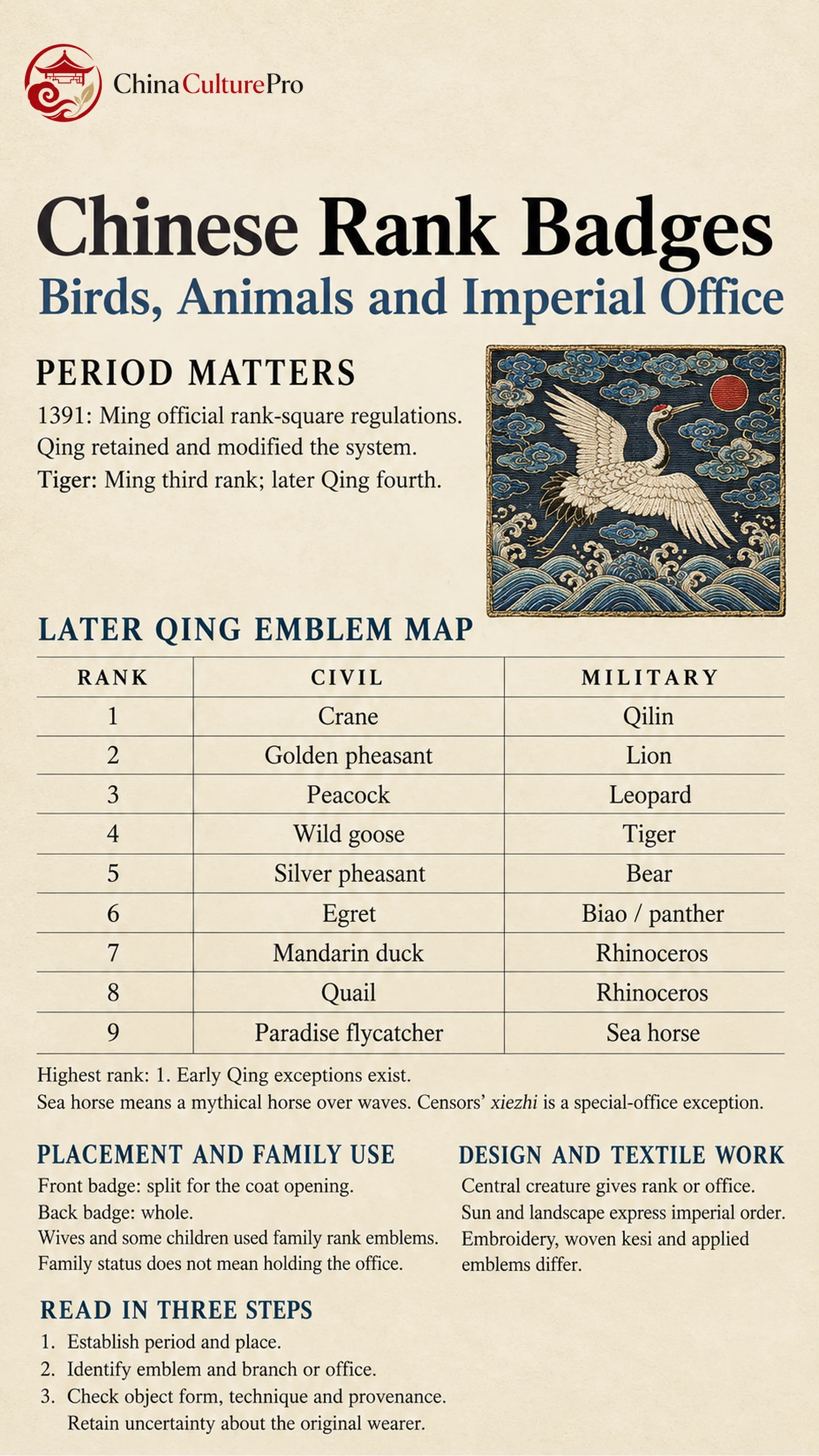
A square of embroidery can identify an official’s position, but it can also mislead a hurried viewer. A tiger’s rank depends on the period; a seam may belong to the coat opening; and a woman’s badge may reflect family status. Read those details before assigning a title to the wearer.
From Ming Regulations to Qing Variations
Clothing regulations issued in 1391 established decorative rank squares for officials during the Ming dynasty. Birds marked civil officials and animals marked military officers. The Qing dynasty continued and regulated the system, while changing some assignments and visual conventions.[1]
A tiger illustrates why the date matters. It identified a third-rank military commander in the Ming, but a fourth-rank military position in the Qing.[2] The early Qing itself also saw changes before later arrangements settled.[3] Consequently, a convenient Qing identification chart is not a universal key to every badge made across both dynasties.
The insignia communicated a place within an institutional hierarchy. The creature was not simply the wearer’s favorite animal, a personal zodiac sign or a general wish for good fortune. Auspicious decoration could surround that central emblem, but its administrative role remained distinct.
Qing Civil and Military Rank Emblems
The following table gives a commonly documented later Qing mapping. First rank is the highest of the nine grades shown. It is a lookup for emblems, rather than a complete list of government job titles or every early Qing exception.[4]
| Rank | Civil emblem | Military emblem |
|---|---|---|
| First | Crane | Qilin (麒麟, qílín), a mythical creature |
| Second | Golden pheasant | Lion |
| Third | Peacock | Leopard |
| Fourth | Wild goose | Tiger |
| Fifth | Silver pheasant | Bear |
| Sixth | Egret | Biao (彪, biāo), often translated as panther |
| Seventh | Mandarin duck | Rhinoceros |
| Eighth | Quail | Rhinoceros |
| Ninth | Paradise flycatcher | Sea horse, a mythical horse bounding over waves |
The nine-bird sequence runs from the first-rank crane to the ninth-rank paradise flycatcher.[5] On the military side, seventh and eighth rank share a rhinoceros, so the animal alone cannot distinguish those grades. The ninth-rank “sea horse” is a horse-like creature moving over waves, rather than the small marine fish familiar from modern aquariums.[3]
There is also an important office-specific exception: the xiezhi (獬豸, xièzhì), a mythical single-horned creature, appears on censors’ badges. A badge bearing a beast therefore does not automatically identify an ordinary military rank.[6] Likewise, the qilin and xiezhi should not be merged into one generic “unicorn” symbol; their roles in this clothing system differ.
Where Badges Were Worn and Who Used Them
The badge-bearing outer coat is often called bufu (补服, bǔfú). A front badge could be divided vertically into two matching halves to accommodate the coat’s center opening; the corresponding back badge remained whole. The split can be an intentional feature of placement, rather than evidence of damage.[4]
The garment belongs within a larger court outfit. A badge-bearing outer coat and a dragon robe are related elements of court dress, not interchangeable names for the same decorated textile. A detached square has lost some of the information supplied by its original garment and accessories.
Women in officials’ families could wear insignia corresponding to their husbands’ rank. Surviving children’s garments also carry a father’s emblem. Such use expressed family standing; it does not establish that the woman or child personally held the administrative office.[7]
Facing direction sometimes helps specialists interpret a pair or its original placement. It should be checked against the object record rather than used alone to assign a wearer’s gender. Front and back, male and female garments, and later assemblages can make an isolated image ambiguous.
Reading the Design and Its Making
On many Qing examples, the creature occupies a small landscape of rocks, waves and clouds and faces a sun disk. The sun represents the emperor, while the arrangement expresses the official’s relationship to imperial authority.[1] Additional auspicious objects belong to the wider language of embroidery symbols; they do not replace the rank-bearing creature.
Production methods differ. Embroidery adds stitches to a ground fabric. Kesi (缂丝, kèsī) is silk slit tapestry, in which colored wefts form the design as it is woven. Couching holds decorative surface threads down with smaller stitches, making it useful for metallic yarns.[8] These distinctions connect badges to both needlework and silk weaving.
Some later badges used separately made, applied creature emblems, making a change of rank easier than replacing an entire worked background. Individual surviving examples can also combine parts made or assembled at different dates.[7] A removable-looking bird is therefore an object feature to investigate, not automatic proof that a badge is modern or fraudulent.
Identifying a Badge Without Overclaiming
- Establish the period: Read the catalogue’s date and place before choosing a rank chart.
- Identify the emblem: Compare the complete creature and determine the relevant branch or special office. Stylized animals may differ from natural-history illustrations.
- Check the object: Examine whether it is whole, split, paired or attached to clothing. Read its material and technique separately, and retain qualifications such as “probably” when provenance is incomplete.
For the civil-service setting, imperial examinations explain an important route toward office. A badge, however, records neither an examination transcript nor a named person’s entire career. Its narrower value is identifying a status claim within the wider system of Chinese dress.
A description such as “a Qing civil badge with a crane emblem, associated with first rank” states what the evidence supports. Family use, altered components and incomplete provenance can still leave the original wearer unidentified.
FAQs About Chinese Rank Badges
Why are some rank badges split in half?
The halves fitted the two sides of a center-opening outer coat. A matching back badge could remain whole. A deliberate vertical division therefore need not indicate accidental damage.
Did women wear rank badges?
Yes. Officials’ wives could wear badges reflecting their husbands’ rank. The insignia expressed family standing and does not by itself show that the wearer held that office.
Does a tiger always mean the same rank?
No. A tiger can indicate a third-rank Ming military position or a fourth-rank Qing position, with additional early Qing changes. Date the garment before applying a rank chart.
Is every animal badge military?
No. The ordinary military system used beasts, but censors’ xiezhi badges provide a distinct office-specific exception. Identify the creature and institutional context together.
Sources
[1] Cleveland Museum of Art. Rank Badge (Buzi), 1948.69
[2] The Metropolitan Museum of Art. Rank Badge with Tiger
[3] USC Pacific Asia Museum. Rank and Style, Section 3: Lions and Tigers
[4] Taiwan Historica. Buzi
[5] Kyoto National Museum. Buzi (Rank Badges) for Civil Officials
[6] Cleveland Museum of Art. Rank Badge (Buzi), 1948.72
[7] USC Pacific Asia Museum. Rank and Style, Section 2: Cranes and Peacocks
[8] USC Pacific Asia Museum. Rank and Style: Textile Terms