
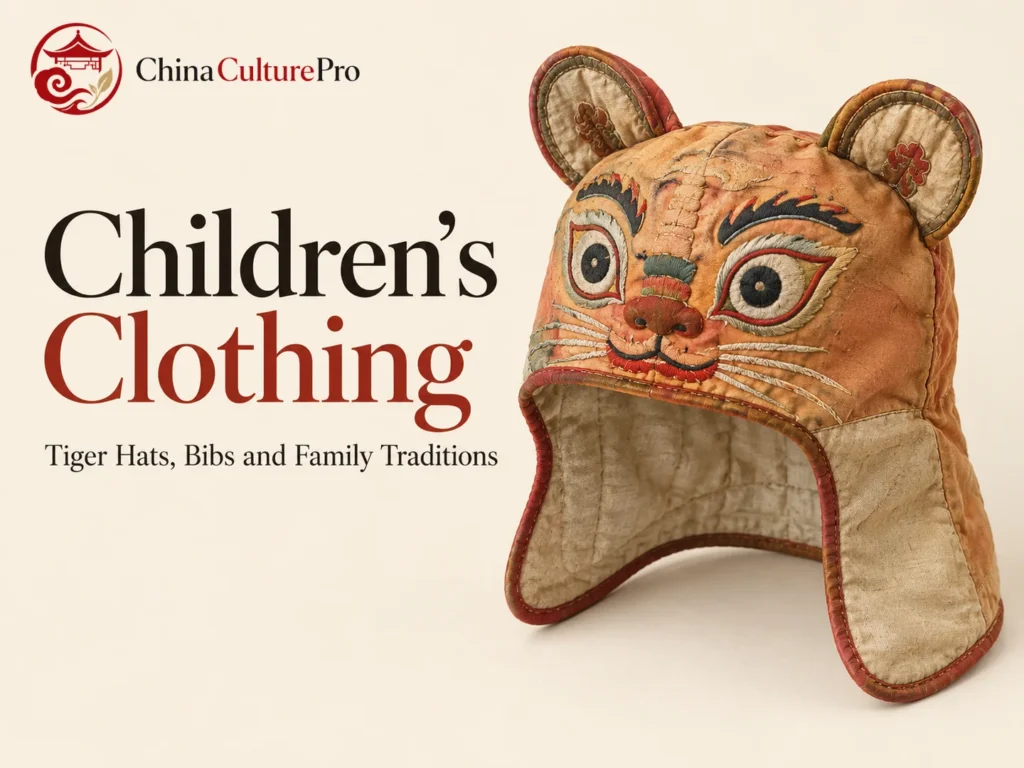

Quick Answer: What Is Traditional Chinese Children’s Clothing?
Traditional Chinese children’s clothing includes garments and accessories made for a child’s age, needs and family occasions. A tiger-head hat (虎头帽, hǔtóumào) is a recognizable example, but hats are only one part of the wider wardrobe.
- Forms: Caps, robes, vests, bibs, body coverings and shoes.
- Craft: Sewing, embroidery, applique and combinations of different fabrics.
- Meaning: Family wishes for growth, good fortune and protection, expressed through decoration.
Many elaborate surviving examples were intended for festivals or special occasions. They do not represent everything every child wore, and their protective imagery records beliefs rather than demonstrated effects on health.[1]

An embroidered tiger face on a tiny hat can look playful, fierce and affectionate at once. Its ears and whiskers also belong to a larger history of family needlework and wishes for a child’s future. Garment shape, material and decoration each tell a different part of that story.
Recognizing Garments and Accessories
A display may bring together objects worn on different parts of the body. Identifying their form prevents a decorative resemblance from turning them into the same garment.
| Object group | Basic form and role | Useful distinction |
|---|---|---|
| Tiger-head hat | Headwear incorporating a tiger’s facial features | A hat can combine warmth with symbolic decoration. |
| Bib or collar | A shaped piece worn at the neck or over the upper front | An embroidered ceremonial bib is not simply a modern feeding bib. |
| Dudou (肚兜, dùdōu) | A close-fitting covering for the chest and belly | Its coverage and construction distinguish it from a neck bib. |
| Hundred-families garment (百家衣, bǎijiāyī) | Clothing associated with joined fabric pieces and shared good wishes | The term describes a tradition, not proof of exactly one hundred donors. |
| Longevity lock (长命锁, chángmìngsuǒ) | A pendant expressing wishes for long life | It is an accessory, not a garment or working door lock. |
A dudou covers the chest and belly, whereas a bib or collar sits differently on the upper front.[7] Late-Qing and Republican-period children’s wardrobes included these alongside vests, footwear and pendants.[6]
Tiger Hats: Practical Clothing and Protective Imagery
A padded tiger-head wind hat from the Tongzhi reign has an apricot-colored satin surface, a pale silk lining and cotton filling. Embroidered eyes, brows, nose and whiskers create its animal face. Its extended shape is closer to a small hooded covering than to a simple round cap.[2]
The same object therefore has several roles: headwear, a warm textile construction and a tiger-shaped design. The tiger’s feared strength was understood as a defense against harmful forces. That is the cultural meaning attached to the image, not evidence that the hat could prevent illness.[2]
This court example does not set the material standard for all families. Other children’s headwear used different animal forms, fabrics and decoration. Tigers were memorable, but were never the only creatures represented.[1]
Needlework, Motifs and the Child’s Body
A nineteenth-century blue silk-damask bib takes the form of a tiger and includes embroidered flowers, applied motifs, metal-wrapped thread and contrasting edging. Its decoration includes creatures associated with the Five Poisons (五毒, wǔdú), part of a protective symbolic vocabulary.[3]
Chinese embroidery helps explain the stitching; embroidery symbols concern the meanings attached to the design. A motif can express a wish without identifying exactly who made the piece or proving that every wearer understood it identically.
The blue bib is also a reminder to distinguish the textile ground from its additions. Damask, stitches, applique and edging are different components of its making.[3] Chinese silk clothing offers the broader fabric context, while a particular object’s record supplies its actual materials.
Family Gifts and Shared Blessings
The hundred-families garment links needlework with contributions from a wider community. In the documented tradition, neighbors supplied fabric or embroidered pieces for a child’s new clothing, expressing shared wishes for good fortune. A late nineteenth-century boy’s robe combines hexagonal patches and embroidered motifs; some of its applied trims may have been added later.[4]
A surviving garment can have a history of alteration, so its present appearance need not record a single making event. The name also cannot verify how many households contributed to an individual piece.
Longevity locks express a related wish in another material. One silver example has a chain, floral decoration and auspicious wording. Such pendants were presented as blessings for a child’s life; the “lock” refers to a symbolic purpose rather than a practical fastening.[5] Chinese baby traditions provide the wider context for early-life gifts and celebrations, whose timing and forms were not identical everywhere.
Family affection could coexist with unequal expectations. Some historical objects and accounts focus particularly on sons and continuation of the family line.[3] This evidence should be acknowledged without making every family or child conform to the same experience.
Historical Variety and Museum Interpretation
Many familiar museum examples date from the late Qing dynasty into the Republican period. That is a valuable body of evidence, but it is not a complete wardrobe history for every region, ethnic community or century.[6]
Date, place, construction, wear and provenance are complementary clues. An elaborate festival garment may survive precisely because it was treasured. It cannot alone establish what a child wore for work, play or sleep. Likewise, the presence of skilled needlework does not prove the identity of the maker unless a record preserves it.
Within traditional Chinese clothing, these objects reveal how adults clothed children and imagined their futures. Reading practical use alongside symbolic meaning preserves both the garment and the family relationships around it.
FAQs About Chinese Children’s Clothing
Did all Chinese children wear tiger hats?
No. Headwear varied by place, period, family and occasion. Tiger hats are a distinctive tradition, not a universal childhood uniform.
Is a dudou the same as a bib?
No. A dudou covers the chest and belly. A bib or collar has a different position and construction, even when both carry embroidery.
Did symbolic clothing actually protect children from illness?
Protective motifs expressed beliefs and wishes. Their presence documents a family’s hopes, not proof that a garment prevented or treated illness.
Sources
[1] Textile Museum of Canada. Good Beginnings: Children’s Hats and Clothing from China
[2] Ruan Weiping, The Palace Museum. Apricot Satin Tiger-Head Padded Wind Hat
[3] Sarah Spotowski, University of Alberta Museums. Ferocity and the Five Poisons: Symbolism on Qing Dynasty Children’s Clothing
[4] Saint Louis Art Museum. Han Chinese Boy’s Robe: One Hundred Households Patchwork Design
[5] National Museum of Prehistory. Baijia Lock, Object 20050100113
[6] Hong Kong Heritage Museum. Wearable Blessings: Stories in Traditional Children’s Clothing
[7] Taiping Agricultural Heritage Museum, Taichung. Dudou