
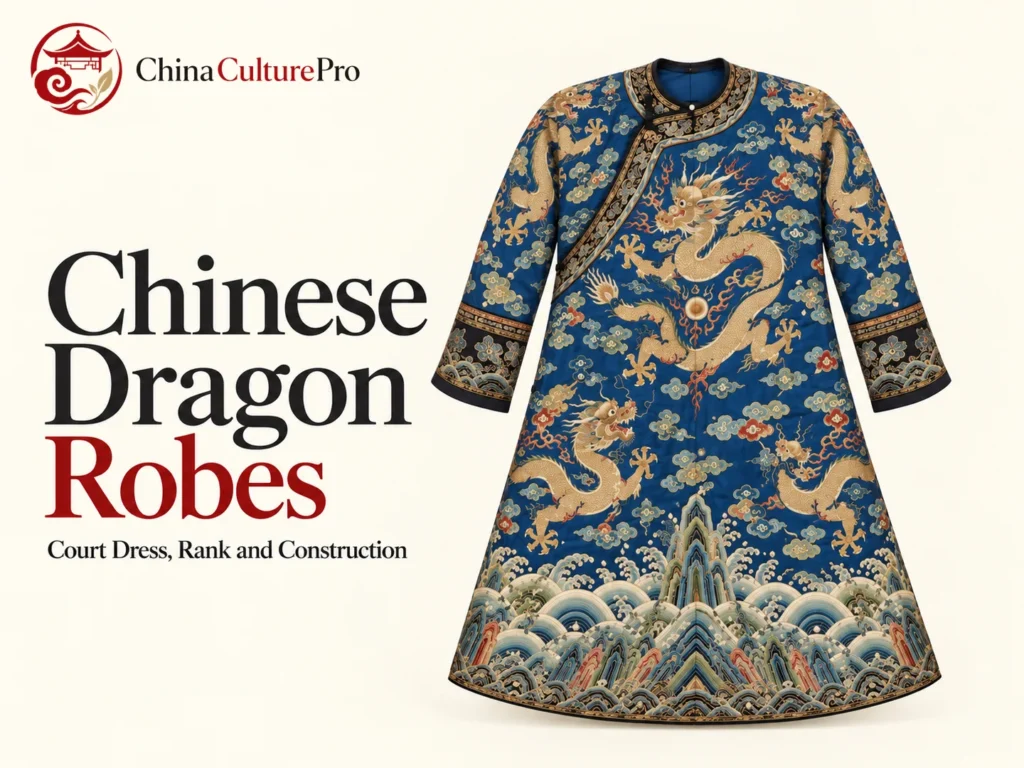

Quick Answer: What Are Chinese Dragon Robes?
Chinese dragon robes are garments whose dragon designs form part of a court dress system. The familiar Chinese term longpao (龙袍, lóngpáo) means “dragon robe,” but English museum descriptions can include several robe classes and wearer ranks under the broader label.
- Occasion: Formal audience robes and less formal court robes served different functions.
- Rank: Color, motifs, accessories and the garment’s date must be read together.
- Construction: Cut, cuffs, silk weaving and embroidery help explain how a robe was made.
Most examples discussed here are Qing court garments. Five claws or nine dragons alone do not establish that an emperor wore a particular robe.[5]
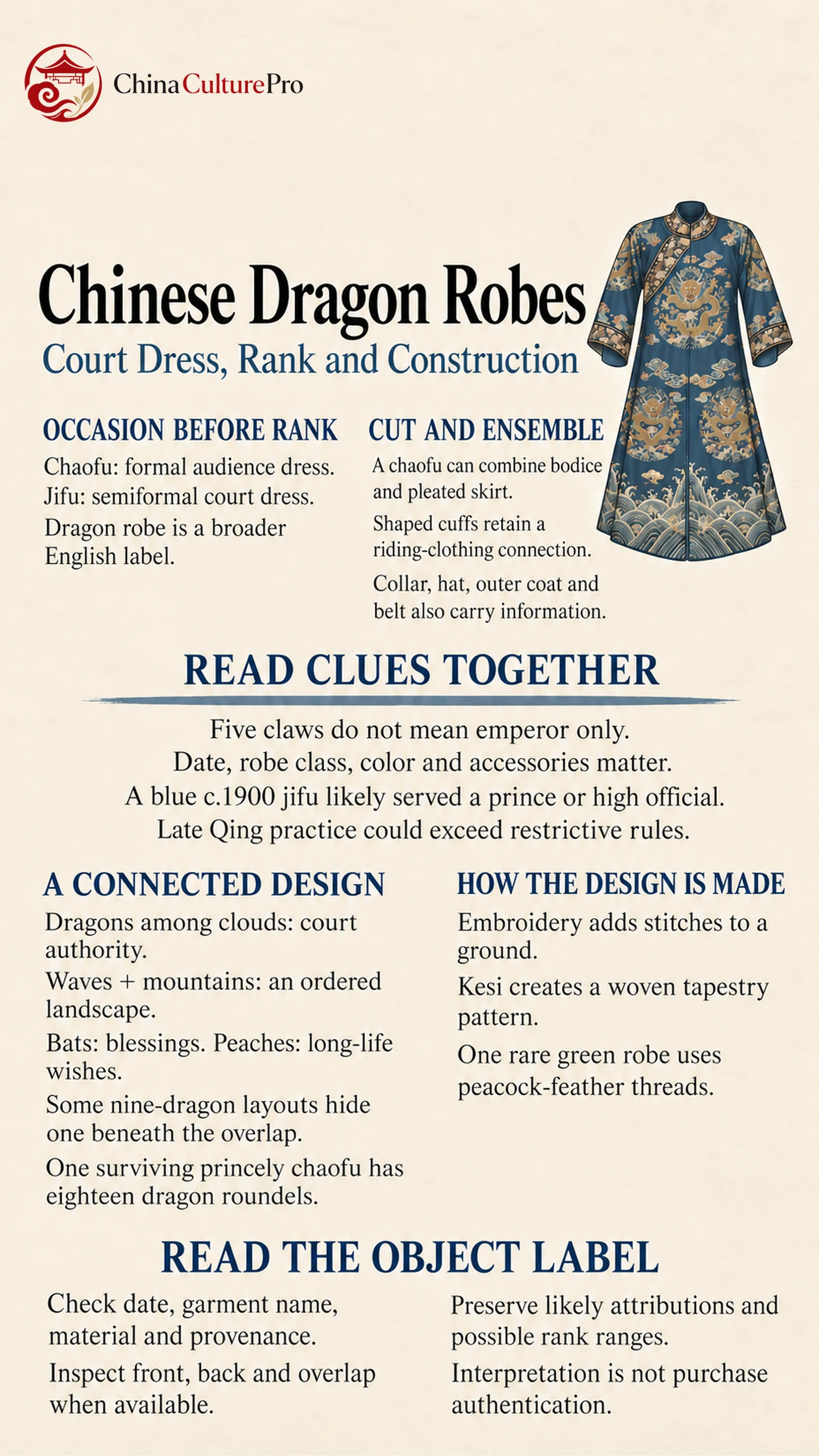
A blue robe covered in dragons can look as imperial as a yellow one. Yet its wearer may have been a prince or an official, and its woven surface may be mistaken for embroidery. Understanding the robe means reading its occasion, construction and complete design rather than one striking detail.
Court Robe Types and When They Were Worn
The Qing dynasty court used a wardrobe with distinct categories. “Dragon robe” is a useful English description, but it is not a substitute for identifying the garment’s actual role. These labels overlap rather than forming three mutually exclusive styles.
| Term | Meaning and use | Important boundary |
|---|---|---|
| Longpao | Literally “dragon robe,” commonly used for dragon-decorated imperial garments. | An English dragon-robe label may cover a wider range of court clothing and users. |
| Chaofu (朝服, cháofú) | Formal audience dress for major court ceremonies, assemblies and state sacrifices. | Its cut differs from the familiar straight-bodied semiformal robe. |
| Jifu (吉服, jífú) | Literally “auspicious dress,” associated with semiformal court occasions and official activity. | It is ceremonial court clothing, not simply an emperor’s everyday house robe. |
The distinction between the formal chaofu and the widely surviving jifu is useful before trying to interpret rank.[2] Dragon-decorated court clothing also predates the Qing: it was already regulated under the Ming, while the Qing developed its own arrangements and requirements.[3]
Cut, Cuffs and the Layered Court Ensemble
A formal chaofu can combine a hip-length upper body with an attached pleated skirt. Its side fastening, narrow sleeves and shaped cuffs give it a different outline from a straight-bodied robe. The horse-hoof cuffs (马蹄袖, mǎtíxiù) preserve a connection with cold-weather horseback clothing within Manchu dress.[4] Ceremonial use retained those features even when the wearer was not riding.
Season also affected construction. A surviving princely summer chaofu uses airy gauze, whereas winter versions could use heavier fabric and fur lining or trim. The formal outfit extended beyond the robe to a collar, rank-related headwear and boots.[2]
The wider court ensemble could also include an outer coat, belt and other accessories. Reading the robe alone removes part of the evidence for position and occasion.[1] Rank badges belong to that larger clothing system; they should not be confused with every dragon woven or stitched into a robe.
Reading Rank Without a One-Clue Rule
Court dress regulations assigned meaning to colors and designs, but identifying an object requires its period and clothing category. The familiar claim that only an emperor could wear five-clawed dragons is too broad. A blue jifu dated around 1900, for example, is identified as likely belonging to a Manchu prince or a first- or second-rank official.[5]
A different formal robe, dated to the nineteenth century, combines dark blue cloth with four-clawed dragons. Its possible wearer falls within a range extending from a third-degree prince to a fourth-degree official. The court’s 1759 standardization provides context for interpreting that combination.[4] Neither example supports identifying an exact individual merely by counting claws.
Practice could also diverge from restrictive ideals. Five-clawed designs circulated more widely during the late Qing than an emperor-and-princes rule alone would suggest.[3] Imperial colors likewise need a period-specific reading; “yellow” should not be treated as one timeless shade with one universal wearer.
One eighteenth-century green robe has nine five-clawed dragons but is identified with an imperial-family wearer rather than an emperor. Its comparison with an emperor’s robe draws attention to the Twelve Symbols (十二章, shí’èr zhāng), a group of imperial emblems absent from the green example.[6] This is evidence about those objects, not a complete authentication test for every dragon robe.
Dragons, Waves and Auspicious Motifs
The Chinese dragon could express imperial authority, but the surrounding design matters too. Many Qing robes arrange imagery as a world: waves below, mountains rising from them, and dragons among clouds above. The decoration is a composition with relationships, rather than a random collection of lucky pictures.[7]
| Design element | Reading within a documented robe composition | What to look at |
|---|---|---|
| Dragons among clouds | Authority and auspicious power in the court setting. | Placement, posture and the complete garment class. |
| Sea waves and mountains | An ordered landscape connecting sea, land and the world above. | Their relationship along the lower part of the robe. |
| Bats | Blessings, through a Chinese sound association. | Their placement among clouds and other motifs. |
| Peaches | Wishes for long life. | The surrounding auspicious design rather than an isolated fruit. |
The embroidery-symbol guide explains the wider motif vocabulary. On the documented robe, bats and peaches contribute blessings and long-life wishes to the larger sea–land–sky composition.[7]
Dragon counts also depend on robe type and what can be seen. A familiar nine-dragon arrangement places three on the front, three on the back, two at the shoulders and a ninth beneath the overlap, hidden when worn.[6] One surviving princely chaofu instead carries eighteen dragon roundels.[2] Counting only the visible front cannot establish the garment’s full design.
Silk, Embroidery and Woven Designs
Not every dragon is embroidered. One blue court robe uses kesi (缂丝, kèsī), a silk slit-tapestry technique, with gold thread.[5] Its pattern is woven into the textile. By contrast, embroidered designs add stitches to a fabric ground. This distinction connects the robe to two related crafts: Chinese silk weaving and Chinese embroidery.
An unusually green eighteenth-century robe supplies another material example. Peacock feathers were twisted onto silk threads before weaving, while gold-wrapped threads formed the dragons.[6] Its green effect does not mean that every similar-looking robe used feathers. Color and shine are insufficient to identify a fiber or metal composition.
The broader subject of silk clothing separates fiber, weave and surface decoration. On a court garment, all three contribute to appearance, but they are different kinds of information. A museum’s material description is a better starting point than assuming that every raised or glittering motif was made by the same process.
How to Read a Dragon Robe in a Museum
Start with the object label’s date, garment name and material. Then compare those details with the visible cut, cuffs, opening and motif arrangement. If the label says “likely” or gives a range of possible ranks, preserve that uncertainty when describing the object.
Look for evidence beyond the front view: a dragon may lie under an overlap, and the back may carry essential parts of the design. Accessories can also change how a robe belongs within an ensemble. A display photograph is not necessarily a complete historical dressing arrangement.
The useful result is a description such as “a late Qing blue silk jifu associated with a high-ranking wearer,” with the relevant uncertainty intact. It places the garment within Chinese clothing traditions without claiming an emperor, a named owner or an exact rank that the evidence cannot establish. This reading method explains an object; it does not certify age or authenticity for a purchase.
FAQs About Chinese Dragon Robes
Could anyone besides the emperor wear five-clawed dragons?
Yes. Princely garments provide clear examples, and some late Qing robes are associated with other high-ranking wearers. The permitted or actual use depends on period, garment class and the complete evidence.
Do all dragon robes have nine dragons?
No. Nine is familiar on some jifu, sometimes including a hidden dragon beneath the overlap. Other court garments can use different arrangements, including a princely chaofu with eighteen dragon roundels.
Were all dragon robes yellow?
No. Surviving examples include blue, brown and green robes. Their colors need to be read alongside date, category and other design features, rather than treated as a universal emperor-versus-official test.
Are the dragons always embroidered?
No. Designs can be woven, including in kesi tapestry, or created with embroidery. The material and technique recorded for the individual object give a more reliable answer than its shine alone.
Sources
[1] Museum of Fine Arts Boston. Draped in Dragons
[2] Smithsonian National Museum of Asian Art. Designing with Numbers
[3] Cooper Hewitt, Smithsonian Design Museum. Five-Clawed Dragon
[4] The Metropolitan Museum of Art. Robe of State
[5] Seattle Art Museum. Nine-Dragon Imperial Robe
[6] Denise Patry Leidy, The Metropolitan Museum of Art. Peacocks and Dragons, Oh My!
[7] Shigeki Kawakami, Kyoto National Museum. Lucky Motifs on a Dragon Robe