
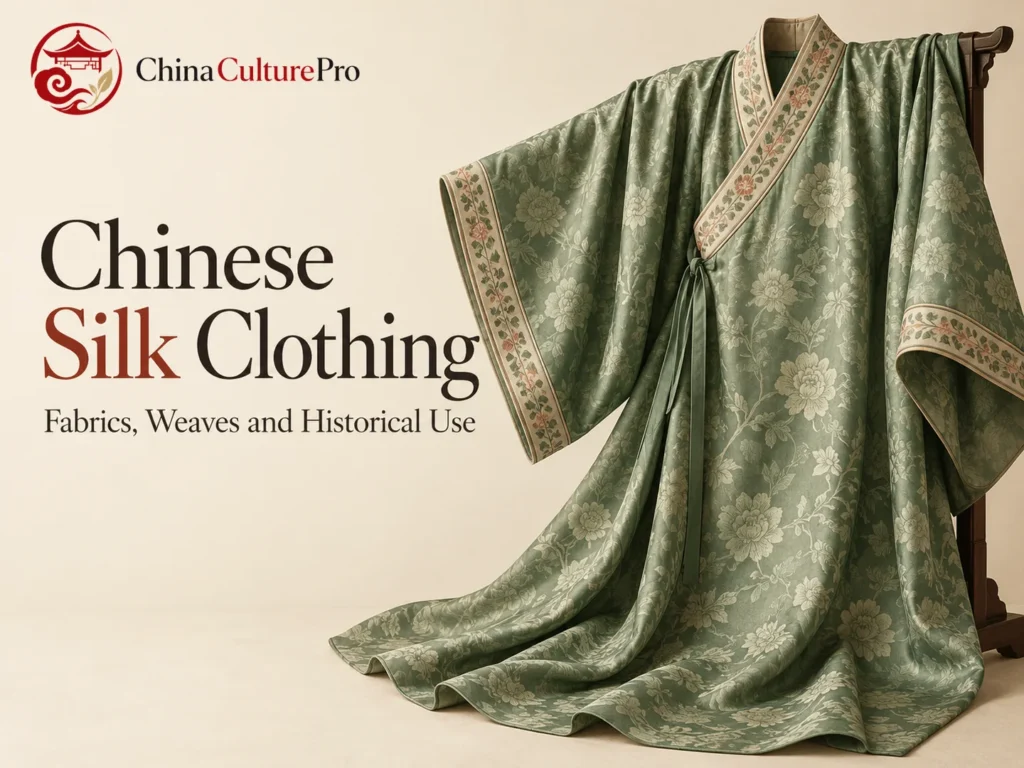

Quick Answer: What Is Chinese Silk Clothing?
Chinese silk clothing is clothing made wholly or partly from silk textiles. Silk names a natural fiber obtained from silkworm cocoons; it does not specify one weave, surface finish or garment shape.[1]
- Material: Silk thread provides the fiber basis of the cloth.
- Structure: Different weaves produce plain, patterned, open or lustrous surfaces.
- Garment: Cutting, lining and decoration turn the textile into clothing.
A satin robe, a gauze jacket and a tapestry-woven court garment can all contain silk while looking very different. Conversely, the word “satin” alone does not prove silk fiber: satin fabrics can use other materials too.[2]

A pale gauze robe and a richly patterned coat can seem to have little in common. Both belong within the history of Chinese silk clothing, but their differences matter. Reading the fiber, woven structure, added decoration and finished garment separately makes museum descriptions and clothing labels much easier to understand.
Fiber, Thread, Fabric and Garment
Silk is an animal-derived natural fiber whose principal structural component is a protein called fibroin. Thread preparation and the arrangement of threads then create different textiles.[1] The material is the starting point, not the complete description.
A fabric name may identify structure, texture or pattern; a garment name identifies the finished article. The same general garment form can be made in different textiles, while one robe can combine several materials in its body, cuffs, borders and lining.
Satin illustrates the distinction especially clearly. It describes a smooth, lustrous textile produced with a particular weaving arrangement. Silk satin exists, but so do satin fabrics made with fibers such as rayon or acetate.[2] “Silky” appearance and “silk” composition are therefore different claims. Neither a photograph nor shine alone settles the fiber question.
Common Chinese Silk Fabric Terms
Historical Chinese textile names are useful, but their English equivalents should be read in context. The terms below provide a working vocabulary rather than one timeless set of modern retail specifications.
| Term | Core meaning in historical textile descriptions | Reading caution |
|---|---|---|
| Juan (绢, juàn) | Plain or tabby-woven silk | A plain structure need not mean an undecorated finished garment. |
| Ling (绫, líng) | Twill or twill-damask silk | Twill structure and a figured design are related but separate details. |
| Luo (罗, luó) | Gauze associated with an open structure | Different gauzes can vary in density and pattern. |
| Duan (缎, duàn) | Satin or satin-damask silk | The weave name does not identify every component of a garment. |
| Jin (锦, jǐn) | Polychrome patterned woven silk, often translated as brocade | The broad historical name does not mean one identical weaving method. |
| Kesi (缂丝, kèsī) | Silk tapestry with discontinuous colored wefts | The design is woven into the textile, rather than stitched onto a ground. |
Historical fabric names can describe structure, pattern or a combination.[3] Kesi specifies tapestry construction.[4] A label may combine several terms because a single object contains more than one fabric or technique.
Woven Patterns and Embroidered Decoration
A woven pattern is formed as the cloth is made on the loom. Chinese embroidery adds stitches to an existing textile. A decorated surface may involve one process or a combination, so “patterned silk” is not automatically embroidery.
Kesi uses continuous warp threads with colored wefts worked only where their sections of the design require them. This produces sharply defined areas of color. The familiar translation “cut silk” refers to that visual effect; it does not mean that the picture consists of separate fabric pieces cut out and sewn together.[4]
Woven and embroidered work can coexist on one object. Painting may also supplement a woven design. Recognizing the main structure is therefore different from claiming that every visible detail was produced by the same technique.[4]
Historical Uses and Dated Examples
The Han-dynasty tombs at Mawangdui yielded two plain unlined gauze gowns. Their ground fabric is the same, but their collars and cuffs use different materials. They demonstrate both the extraordinary lightness possible in silk textiles and the need to examine components separately.[5] They do not establish what every Han person wore.
A Ming-dynasty coat dated to the fifteenth or sixteenth century combines a silk-gauze ground with polychrome silk embroidery. Here, fiber, open woven structure and applied decoration all contribute to the same garment.[6] The example also shows why gauze should not automatically be treated as a plain, decoration-free textile.
Ceremonial clothing made silk particularly visible. Chinese dragon robes belong to specialized systems of status and occasion, but they are only one part of silk clothing history. Production also connected agricultural work, textile workshops and the movement of goods. Silk circulated along the routes discussed in Silk Road history and served uses beyond clothing, including painting and calligraphy.[6]
A fabric’s prestige does not make every surviving piece imperial. Garment form, workmanship and the wearer’s recorded context need to be assessed independently from the presence of silk.
Reading a Silk Garment or Label
Fiber composition, weave, decoration and garment components are complementary information. A description of a silk outer fabric may say nothing about the lining. An embroidered border may differ from the body fabric even when both are silk.
On a modern label, look for an actual composition statement rather than relying on words such as “silky,” “satin” or “brocade.” With a museum object, preserve the catalogue’s qualifications and distinguish original material from later repairs. A front-view image cannot establish every thread or alteration.
A qipao or cheongsam (旗袍, qípáo) describes a garment form, not a guarantee of silk. The broader guide to traditional Chinese clothing supplies the garment context; the material description answers what that particular piece is made from.
FAQs About Chinese Silk Clothing
Are silk and satin the same thing?
No. Silk is a fiber; satin identifies a textile structure and surface. Satin can be made with silk or other fibers, so the words are not interchangeable.
Is all Chinese silk shiny?
No. Surface appearance varies with thread, weave and finishing. An open gauze and a smooth satin can both be silk without having the same luster.
Is kesi a form of embroidery?
No. Kesi is tapestry weaving. Its colored wefts form the design as the textile is woven, although other decoration can be added to a finished piece.
Sources
[1] Museum of Fine Arts Boston, CAMEO. Silk
[2] Museum of Fine Arts Boston, CAMEO. Satin
[3] China National Silk Museum. Museum Exhibition Text: Classification of Silk Textiles
[4] China National Silk Museum. Interlacing New Directions: Exhibition of Chinese Kesi Art
[5] Hunan Provincial Department of Culture and Tourism. Curving-Front Plain Unlined Gauze Gown
[6] Hong Kong Palace Museum. A History of China in Silk