

Quick Answer: What Were Chinese Lotus Shoes?
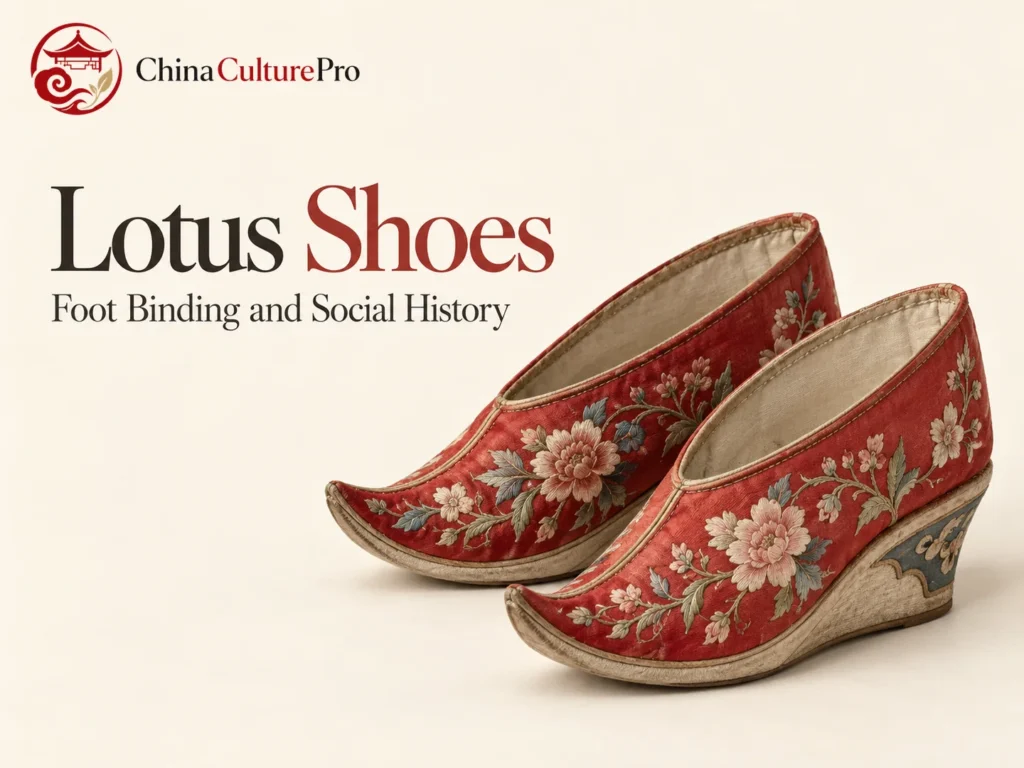
Chinese lotus shoes were footwear made for women whose feet had been altered by foot binding (缠足, chánzú). Their small size can be misleading when they appear without a wearer’s history.
- Object: Adult shoes in varied materials, shapes and levels of decoration.
- Practice: A painful restriction of girls’ growing feet, with lasting bodily consequences.
- Context: Footwear connected with beauty ideals, marriage expectations, family work and changing social pressures.
They were not ordinary children’s shoes. Nor do surviving embroidered pairs show that every Chinese woman bound her feet or experienced the practice in the same way.[1]

A small embroidered shoe in a display case can look like a miniature work of art. Its stitching deserves attention, but so does the woman who wore it. Understanding lotus shoes requires looking beyond their decoration to the bodily constraints, family expectations and working lives they accompanied.
The Shoes and the Practice They Accompanied
The shoes were made to fit feet already shaped by binding; buying a small shoe alone did not create the condition. Binding began in childhood and could permanently alter the feet, restrict mobility and cause pain. This was a bodily intervention, not simply a preference for a snug style of footwear.[6]
Historical expressions such as lotus feet (莲足, liánzú) and golden lotus (金莲, jīnlián) gave the altered feet an admired, poetic identity. These are euphemisms to interpret in their historical setting, rather than neutral descriptions of anatomy or ideals to endorse today.[1]
Two things can be acknowledged together: women made and wore shoes with considerable textile skill, while the social practice behind them imposed serious constraints. Admiring the needlework should not erase the latter.
Origins, Evidence and Uneven Spread
Foot binding has no securely established single inventor. Stories about a court dancer are often repeated as an origin account, but they should not be treated as proof of one founding event.[5]
Archaeological shoes provide firmer evidence for particular places and dates. Six pairs from the thirteenth-century tomb of Huang Sheng in Fujian averaged about 13 centimeters in length and had flat soles. These Song-dynasty objects also show why later, sharply arched shoes should not be projected unchanged into every earlier period. The finds establish that such footwear existed; they do not establish the first year of binding.[2]
By the Qing dynasty, binding was widespread among Han communities, but its prevalence and severity varied. It never included all Chinese women. Manchu clothing offers a useful contrast: the raised platform shoes associated with Manchu women accommodated unbound feet and belonged to a different footwear tradition.[5]
Beauty, Marriage and Women’s Work
Small feet could be associated with desirable femininity and marriageability. A girl’s family might therefore see binding as preparation for her future, even when it caused distress. Making an embroidered pair also displayed needlework that a prospective husband’s family could assess. The decision cannot be understood solely as an individual adult choosing a fashionable accessory.[1]
Yet a simple story of wealthy women doing nothing is equally misleading. Interview-based research in two rural Shaanxi communities found that women with bound feet participated in household production, including spinning and weaving. This evidence connects binding with girls’ labor and the economic organization of particular families, rather than treating it only as a sign of leisure.[6]
This is regional evidence, not a complete explanation for China. Some bound women also walked unaided and worked in fields.[5] Accounts of women in Chinese history need room for work, coercion and differing personal responses.
Shoe Types, Materials and Needlework
One documented pair dated 1860–1899 measures 11.5 centimeters long. It has red silk-satin uppers, floral decoration and wedge heels; its materials include silk, cotton and wood. The measurement belongs to that object, not to a universal standard for adult women’s feet.[3]
The wider range included footwear for different settings:
| Form | Construction and use | What it helps explain |
|---|---|---|
| Everyday shoes or boots | Cotton, silk or wool, with varied soles and heel forms | Daily footwear was not one identical red satin style. |
| Sleeping shoes | Soft materials and soft soles | Shoes could be made for use indoors at night. |
| Bridal shoes | Often red, with embroidery or other decoration | Ceremonial pairs could emphasize textile display. |
| Bad-weather footwear | Felt or leather forms, alongside protective overshoes | Practical adaptations existed for weather and ground conditions. |
These forms are documented examples, not categories that every woman necessarily owned.[4]
Chinese embroidery helps explain the surface work, while Chinese silk clothing provides context for the fabric. Fiber, stitching, sole and heel should be considered separately: a silk upper does not mean that the whole shoe is silk, and elaborate decoration cannot identify its wearer’s complete social position.
Anti-Binding Campaigns and a Gradual End
Late nineteenth-century opposition included Chinese reform organizations and Christian missionary campaigns. Advocates promoted unbound feet through changing ideas about education, marriage and national renewal. This was a contested social change, not simply the arrival of a different shoe fashion.[7]
A Republican ban in 1912 did not immediately end the practice. Stronger intervention after 1949 further suppressed new binding, but women who had already undergone it continued to live with its effects.[5] Removing bindings did not necessarily restore the feet to an unaltered state. Changing attitudes could also stigmatize women who had previously been pressured to conform.[7]
Economic changes mattered as well. Research on rural textile work links declining demand for household spinning and weaving with reduced incentives to restrict girls to such work. This is a locally grounded interpretation, alongside reform and enforcement, rather than a single cause for every region.[6] The transition belongs within Chinese clothing history, but cannot be reduced to a clean dividing line between two dates.
Reading Lotus Shoes as Historical Objects
A museum description can combine the catalogue’s date and place, the shoe’s dimensions and construction, and evidence about its wearer. A surviving pair without provenance cannot reveal an entire life, or stand for every region and class.
Decoration and bodily history deserve attention together. Labels that describe only “exquisite little shoes” can leave the adult wearer invisible; labels that describe only suffering can overlook her work and skill. Within traditional Chinese clothing, lotus shoes are a historically specific object group, not a summary of Chinese women’s dress.
FAQs About Lotus Shoes and Foot Binding
Were lotus shoes children’s shoes?
Usually the term refers to shoes for adult women with bound feet. Their small dimensions can cause confusion, so a museum object’s catalogue and provenance matter more than size alone.
Did all Chinese women bind their feet?
No. Practices differed by community, region, class and period. Many women had unbound feet; Manchu platform shoes, for example, are a separate footwear tradition.
Could women with bound feet walk and work?
Many did. Binding could restrict movement and cause pain without making every woman unable to walk. Rural research documents domestic textile work, and some women also performed agricultural labor.
Did one ban end foot binding immediately?
No. Reform campaigns, government action, changing family expectations and economic shifts contributed to an uneven decline. Women already affected continued living with lasting consequences.
Sources
[1] Gillian Vogelsang-Eastwood, Textile Research Centre Leiden. Chinese Lotus Shoes: Introduction
[2] Textile Research Centre Leiden. Archaeological Examples of Lotus Shoes, China
[3] Bata Shoe Museum. Han Lotus Shoes
[4] Textile Research Centre Leiden. Main Forms of Lotus Shoes
[5] Textile Research Centre Leiden. A Brief History of Foot Binding
[6] Laurel Bossen, Wang Xurui, Melissa J. Brown and Hill Gates. Feet and Fabrication: Footbinding and Early Twentieth-Century Rural Women’s Labor in Shaanxi
[7] Textile Research Centre Leiden. The End of Foot Binding