

Quick Answer: Who Was Cao Xueqin?
Cao Xueqin (曹雪芹, Cáo Xuěqín) was an eighteenth-century novelist whose major work is Dream of the Red Chamber (红楼梦, Hónglóu Mèng), also called The Story of the Stone (石头记, Shítou Jì). His life is usually dated approximately 1715–1763. [1]
- His family’s movement from imperial favour to reduced circumstances provides useful historical context. [1]
- The first eighty chapters are generally attributed to Cao; the authorship of the final forty remains disputed. [4][5]
- Complete English editions include the five-volume Hawkes–Minford translation and the translation by Yang Hsien-yi and Gladys Yang. [2]
Read the novel as crafted fiction, with a publication history that needs distinguishing from the author’s life.
An author guide to Cao Xueqin begins with one extraordinary novel and the different forms in which readers encounter it. The Dream of the Red Chamber reading guide covers the story and characters; here the focus is his background, narrative methods and the editions that carry his work into English.
Family Fortune, Loss and the Limits of Biography
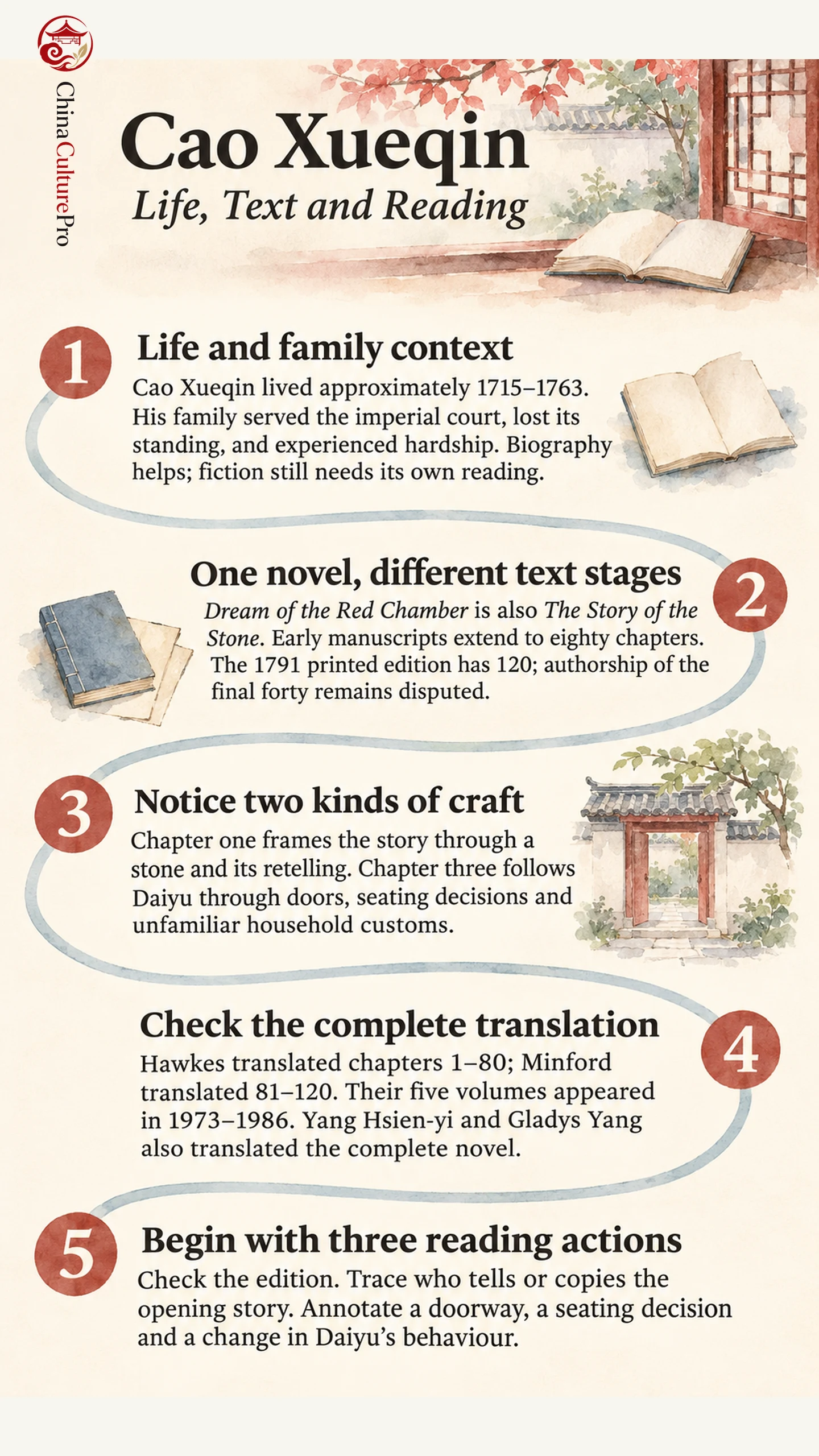
Cao belonged to a family connected with imperial textile administration at Jiangning, present-day Nanjing. Its standing depended on court service. After the family’s reversal of fortune in 1728, the privileged setting of his early background gave way to hardship; he later lived in the countryside west of Beijing. [1][2]
This places him within the social world of the Qing dynasty. Family decline makes an autobiographical reading tempting, but a resemblance between an author’s circumstances and a fictional household cannot establish that every character or event records his experience. [5]
Keep the approximate dates approximate. They provide an eighteenth-century setting without turning an uncertain biography into a precise calendar.
One Major Novel, Several Textual Stages
Cao’s central achievement belongs to the tradition of Chinese literature and is counted among the Four Great Classical Novels. The two familiar English titles identify the same novel, rather than separate entries in his bibliography. [3][9]
| Textual stage | What the reader should distinguish |
|---|---|
| Early manuscript circulation | Copies circulating from 1754 preserve a text extending no further than eighty chapters, leaving the story unfinished. [4] |
| First printed edition, 1791 | Cheng Weiyuan (程伟元, Chéng Wěiyuán) and Gao E (高鹗, Gāo È) brought out a 120-chapter edition using wooden movable type. Publication came after Cao’s death. [3] |
| Complete English translations | Modern translators can render all 120 chapters while still distinguishing the first eighty from the later forty. [2] |
Cheng and Gao described themselves as editors who had recovered missing material. How much access they had to Cao’s drafts is uncertain. Their published ending became enormously influential, but that influence does not settle its authorship. [4]
Two Passages That Show His Narrative Craft
- Chapter one: a story about making a story: A stone longs to enter human life, and its experiences become writing that is copied and retitled. The opening also looks back on women whose lives deserve remembrance. These frames make desire, recollection and loss part of the novel’s construction before the household narrative develops. Even the statement that Cao spent ten years revising the work five times occurs inside this elaborate account of the book’s origins. It should not be treated as an independently established writing schedule. [6]
- Chapter three: social order through a newcomer’s eyes: Lin Daiyu (林黛玉, Lín Dàiyù) arrives at her grandmother’s household determined to avoid a wrong word or step. Gates, changes of attendants and seating at dinner turn a visit into an education in rank. Her hesitation about where to sit, and adjustment to unfamiliar tea customs, bring the pressure into small actions. Reading these details alongside Chinese family traditions can open questions about kinship and hierarchy; the fictional household still needs reading on its own terms. [7]
The two scenes invite different kinds of attention: one asks how a narrative claims authority, while the other makes social relationships perceptible through movement and behaviour.
Choosing an English Edition
David Hawkes and John Minford’s The Story of the Stone appeared in five volumes between 1973 and 1986. A Dream of Red Mansions, translated by Yang Hsien-yi and Gladys Yang, appeared in 1978–1980. Both provide complete English versions for a sustained reading project. [2]
Hawkes translated chapters 1–80; Minford translated chapters 81–120. That division lets readers recognize the textual boundary within a continuous English edition. [4]
Check translator names and volume coverage before choosing a free online text or a single volume. An extract, an abridgment and a complete translation serve different purposes, even when their covers use the same novel title.
For a closer look at translation as a working process, CUHK’s David Hawkes Archive provides his digitized translation manuscript for chapters 2–80. That particular archive does not contain the whole five-volume English translation. [8]
A Three-Step Reading Start
- Check your edition: Record the translators, chapter range and whether the text is complete or abridged. Keep that information with your reading notes.
- Read the opening frame: In chapter one, list the people or beings who tell, copy or rename the story. Notice how the supposed origin of the book becomes another story. [6]
- Annotate one household scene: In chapter three, note a doorway, a seating decision and a change in Daiyu’s behaviour. Ask how each makes her position in the family visible. [7]
This gives a manageable beginning: identify the text, notice its framing, then follow its precise social observations.
FAQs About Cao Xueqin
Did Cao Xueqin write all 120 chapters?
The first eighty chapters are generally accepted as his work. The final forty appeared in the 1791 printed edition associated with Cheng Weiyuan and Gao E; their authorship and relationship to Cao’s lost material remain debated. [4][5]
Is the novel an autobiography?
It is often read in relation to Cao’s family history. That is an interpretive approach, rather than proof that its characters and events directly reproduce his life. [5]
Are Dream of the Red Chamber and The Story of the Stone different books?
They are two titles for the same novel. In English, the title alone will not tell you which translation you have or whether it contains all 120 chapters. Check the translator and edition information. [2][3]
Sources
[1] Palace Museum. Cao Xueqin: Biographical Entry
[2] Chinese University of Hong Kong, Renditions. Cao Xueqin: Biography and Works Available in English
[3] Library of Congress, with the National Library of China. Hong lou meng yi bai er shi hui: 1791 Printed Edition
[4] University of Minnesota, Dream of the Red Chamber. Controversy Over the Last 40 Chapters
[5] University of Minnesota, Dream of the Red Chamber. Authorship
[6] Cao Xueqin, Chinese text hosted by Wikisource. Dream of the Red Chamber, Chapter One
[7] Cao Xueqin, Chinese text hosted by Wikisource. Dream of the Red Chamber, Chapter Three
[8] Chinese University of Hong Kong, Research Centre for Translation. David Hawkes Archive
[9] State Council Information Office, China Keywords. A Dream of Red Mansions