


Quick Answer: Who Was Cen Shen?
Cen Shen (岑参, Cén Shēn; approximately 715–770) was a Tang poet known especially for writing about the northwestern frontier. His work draws on service in military headquarters as well as the literary possibilities of unfamiliar landscapes. [1][2]
- Start with a short encounter poem to see how he turns travel into a message home.
- Read a complete snow poem to follow its movement from astonishing scenery to personal farewell.
- Compare a campaign poem to distinguish anticipated victory from an account of a battle already won.
The useful starting point is a small group of different poems, rather than one famous couplet standing for his whole career.
Cen Shen’s best-known images can seem spectacular: snow becomes blossom, wind drives stones, and bitter cold reaches into a military camp. Reading the poems through to their endings reveals something more varied. Landscape can frame a departure, magnify a campaign or give way to an intimate request.
A Tang Poet with Frontier Service
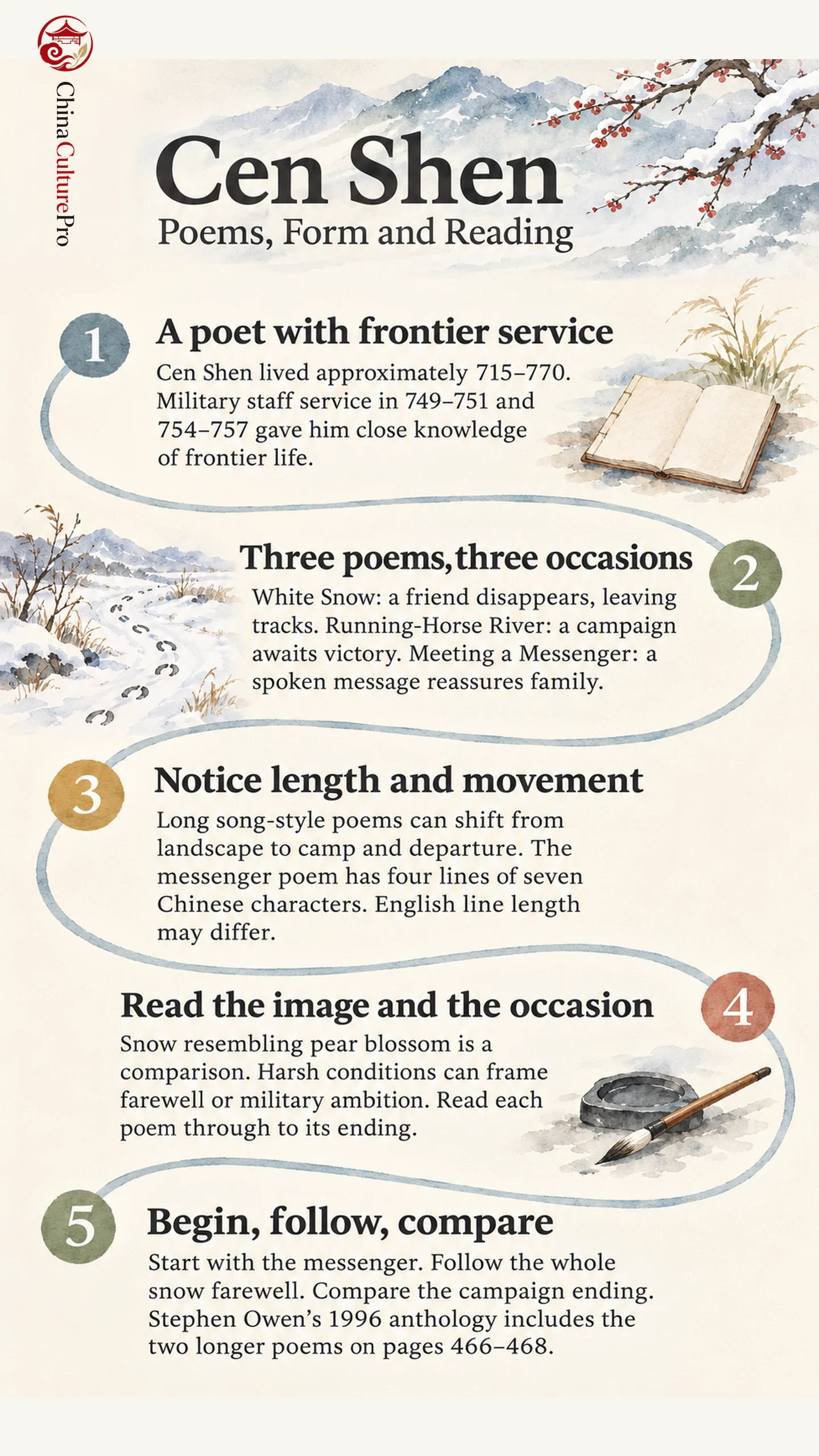
Cen passed the imperial examination in 744 and later served on military staffs in the northwest. His two periods of frontier service fell in 749–751 and 754–757, connecting his writing with the Anxi and Beiting commands. These appointments placed him within the working life of military headquarters. [2][7]
Within Tang poetry, he is often paired with Gao Shi (高适, Gāo Shì), another major frontier poet. Read Gao Shi’s work as a related body of writing with its own situations and voices. [2]
Cen’s later appointment as prefect of Jiazhou gave rise to the name Cen Jiazhou (岑嘉州, Cén Jiāzhōu). This is an official-place association, rather than a second poet. [1]
Three Poems and What to Notice
- Song of White Snow: The fuller title is Song of White Snow Sending Off Official Wu on His Return to the Capital (白雪歌送武判官归京, Báixuě Gē Sòng Wǔ Pànguān Guī Jīng). Snow-covered trees suggest pear blossom, but the cold also makes clothes inadequate and military equipment difficult to use. A farewell gathering brings wine and music into the scene. The friend disappears around the mountain road, leaving tracks in snow. Follow the change from startling landscape to the trace of an absence. [3]
- Song of Running-Horse River: This campaign farewell is also titled Song of Running-Horse River Sending Off General Feng on a Western Expedition (走马川行奉送封大夫出师西征, Zǒumǎ Chuān Xíng Fèng Sòng Fēng Dàfū Chū Shī Xī Zhēng). Wind drives stones across the ground; soldiers move at night, and water freezes in the inkstone where a military document is being drafted. Its final movement imagines the enemy frightened and awaits news of victory. That expected triumph is part of the poem’s encouragement to the departing force, rather than a reported result. [4]
- On Meeting a Messenger to the Capital: This brief poem (逢入京使, Féng Rù Jīng Shǐ) begins with the speaker looking east toward his distant home, his sleeves wet with tears. An encounter on horseback offers a chance to send word, but there is no paper or brush. He asks the other traveller to carry a spoken message that he is safe. The force comes from that practical request after the visible signs of distress: feeling and reassurance occupy the same moment. [5]
Long Songs and a Short Quatrain
Cen was particularly accomplished in seven-character song-style poetry, or gexing (歌行, gēxíng). The longer works give him room to move between landscape, bodies, camp life and a departure. Their titles identify occasions as well as subjects: a snow poem is also a farewell, while a river poem sends off a campaign. [2][7]
On Meeting a Messenger to the Capital is a seven-character quatrain, or jueju (绝句, juéjù): four lines of seven Chinese characters each. The tight space makes the turn from tears to an oral message especially decisive. In English, count the movement of the thought before expecting a translation to reproduce Chinese line length or sound. [5]
The guide to Chinese regulated verse explains how such formal patterns work. A translated line’s number of English words is a different matter from the original’s character count.
Reading Landscape, Farewell and Military Ambition
The landscape does emotional work. White Snow moves toward the loss of a companion; Running-Horse River makes harsh conditions a measure of the army’s determination. The same cold environment can serve different situations and endings. [3][4]
Military experience supplies context, but vivid detail need not mean literal reportage. Hyperbole and unexpected comparisons are part of the poetry’s energy. A frozen camp and blossoming snow can belong to the same imaginative treatment of the frontier. [6]
Historical names also require care. Tang poets could borrow Han-dynasty language for their own imperial world, a use of literary allusion. Read the campaign poem within its Tang-dynasty setting, rather than relocating it to the Han merely because the poem invokes that earlier dynasty. [7]
A Reading Order and an English Starting Point
- Begin with the messenger: Read the four-line encounter and mark the change from visible distress to the request for reassurance. [5]
- Follow the whole snow farewell: Trace the movement from trees and cold to the departing friend and the tracks left behind. [3]
- Compare the campaign ending: Notice how the expectation of victory differs from the snow poem’s disappearance and the messenger poem’s spoken request. [4]
For English versions of the two longer poems, Stephen Owen’s An Anthology of Chinese Literature: Beginnings to 1911, published by W. W. Norton in 1996, includes White Snow on pages 466–467 and Running Horse River on pages 467–468. This is a selection within a broad anthology, rather than Cen’s complete collected poems. Its neighbouring discussion of Du Fu also opens a comparison between different perspectives on frontier warfare. [6]
FAQs About Cen Shen
Are the pear blossoms in Song of White Snow real flowers?
They are the comparison through which snow on the trees suddenly resembles spring blossom. The poem continues to describe severe cold, rather than an actual change of season. [3]
Why is Cen Shen also called Cen Jiazhou?
He served as prefect of Jiazhou. The name associates the poet with that official post; it does not identify a different writer. [1]
Does every frontier poem celebrate victory?
Their occasions differ: anticipated success in Running-Horse River, farewell in White Snow and reassurance in the messenger poem. [3][4][5]
Sources
[1] Ministry of Education, Taiwan. Revised Mandarin Chinese Dictionary: Cen Shen
[2] Nanyang Municipal People’s Government. Cen Shen
[3] Cen Shen, Chinese text hosted by Wikisource. Song of White Snow Sending Off Official Wu on His Return to the Capital
[4] Cen Shen, Chinese text hosted by Wikisource. Song of Running-Horse River: Campaign Farewell
[5] Cen Shen, Chinese text hosted by Wikisource. On Meeting a Messenger to the Capital
[6] Stephen Owen, editor and translator. An Anthology of Chinese Literature: Beginnings to 1911, Selected Pages 466–468
[7] Guangdong Research Institute of Culture and History. Cen Shen: When the Tianshan Mountains Are Full of Snow