


Quick Answer: Who Was Gao Shi?
Gao Shi (高适, Gāo Shì) was an eighth-century Tang poet and official, known especially for frontier writing and poems of parting. He died in 765. His poems bring courage, unequal conditions, friendship and separation into view. [1]
- Begin with the famous farewell quatrain for its turn from bleak weather to encouragement.
- Read the long frontier song for changes of viewpoint between commanders, soldiers and people at home.
- Compare a demotion farewell and a flute poem to hear other kinds of distance.
The range matters: public service, personal affection and criticism of leadership can all enter this poetry.
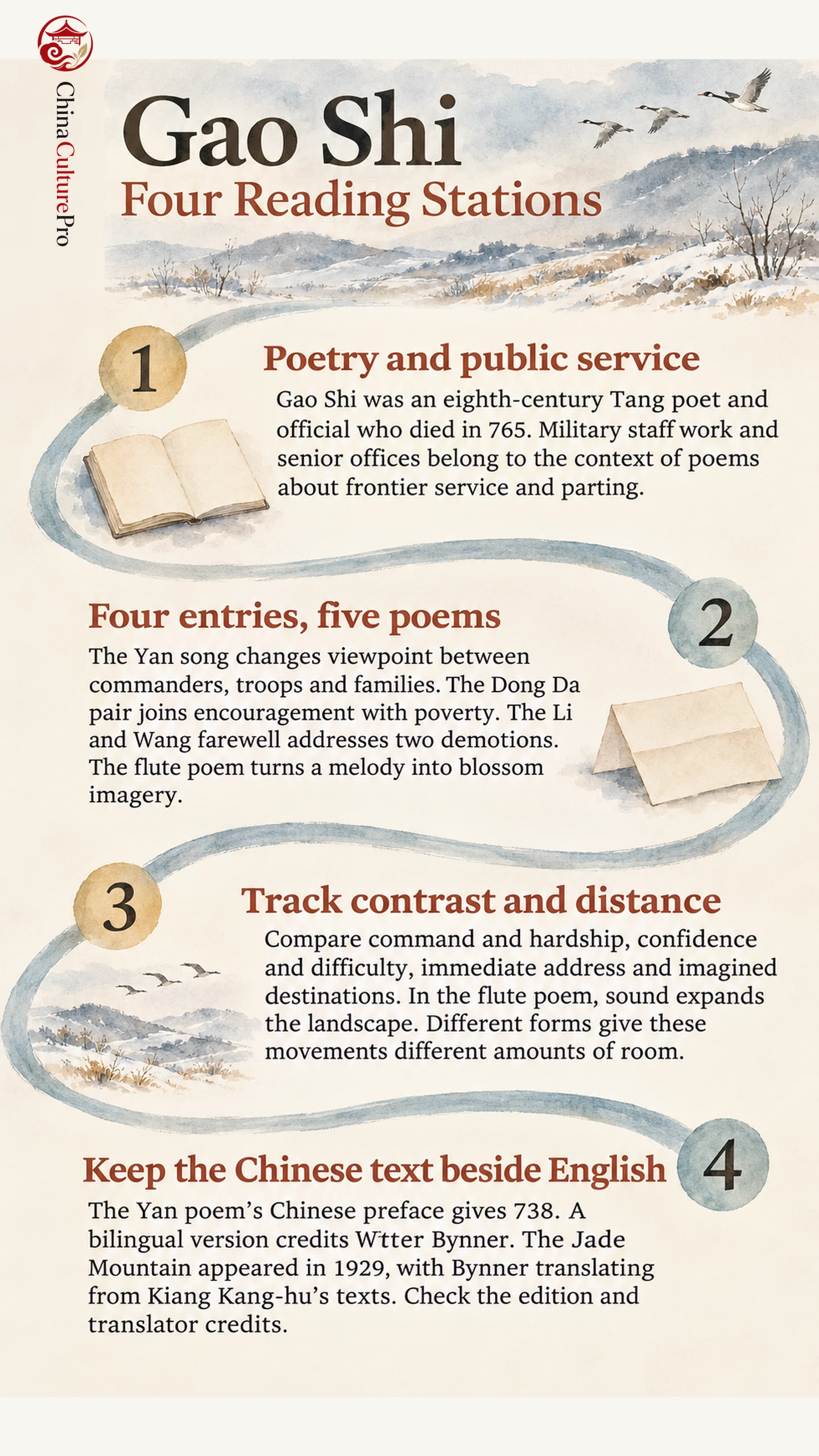
Gao Shi’s poems can move from marching troops to a commander’s tent, or from falling snow to words meant to sustain a friend. Their force often comes from the relationship between scenes. A few carefully chosen poems show how landscape, social position and the person addressed change what a poem asks us to feel.
A Tang Poet with an Official Career
Gao’s life belongs to the eighth-century Tang dynasty. Born near the beginning of the century, he served on military staff and later held senior regional and court offices. His writing therefore connects literary ambition with the world of government and military command. [1]
He is often studied alongside Cen Shen (岑参, Cén Shēn), another major poet associated with frontier life. The shared setting provides a starting point for comparing their poetry. [1]
Four Entries into Gao Shi’s Poems
- A Song of the Yan Country: This poem (燕歌行, Yān Gē Xíng) uses the extended song-style gexing (歌行, gēxíng) form. Its Chinese preface dates the occasion to 738 and says that Gao responded to a poem shown by someone returning from the frontier. The poem contrasts soldiers’ suffering with entertainment in the commander’s tent, then brings separated wives and soldiers into view. Respect for endurance accompanies scrutiny of the leadership responsible for it. Follow how each change of scene reshapes the account of service. [2]
- Farewell to Dong Da: This pair (别董大, Bié Dǒng Dà) contains two four-line poems. The first sets yellow clouds, a dim sun, north wind, geese and snow against an assurance that the departing friend will find recognition. Its turn is an act of encouragement. The second mentions years away and a meeting without money for wine. Read together, they place confidence beside material difficulty; the familiar first poem is only part of the encounter. [3]
- Farewell to Li and Wang on Their Demotion: This poem (送李少府贬峡中王少府贬长沙, Sòng Lǐ Shàofǔ Biǎn Xiázhōng Wáng Shàofǔ Biǎn Chángshā) addresses two departing officials in eight seven-character lines. A halted horse and farewell cup open into imagined destinations: gibbons in the gorge, geese associated with letters and distant autumn landscapes. The closing reassurance invokes imperial favour. Notice how the poem holds the two men’s different journeys within one act of consolation. [4]
- Hearing a Flute at the Frontier: In the collected version of this poem (塞上听吹笛, Sàishàng Tīng Chuīdí), snow, returning horses, moonlight and a garrison establish the setting. The last lines let music fill the passes like falling blossoms, playing on the tune Falling Plum Blossoms (梅花落, Méihuā Luò). Sound opens an imagined landscape within the physical one. Read the title and wording beside the edition being used, because both vary in transmission. [5][6]
Contrast, Distance and Different Kinds of Farewell
The frontier song changes viewpoint to make unequal conditions visible. A commander’s privilege and a soldier’s exposure belong to the same military world, yet their juxtaposition changes how that world is judged. The distant household adds another measure of what service costs. [2]
The two farewell settings also differ. The snowy quatrain answers an immediate friend’s anxiety with confidence. The demotion poem imagines places its recipients will inhabit and draws them into a shared farewell. Distance becomes social and emotional as well as geographical. [3][4]
The flute poem makes a different movement: a melody is heard across the frontier, while the tune’s blossom imagery expands what the listener can imagine. It is a useful example of how musical culture can shape a poem’s language. [5][6]
English Reading and the Value of the Chinese Text
An accessible bilingual version of the frontier song credits its English text to Witter Bynner. Keep the Chinese preface beside the translation: its twenty-sixth year of the era gives 738, although the displayed English says “sixth.” This is a concrete reason to check dates against the original. [1]
The Jade Mountain, published by Knopf in 1929, identifies Bynner’s English translations as based on the texts of Kiang Kang-hu. It is a multi-poet anthology. The translator and collaborator credits help identify an edition when older spellings of poets’ names differ from modern romanization. [7][8]
When reading these poems as an introduction to Chinese poetry, compare the longer song, the four-line poems and the eight-line farewell. Their different lengths give scenes and turns different amounts of room.
FAQs About Gao Shi
Was the frontier song an eyewitness battle report?
Its preface describes a response to a poem brought back by another traveller. That occasion supports reading it as a crafted engagement with frontier service; it does not make every scene Gao’s personal eyewitness testimony. [2]
Why does a Tang poem refer to Han armies?
Tang poets could use the earlier dynasty’s names and historical language to discuss their own times. Those references belong to a literary convention and should be read alongside the poem’s Tang context. [2]
Why do editions give the flute poem different titles?
The poem survives with different titles and readings in older collections. Matching the opening lines and the edition helps identify the text more securely than an English title alone. The version discussed here is found in Gao’s collected poems. [5][6]
Sources
[1] Chinese Classical Literature. A Song of the Yan Country: Text, Bynner Translation and Author Profile
[2] High School Chinese teaching materials. A Song of the Yan Country: Chinese Text, Preface and Notes
[3] Gao Shi, Chinese text hosted by Wikisource. Farewell to Dong Da: Two Poems
[4] Gao Shi, Chinese text hosted by Wikisource. Farewell to Li and Wang on Their Demotion
[5] Gao Shi, collected edition hosted by Wikisource. Collected Poems, Volume Eight: Hearing a Flute at the Frontier
[6] Web Kanbun Taikei. Hearing a Flute at the Frontier: Text, Tune Allusions and Edition Variants
[7] Smithsonian Libraries. The Jade Mountain: Translator and Text Credits
[8] OCLC WorldCat. The Jade Mountain: Knopf, 1929