

Quick Answer: Who Is Can Xue?
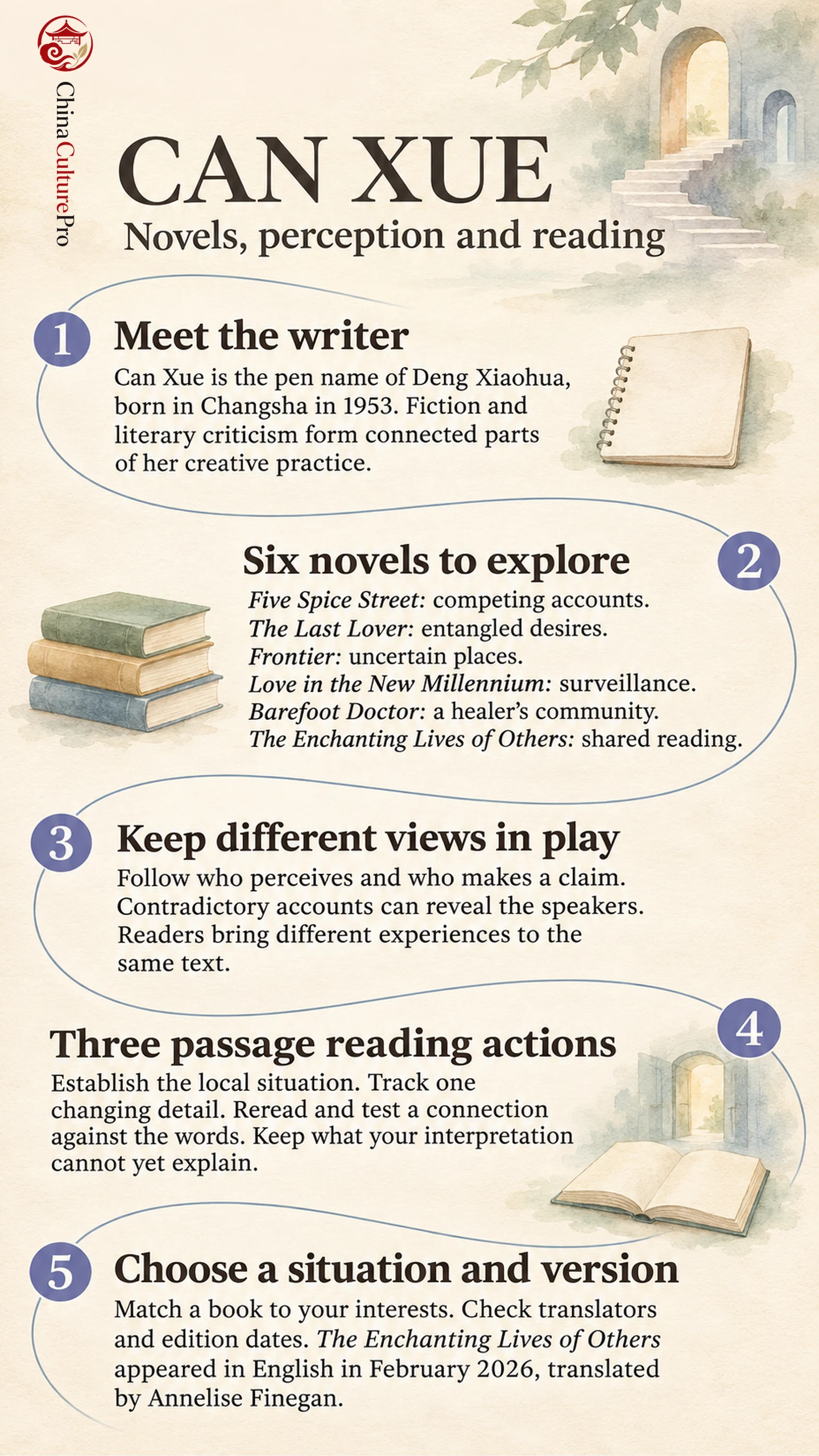
Can Xue (残雪, Cán Xuě) is the pen name of Deng Xiaohua (邓小华, Dèng Xiǎohuá), a Chinese fiction writer and literary critic born in Changsha in 1953. [1] Her experimental fiction asks readers to follow shifting perceptions, desires and relationships beyond familiar realistic plotting.
- For conflicting accounts: Try Five Spice Street (五香街, Wǔxiāng Jiē), where neighbours’ stories about a mysterious woman compete.
- For a changing fictional place: Try Frontier (边疆, Biānjiāng), centred on life in the unsettling world of Pebble Town.
- For reading as a subject: Try The Enchanting Lives of Others (激情世界, Jīqíng Shìjiè), whose English edition appeared in 2026.
These are interest-based starting points. A plot summary can orient you, while rereading a scene reveals connections that the summary cannot preserve.
A person enters a town; neighbours disagree about a woman; readers meet to discuss a book. Can Xue begins with recognizable situations and opens them into less stable experiences of space, knowledge and desire. This guide places six novels within contemporary Chinese literature, then gives you a concrete way to read a passage without expecting an answer key for every image.
A Writer of Fiction and Literary Criticism
Can Xue’s education was disrupted by family persecution and the Cultural Revolution. Largely self-taught, she developed an extensive reading life and became a writer of fiction and literary criticism, including studies of Kafka, Borges and other authors. [1] She treats criticism and fiction as connected forms of creative activity; an author’s explanation provides a possible reading, rather than a frame that every reader must accept. [9]
Biography gives context for approaching her place in Chinese literature. It does not settle the meaning of a particular room, animal or conversation. Begin with the relationships and perceptions a text creates, and bring a historical explanation to a passage only when the evidence makes that connection useful.
Six Novels and Their Different Points of Entry
Each novel gives the reader a different central situation to follow. This selection introduces major routes through the fiction, rather than attempting a complete bibliography.
- Conflicting testimony: In Five Spice Street, neighbours circulate incompatible accounts of Madam X: even her age and the nature of her powers are disputed. Their attempts to explain her reveal the speakers’ own fantasies and prejudices. Ask who is making a claim and what that person gains from the version being told. [3]
- Entangled desires: The Last Lover (最后的情人, Zuìhòu de Qíngrén) follows husbands, wives and lovers whose relationships open into one another’s fantasies. Its setting is a fictional Western country. Read for how a pursuit changes a person’s world, rather than treating a character’s imagined journey as a straightforward itinerary. The English translation won the 2015 Best Translated Book Award for fiction. [4]
- A place with uncertain boundaries: Frontier follows a young woman beginning an independent life in Pebble Town, near Snow Mountain. Wolves and a garden available to certain people unsettle ordinary expectations of the town. Compare how different characters encounter a place, and notice what they can enter, perceive or understand. [5]
- Love under surveillance: Love in the New Millennium (新世纪爱情故事, Xīn Shìjì Àiqíng Gùshì) follows women moving through a world of informants, commerce, exploitation and elusive possibilities of escape. Love takes several changing forms within that world. Follow the pressures surrounding a relationship as well as the apparent romance. [6]
- A healer and a continuing vocation: Barefoot Doctor (赤脚医生, Chìjiǎo Yīshēng) centres on a village herbalist seeking a successor as younger people observe and imitate her work. The mountain and the boundaries between life and death grow increasingly mysterious. Read for how knowledge and responsibility pass between people within this fictional community. [7]
- Books entering everyday life: The Enchanting Lives of Others brings readers together at the Pigeon Book Club. Work, love, storytelling and shared reading become intertwined. Its 2026 English publication offers a further point of entry: ask how a character’s reading changes the experience of an ordinary day or a relationship. [8]
Desire, Perception and the Work of Reading
Can Xue describes emotions and desires as a central mystery in her fiction. In discussing the book-club novel, she also emphasizes that readers bring different experiences to the same text; their conversations can widen one another’s perspectives and expand its meaning. [2] That account makes the reader an active participant in building a connection.
Active reading still requires attention to details. In Five Spice Street, conflicting reports are themselves part of the situation. Choosing one report as a final authoritative biography would remove the very disagreements the novel asks you to encounter. [3] Keep the conflict visible long enough to consider what each account reveals about its teller.
The same practical distinction helps elsewhere. A strange event can change a relationship, make a desire visible or alter access to a place. Ask what changed in that scene before deciding what the event must symbolize. This preserves a text’s particular movement while leaving room for more than one supported interpretation.
How to Read a Scene without a Fixed Symbol Key
Choose a short passage that interests or unsettles you, then try three actions.
- Establish the local situation: Identify who is speaking or perceiving, where the exchange begins and what each person seems to want. Keep a report about an event separate from the event itself.
- Track one changing detail: Follow a room, an animal, a repeated phrase or a gesture through the passage. Note how the surrounding voice or relationship changes when the detail returns.
- Reread and test a connection: Return to the beginning with one possible interpretation. Identify the words that support it and the details it cannot yet explain. Revise the connection instead of forcing every feature into it.
You can repeat this with a second passage and compare your notes. The aim is a more attentive encounter with the writing, not a claim that uncertainty has disappeared.
English Editions and Choosing Where to Begin
Match your first choice to a situation you want to explore: neighbourhood rumours, a strange town, a healer’s community or readers whose books affect their lives. A shorter reading session can consist of one passage, even when the book itself is a substantial novel.
Five Spice Street, Frontier and Barefoot Doctor are translated by Karen Gernant and Chen Zeping, whose name also appears in Western order as Zeping Chen. [3][5][7] Check the actual credit and edition when comparing listings.
The Enchanting Lives of Others is translated by Annelise Finegan. Its hardcover and ebook editions were published on February 24, 2026. [8] An English edition’s date can differ from a Chinese publication or a later paperback reissue; use the date belonging to the version you are reading.
FAQs About Can Xue
Is Can Xue a pen name?
Yes. The author’s name is Deng Xiaohua; Can Xue is her literary pseudonym. [1]
Does experimental mean the details do not matter?
No. Follow the particular words, repeated details and changes in perception. An open interpretation should still answer to the evidence of the passage.
Which novel won the 2015 Best Translated Book Award?
The Last Lover won the fiction award in 2015. It is a different novel from Love in the New Millennium. [4]
Sources
[1] MIT, Contemporary Chinese Writers project. Can Xue: Biography
[2] Yale University Press. The Enchanting Lives of Others: A Conversation with Can Xue
[3] Yale University Press. Five Spice Street
[4] Yale University Press. The Last Lover
[5] Open Letter. Frontier
[6] Yale University Press. Love in the New Millennium
[7] Yale University Press. Barefoot Doctor
[8] Yale University Press. The Enchanting Lives of Others
[9] MIT, Contemporary Chinese Writers project. Can Xue: Questions and Answers on Writing and Reading