


Quick Answer: What Are Sanfu Days?
Sanfu (三伏, Sānfú) is a traditional Chinese midsummer period lasting thirty or forty days. Its name groups three successive phases associated with the hottest part of the year. [3]
- Chufu (初伏, Chūfú): The first phase lasts ten days.
- Zhongfu (中伏, Zhōngfú): The middle phase lasts ten or twenty days.
- Mofu (末伏, Mòfú): The final phase lasts ten days.
Dates follow Geng days (庚, Gēng), not fixed lunar dates. Sanfu is not one of the twenty-four solar terms (节气, jiéqì), and its length does not predict how long a heatwave will last. [1][5]
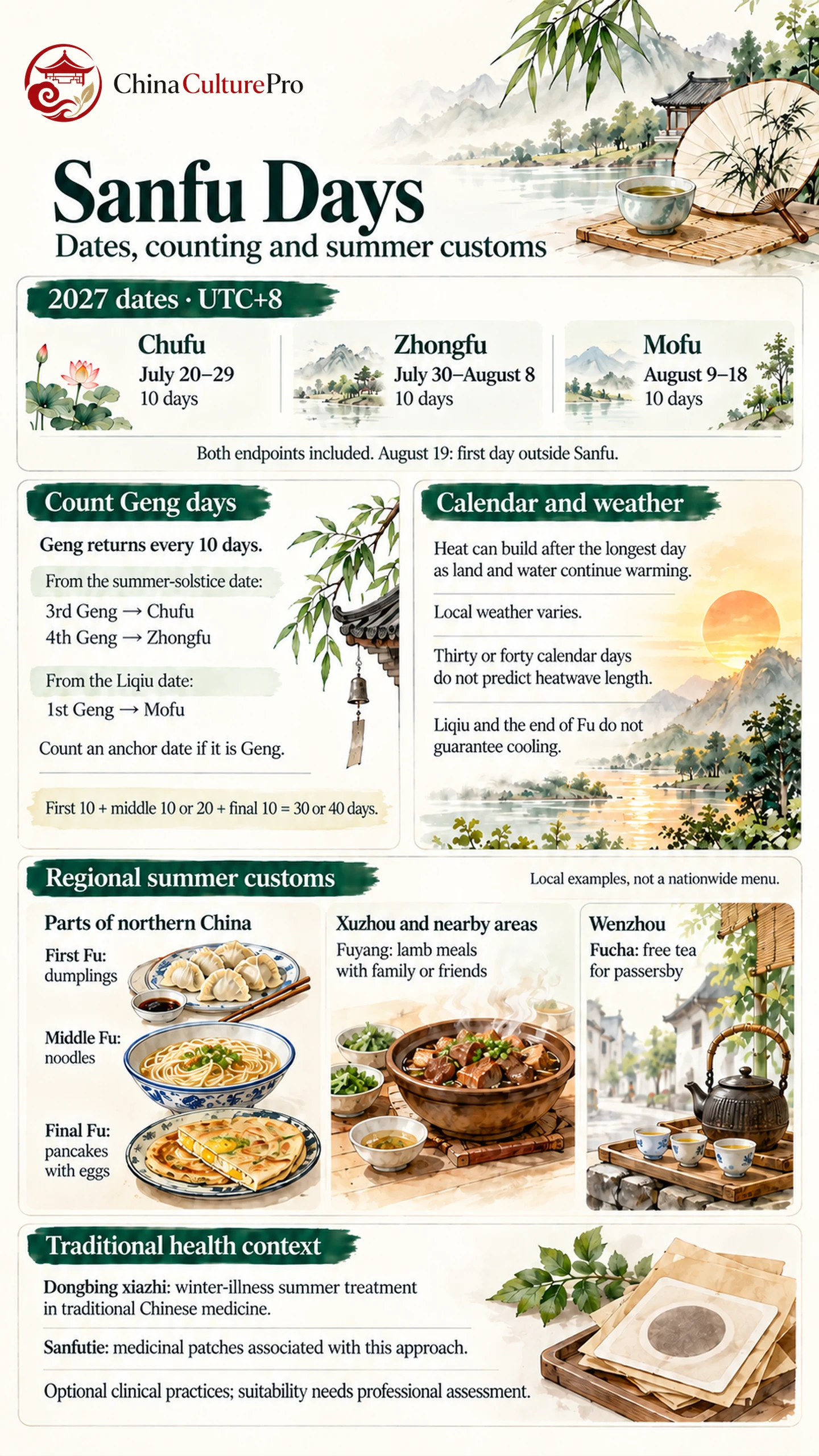
Why can China’s “hottest period” last forty days, and why does peak heat often arrive after the longest day? Sanfu (三伏, Sānfú) connects traditional date counting with summer food and community customs. Understanding it starts with separating a calendar period from a weather forecast; the broader framework appears in our Chinese lunar calendar guide.
When Are Sanfu Days in 2027?
In 2027, Sanfu runs from July 20 through August 18, a total of thirty days. The following Gregorian date ranges use UTC+8 and include both the first and last day of each phase. [2]
| Phase | Gregorian dates in 2027, UTC+8 | Length |
|---|---|---|
| Chufu: first phase | July 20–July 29 | 10 days |
| Zhongfu: middle phase | July 30–August 8 | 10 days |
| Mofu: final phase | August 9–August 18 | 10 days |
August 18 is the last included day; August 19 is the first day outside Sanfu, commonly described as the day it ends. “Through August 18” and “out of Sanfu on August 19” describe the same boundary.
These ranges are derived by applying the traditional counting rules to the 2027 daily stem-branch entries and solar-term dates in the Hong Kong Observatory almanac. They are not a separately published official Sanfu table. These are calendar dates; local weather forecasts and community-event notices answer different questions. [2]
How Are Sanfu Days Calculated?
The two seasonal anchors are the summer solstice, Xiazhi (夏至, Xiàzhì), and Start of Autumn, Liqiu (立秋, Lìqiū). Their positions in the solar year are combined with a repeating daily sequence to locate the three phases. The calculation links a solar-year framework to a ten-day counting sequence. [1]
Geng is the seventh of the ten Heavenly Stems (天干, tiāngān). In Gan-Zhi (干支, gānzhī) day counting, stems and branches combine into a sixty-day cycle, but the stem Geng returns every ten days. Count every day carrying Geng, rather than waiting sixty days for an identical stem-branch pair to return. Our Heavenly Stems and Earthly Branches guide explains that larger system. [3]
- Locate Chufu: Starting with the summer-solstice calendar date, count to the third Geng day. That day begins the first phase.
- Locate Zhongfu: The fourth Geng day from the same starting point begins the middle phase, ten days later.
- Locate Mofu: Starting with the Liqiu calendar date, find the first Geng day. It begins the final phase, which lasts ten days. [3]
If an anchor date itself is a Geng day, include it in that count. This is calendar-day counting, not a countdown of hours from the precise solar-term instant. The difference matters when a source uses the shorthand “after the solstice.” [11]
For 2027, the summer solstice falls on June 21. The first three Geng dates from that point are June 30, July 10 and July 20, so July 20 starts Chufu. The fourth is July 30. Liqiu falls on August 8, followed by a Geng day on August 9, when Mofu begins. The intervening middle phase is consequently ten days. [2]
In a longer year, another ten days fit into the middle phase. For comparison, the 2026 middle phase runs from July 25 through August 13: twenty days, producing forty days overall. It remains one extended middle phase, not a fourth Fu. [4]
Why Sanfu Is Associated with Summer Heat
The summer solstice marks the Northern Hemisphere’s longest daylight period, but accumulated heat does not reach its maximum at that same moment. Land and water take time to warm. After the solstice, incoming energy can still exceed outgoing energy, allowing temperatures to continue rising even as daylight gradually shortens. This seasonal lag helps explain the association between Sanfu and midsummer heat. [1]
The calendar describes a broad seasonal expectation. Actual conditions depend on latitude, elevation, distance from the sea, rainfall and passing weather systems. Northern inland areas and southern coastal areas need not reach their hottest temperatures together. Nor does every part of China experience the same combination of heat and humidity. [5]
A forty-day Sanfu does not mean forty consecutive days above a particular temperature, and a thirty-day Sanfu does not guarantee a shorter hot summer. Likewise, crossing the Liqiu boundary or leaving Sanfu does not make the air cool immediately. Use Sanfu dates to understand a seasonal reference; use local forecasts to understand the weather on a particular day. [5]
Foods and Customs: Regional Examples
Sanfu food sayings describe particular communities, rather than a national menu. One northern saying links dumplings with the first phase, noodles with the second, and pancakes with eggs with the final phase. In that saying, the last “third Fu” means Mofu, not the whole thirty- or forty-day period. [6]
| Region or setting | Food or custom | What the practice marks |
|---|---|---|
| Beijing and parts of northern China | Dumplings in the first phase | A seasonal meal marking entry into Sanfu; making and sharing dumplings can also be a group activity. [6] |
| Parts of northern China | Noodles in the middle phase | The second food named in the three-phase saying, without prescribing one noodle recipe or serving style. [6] |
| Parts of northern China | Pancakes with eggs in the final phase | The final food pairing in the saying; it refers to pancakes accompanied by eggs, rather than one nationally standardized dish. [6] |
| Xuzhou, Jiangsu, and nearby areas | Fuyang (伏羊, fúyáng), eating lamb during Fu | Lamb dishes and gatherings with relatives or friends around the start of Sanfu. The Xuzhou custom entered the national intangible cultural heritage list in 2021. [7] |
| Wenzhou, Zhejiang | Fucha (伏茶, fúchá), free summer tea | Volunteers serve passersby at community tea points. Hongriting is a documented local example of this charitable practice. [8] |
The Wenzhou example extends seasonal hospitality beyond the family table. At Hongriting, residents and older volunteers began serving tea in the 1970s. They pooled small donations for a stove and kettle after seeing workers drink directly from the river. A 2022 account describes the service continuing through changes of location and generations of volunteers. This gives the custom a concrete community history without treating every modern tea station as an unchanged ancient institution. [8]
These examples explain local seasonal identity and hospitality. They neither require everyone to eat the same foods nor establish that lamb, noodles or a tea blend prevents illness.
Sanfu and Traditional Health Practices
Summer notices about Sanfu often mention dongbing xiazhi (冬病夏治, dōngbìng xiàzhì), a traditional Chinese medicine approach to treating conditions associated with winter during summer. Sanfutie (三伏贴, sānfútiē), the application of medicinal patches at selected points on the body, is one practice associated with this approach. The wider concept is not limited to patches. [9]
Within traditional theory, the choice of season is linked to ideas about summer yang energy. That is the practice’s traditional rationale, not proof that a calendar date guarantees a clinical benefit. Patches are not suitable for everyone, and their ingredients can irritate skin. Individual suitability requires assessment by a qualified clinician. [9]
These treatments are optional medical practices, not rituals required to observe Sanfu. Recognizing the terms in cultural reporting does not require following a treatment, choosing a formula or learning an application technique.
FAQs About Sanfu Days
Is Sanfu one of the 24 solar terms?
No. Sanfu is a three-phase period calculated using Geng days and two solar-term anchors. The twenty-four solar terms mark positions in the Sun’s annual cycle; Sanfu uses two of those markers to locate its phases. [1]
Does Sanfu always last forty days?
No. It lasts thirty or forty days. The first and final phases each last ten days; the middle phase has either ten or twenty. The 2027 sequence has thirty days, while the 2026 sequence has forty. [2][4]
Does Liqiu mark the end of Sanfu?
No. The first Geng day on or after the Liqiu calendar date starts the final ten-day phase. Sanfu can therefore continue beyond Start of Autumn. Neither that traditional seasonal name nor the eventual end of Sanfu guarantees an immediate drop in temperature. [3][5]
Why are Sanfu days called the dog days of summer?
“Dog days” is an English analogy for oppressive summer heat. Its Western history involves Sirius, the Dog Star, whereas Sanfu is calculated with Geng days. The expressions overlap in seasonal meaning but do not share a calendar rule or necessarily identical dates. [11][10]
Sources
[1] Hong Kong Observatory. “Cold in Sanjiu, Hot in Sanfu”
[2] Hong Kong Observatory. 2027 Astronomical Almanac
[3] Xinhua. Counting Geng Days from the Summer Solstice
[4] Shanghai Municipal Government. The Forty-Day Sanfu Period in 2026
[5] China National Radio, carrying a meteorologist interview. Understanding the Length of Sanfu
[6] Beijing Municipal Health Commission. A Community Dumpling-Making Activity at the Start of Fu
[7] China Intangible Cultural Heritage Network. Xuzhou Fuyang Food Custom
[8] Wenzhou News. Hongriting: Half a Century of Charitable Service
[9] Zhejiang Provincial Hospital of Chinese Medicine, via the National Healthcare Security Administration. Winter-Illness Summer Treatment and Sanfu Patches
[10] NASA. What’s Up: July 2022
[11] Chinese Social Sciences Net. The Summer Solstice in Traditional Chinese Culture