

Quick Answer: What Is Zuo Zhuan?
Zuo Zhuan (左传, Zuǒzhuàn), also written Zuozhuan or translated as Zuo Tradition, is an early Chinese historical narrative closely associated with the Spring and Autumn Annals (春秋, Chūnqiū). Brief annal entries appear alongside much fuller narratives and speeches. [1]
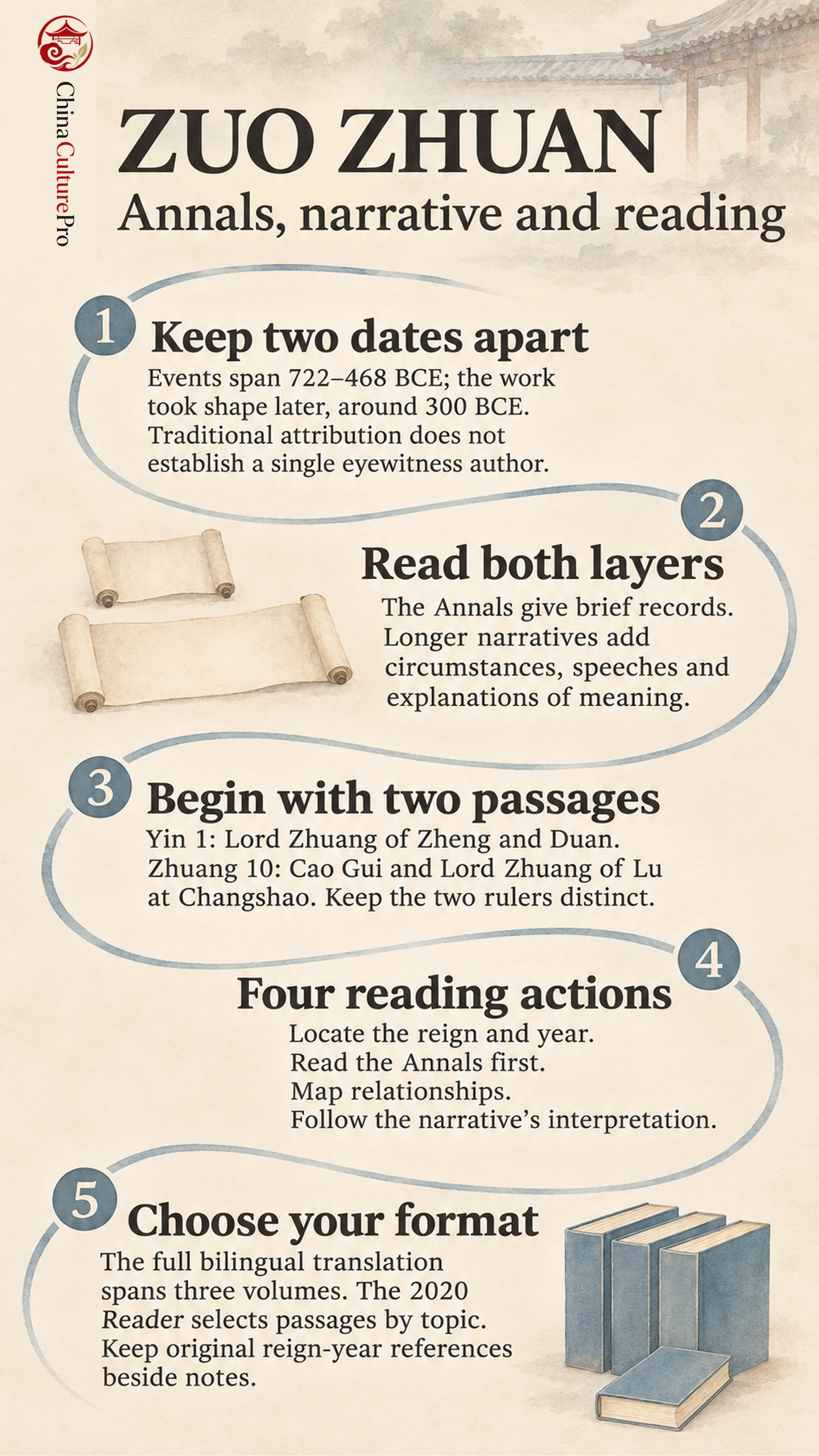
- Historical setting: The narrative recounts events from 722 to 468 BCE. [5]
- Reading focus: Family conflict, diplomacy, warfare, government and judgments about conduct.
- Useful starting point: Compare one short Annals entry with the longer account attached to it.
Keep the date of an event separate from the later formation of the text, and reported speeches separate from verified transcripts.
A short record can report who defeated whom. A longer narrative can ask how a family quarrel became a political crisis, which warnings were ignored, and why an action deserved criticism. That movement between record and interpretation gives Zuo Zhuan its distinctive place in Chinese historical literature. Read the two layers together before extracting a memorable speech or maxim.
Dates, Authorship and Historical Distance
The events belong to the Spring and Autumn period within the wider Zhou world. The received work took shape much later, around 300 BCE. [1][5] A narrative may therefore preserve older material while also showing the concerns of later transmitters and compilers.
Traditional accounts connect the work with Zuo Qiuming (左丘明, Zuǒ Qiūmíng) and the teachings of Confucius (孔子, Kǒngzǐ). Modern scholarship treats the single-author account cautiously; the text reflects a longer process involving different sources and interpretive traditions. [2] This historical distance matters whenever a vivid speech seems to offer direct access to an ancient speaker’s mind.
The Annals and the Larger Narrative
The Annals give a compressed record organized by the reigns of Lu’s rulers. Zuo Zhuan supplies narrative circumstances, speeches and explanations that help readers interpret those records. Its relationship to the Annals includes questions about wording and moral significance, as well as expanded accounts of events. [2]
The added narrative can redistribute attention. A brief entry might name a victorious ruler and a defeated opponent; the longer account can place relatives, advisers and earlier decisions beside that result. Ask what the expansion makes visible. Does it explain a cause, expose an ignored warning, complicate a judgment, or account for an unusual expression in the record?
This is also why the boundary between historical evidence and traditional narrative needs care. Literary construction is itself worth studying, while a claim about what actually happened may require comparison with other evidence.
Two Passages with Different Questions
Use the reign and year labels below to locate these accounts across editions. They offer different reasons to read beyond the bare event.
- Yin 1: Lord Zhuang of Zheng (郑庄公, Zhèng Zhuānggōng) confronts the growing power of his younger brother Duan. The narrative follows family favouritism, warnings and the ruler’s delayed response before Duan’s defeat and flight. It reads the verb for overcoming as a contest between rival rulers and the Zheng ruler’s designation as criticism of his failed guidance. Read for how responsibility is distributed, rather than treating the military winner as automatically vindicated. [3]
- Zhuang 10: Cao Gui (曹刿, Cáo Guì) questions Lord Zhuang of Lu (鲁庄公, Lǔ Zhuānggōng) before the battle at Changshao, connecting the ruler’s conduct in judging disputes with the possibility of support. He then delays the attack and checks signs of the enemy’s disorder before pursuit. Read the battle explanation alongside the earlier questions about government; the drum passage is only one part of the argument. [4]
The two rulers called Lord Zhuang belong to different states. Keeping Zheng and Lu beside their names prevents a common beginner’s confusion. For phrases later used as idioms, retain the original narrative setting as well as the modern meaning.
How to Read Across the Two Layers
Choose a complete episode with notes available, then work through four actions.
- Locate the reign and year: Identify the ruler of Lu used as the dating reference. Check the edition’s calendar or chronology before treating a year label as a modern chapter number.
- Read the Annals first: Summarize its brief record in one sentence. Mark which people, actions and results are named, leaving open the causes the entry does not explain.
- Map the relationships: In the longer account, identify the states, kinship ties and official roles. Keep speakers separate even when they share a title or have similar translated names.
- Follow interpretation: Compare reported speeches, narrative outcomes and any explicit judgment or explanation of wording. Note where the longer account changes your understanding of the short entry, and which claim still needs checking.
A small relationship sketch can be more useful than memorizing every name at once. Add only people necessary to explain the episode’s choices; expand the sketch when another passage makes a relationship important.
Choosing an English Edition
Stephen Durrant, Wai-yee Li and David Schaberg offer two useful formats for different reading tasks.
- Chronological study: Zuo Tradition / Zuozhuan: Commentary on the Spring and Autumn Annals is an unabridged bilingual translation in three volumes, with an introduction and annotations. [1][5]
- Selected reading: The Zuo Tradition / Zuozhuan Reader, published in 2020, arranges passages by topic and supplies introductions and notes. It is a selection drawn from the larger translation. [5]
Choose the full edition when following a reign or comparing adjacent years. The Reader suits an initial exploration of subjects such as succession, warfare or governance. Keep the original reign-year reference with any passage you note, so you can return from a thematic selection to its chronological setting.
FAQs About Zuo Zhuan
Is Zuo Qiuming the securely established author?
No. The attribution is part of the work’s traditional history. Its formation is more complex than a confidently identified single author writing down all the events. [2]
Are Zuo Zhuan and the Spring and Autumn Annals identical?
No. The Annals are the brief chronicle; Zuo Zhuan adds narrative and interpretation. Their close association does not erase the distinction between the two. [1]
Does the Zuo Tradition Reader contain the whole text?
No. It organizes selected passages by topic. The separate three-volume bilingual edition provides the unabridged translation. [5]
Sources
[1] University of Washington Press. Zuo Tradition / Zuozhuan: Commentary on the Spring and Autumn Annals
[2] Stephen Durrant, Wai-yee Li and David Schaberg. Zuo Tradition: Introductory Preview and Volume Contents
[3] Zuo Zhuan, classical passage quoted in Gujin Tushu Jicheng, Shidian Guji. Yin One: Lord Zhuang of Zheng and Duan
[4] Zuo Zhuan, classical Chinese text reproduced on Wikisource. Lord Zhuang of Lu, Year Ten: Annals and Narrative
[5] University of Washington Press. The Zuo Tradition / Zuozhuan Reader