


Quick Answer: What Is the Book of Documents?
The Book of Documents is known as Shangshu (尚书/尚書, shàngshū) and Shujing (书经/書經, shūjīng). It collects texts presented as speeches and other documents of early rule.[1][2][3][5]
- Political questions: Rulers and ministers explain decisions, demand cooperation and discuss legitimate authority.
- Textual questions: A chapter’s traditional setting and the history of its surviving text require separate attention.
- Reading method: Identify the speaker, audience and purpose before treating a speech as a factual record.[1][2][3][4]
The received collection is not a modern transcript archive or a continuous chronological narrative.
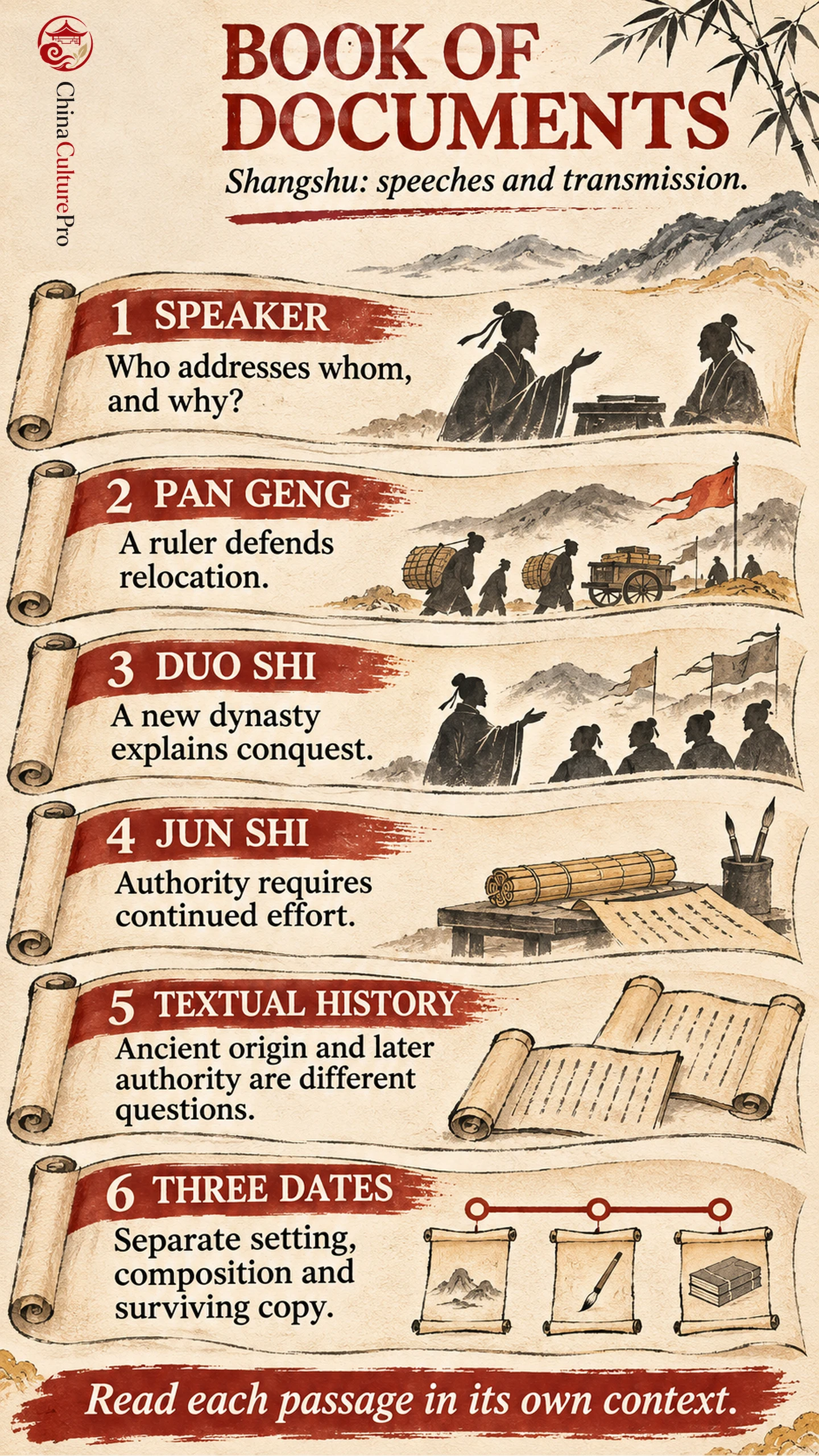
The challenge of the Shangshu is more than unfamiliar wording. Its speakers argue about why people should move, serve or accept a new ruling house. Reading those arguments closely provides a useful entry into the book without assuming that every transmitted chapter has the same history.
Read Speeches as Political Arguments
A royal speech has an audience and a task. In the first Pan Geng (盘庚/盤庚, pán gēng) section, relocation is contested. The ruler invokes earlier kings, the community’s survival and Heaven’s command while criticizing resistance. The speech gives readers a ruler’s justification for action; it does not give equal access to every opponent’s account.[1]
This makes the form important. A command can also persuade, threaten, defend and reinterpret the past. Instead of extracting only a slogan about good government, ask what response the speaker wants and which authorities make that response seem necessary.
Three Passages to Begin With
| Passage | Immediate situation | Question for a reader |
|---|---|---|
| Pan Geng, first section | The ruler defends relocating the community. | How does appeal to predecessors support a contested decision?[1] |
| Duo shi (多士, duō shì) | A Zhou proclamation addresses former Shang personnel. | How is conquest presented as something other than a small state’s ambition?[2] |
| Jun Shi (君奭, jūn shì) | The Duke of Zhou reflects on the new ruling house and earlier ministers. | Why is receiving Heaven’s command no guarantee of keeping it?[3] |
Duo shi explains dynastic change through the conduct of earlier rulers and Heaven’s withdrawal of support. Jun Shi, meanwhile, stresses uncertainty and the contribution of ministers. Read together, the passages make authority a problem requiring explanation and continued effort, rather than a possession that automatically lasts forever.[2][3]
This is a reading of the arguments in these passages. It should not be expanded into a claim that every chapter expresses one perfectly uniform political theory.
Authenticity and Canonical Authority Are Different Questions
The history of the collection includes disputes over chapters transmitted as Old Text material. Zhang Xun’s study of Qing scholarship distinguishes two questions: whether a text was genuinely ancient, and whether it should remain in the canon. Scholars could challenge a chapter’s provenance while still valuing its ideas. For readers, that distinction prevents a simple choice between treating every passage as early evidence and dismissing its entire later influence.[4]
Use an edition that explains the status of the chapter being read. “Authentic” also needs a stated meaning: ancient wording, an accurate report of an event, and acceptance by later scholars are different claims. A general label cannot answer all three.
What a Surviving Manuscript Can Show
Tokyo National Museum’s Guwen Shangshu, volume 6, is a surviving ink-on-paper scroll catalogued to the seventh-century Tang period. Its record describes later Japanese reading annotations in black and red ink. The object therefore documents copying, transmission and use across time and place. It does not turn its contents into an original manuscript written by the rulers whose words the collection presents.[5]
Keep three dates separate when possible: the event or speech setting, the formation of the wording, and the making of the particular copy. A catalogue date normally belongs to the object it describes.
A First Reading Route Through the Shangshu
- Begin with the first Pan Geng section; mark the relocation decision and the objections the ruler answers.
- Read Duo shi beside Jun Shi; compare their explanations of dynastic authority and its insecurity.
- Consult your edition’s textual notes, then record chapter title, translation and edition when quoting.
FAQs About the Book of Documents
Are Shangshu and Shujing Different Books?
They are established names for the Book of Documents. Editions may differ in contents and commentary, so an identical general title does not guarantee identical coverage.[4][5]
Is the Book a Continuous Narrative History?
No. Its speeches and documents require attention to individual occasions and voices. The three passages discussed here address different political situations.[1][2][3]
Does a Speech’s Setting Prove When It Was Written?
No. The represented occasion, composition and surviving copy are separate questions. Textual study and manuscript evidence help investigate them.[4][5]
Sources
[1] Chinese original. Shangshu: Pan Geng, first section
[2] Chinese original. Shangshu: Duo shi
[3] Chinese original. Shangshu: Jun Shi
[4] Zhang Xun. The Debates and Controversy around the Forged Old Text Chapters of the Shangshu among Qing Scholars
[5] Tokyo National Museum. Old-Script Document of Antiquities, volume 6, TB-1572