
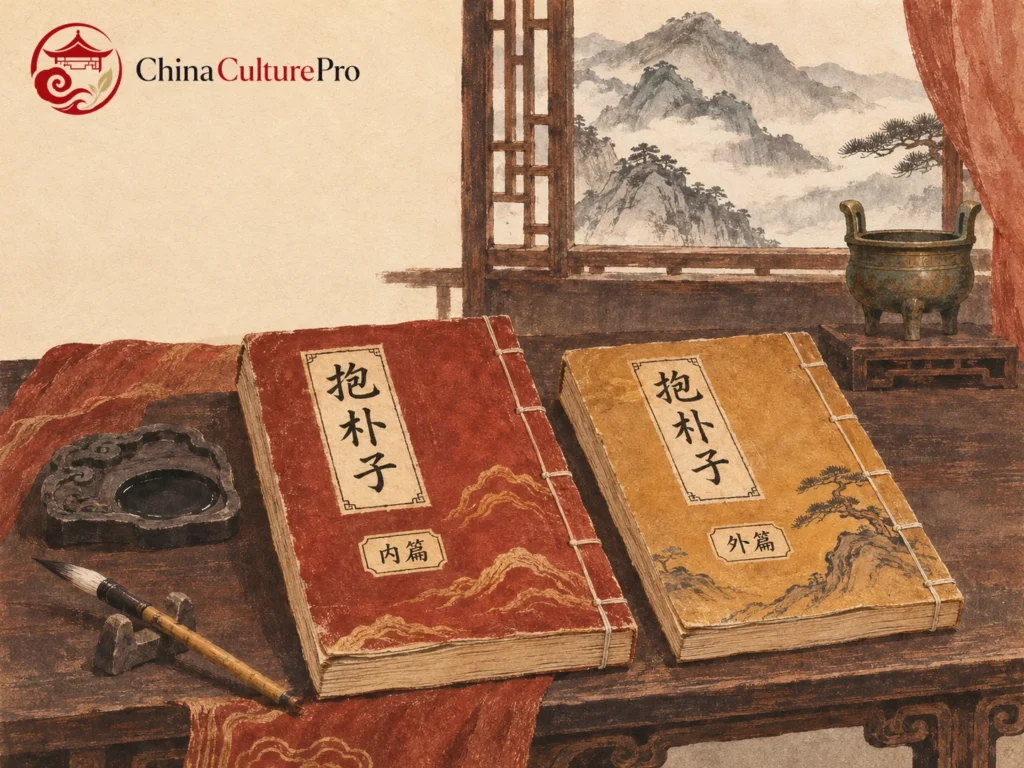

Quick Answer: What Is the Baopuzi?
The Baopuzi (抱朴子/抱樸子, bàopǔzǐ) is associated with the Jin-period writer Ge Hong (葛洪, gě hóng) and comprises two distinct collections.[1]
- Inner Chapters: The Inner Chapters (内篇/內篇, nèipiān) defend immortality practices and discuss religious knowledge.
- Outer Chapters: The Outer Chapters (外篇, wàipiān) address learning, conduct and social affairs.
- Reading approach: Compare their arguments rather than reducing the whole work to alchemical recipes.[1][2][4]
Its claims belong to a historical religious and intellectual setting; explaining them does not endorse their promised effects.

Why does one collection defend becoming an immortal while another insists on disciplined study? The Baopuzi lets readers examine both questions. Its discussions become clearer when read as arguments addressed to particular doubts and social problems, rather than as a single handbook.
Two Collections: Inner and Outer Chapters
Begin by checking which collection an edition contains. The Inner Chapters have a recognizable twenty-chapter sequence, including discussions of immortals, alchemy and religious texts. The Outer Chapters range across public and personal life. The later bibliographic preface reproduced with the Chinese text records disagreement among catalogues about their extent. Its table of contents lists fifty-two Outer Chapters; the preface also reports a self-description of fifty.[1]
| Collection | A useful starting passage | Reader’s question |
|---|---|---|
| Inner Chapters | Dui su (对俗/對俗, duì sú), chapter 3 | How does the author answer skepticism about immortality?[2] |
| Outer Chapters | Xu xue (勖学/勖學, xù xué), chapter 3 | Why must natural ability be developed through learning?[4] |
The labels help navigate the work. They should not replace attention to individual passages or imply that every edition presents an identical collection.
How the Inner Chapters Argue for Immortality
Dui su stages objections and replies. A questioner asks whether extraordinary longevity is an innate gift, like the durability attributed to certain trees and animals, rather than something humans can learn. The answering voice argues that human understanding makes deliberate cultivation possible. It also appeals to earlier records and reported practitioners. The passage is evidence of a debate and its persuasive strategies, not proof that the reported marvels occurred.[2]
Jindan (金丹, jīndān), Inner chapter 4, gives alchemy a privileged place. The narrator links access to specialized knowledge with teachers and transmission, yet also describes lacking resources to pursue it. His analogies connect the durability and transformations of materials with hoped-for changes to the body. Read these as the text’s reasoning within its historical framework, rather than established claims about human physiology.[3]
Learning and Social Life in the Outer Chapters
Xu xue makes learning a demanding practice. It compares developing understanding with crafts that require training: even work that seems simpler than moral and social judgment cannot be mastered without repetition. Natural ability remains unfinished without study. The chapter connects learning both with service in public life and with preserving oneself outside office.[4]
Paired with the Inner debate, this produces a useful reading question: what kinds of teacher, practice and evidence does each chapter recognize? This comparison does not require treating the two collections as either perfectly harmonious or wholly contradictory.
Ge Hong’s Self-Portrait and the Problem of Transmission
The self-account printed as Outer chapter 52 describes losing a father young, hardship, books destroyed in warfare, and the effort of borrowing and copying texts. These details present learning as material labor, not just an abstract virtue. They also remind readers that this is the authorial voice’s account of itself; it should be identified as such when used biographically.[5]
Do not use its chapter number to settle the work’s entire textual history. The bibliographic disagreements recorded in the preface show why edition, collection and chapter title should accompany a reference.[1]
A First Reading Route Through the Baopuzi
- Read Inner chapter 3 and mark the objections separately from the replies.
- Read Outer chapter 3 and compare its account of learning with the first chapter’s claims about learnable attainment.
- Consult the edition’s contents and notes before moving to the alchemical chapter or the self-account; record collection and title with every quotation.
FAQs About the Baopuzi
Is the Baopuzi Only a Book About Alchemy?
No. Alchemy is important within the Inner Chapters, while the Outer collection includes substantial discussions of learning and social conduct.[1][3][4]
Do Inner and Outer Chapters Mean Secret and Public Instructions?
The distinction describes two collections with different emphases. It is too simple to treat every Inner passage as a secret procedure or every Outer passage as a public instruction.[1][2][4]
Which English Edition Should I Choose?
Check whether it translates the Inner collection, the Outer collection, or selections. Prefer an edition that identifies chapter titles and explains textual variants; the title Baopuzi alone does not establish coverage.
Sources
[1] Older bibliographic preface and contents. Baopuzi: Chinese text index
[2] Ge Hong. Inner chapter 3: Dui su
[3] Ge Hong. Inner chapter 4: Jindan
[4] Ge Hong. Outer chapter 3: Xu xue
[5] Ge Hong. Outer chapter 52: self-account in the consulted edition