

Quick Answer: What Is the Classic of Filial Piety?
The Classic of Filial Piety, or Xiaojing (孝经/孝經, xiàojīng), is a Confucian text explaining xiao (孝, xiào), filial reverence, through family conduct and its wider social significance.[1][2]
- Form: A teaching dialogue frames the discussion.
- Scope: Care, respect, public conduct and government are connected.
- Important qualification: Chapter 15 argues that filial conduct can require remonstrance rather than simple obedience.[1][3]
Read the chapter on remonstrance alongside the opening; neither a slogan about obedience nor one about independence captures the whole work.
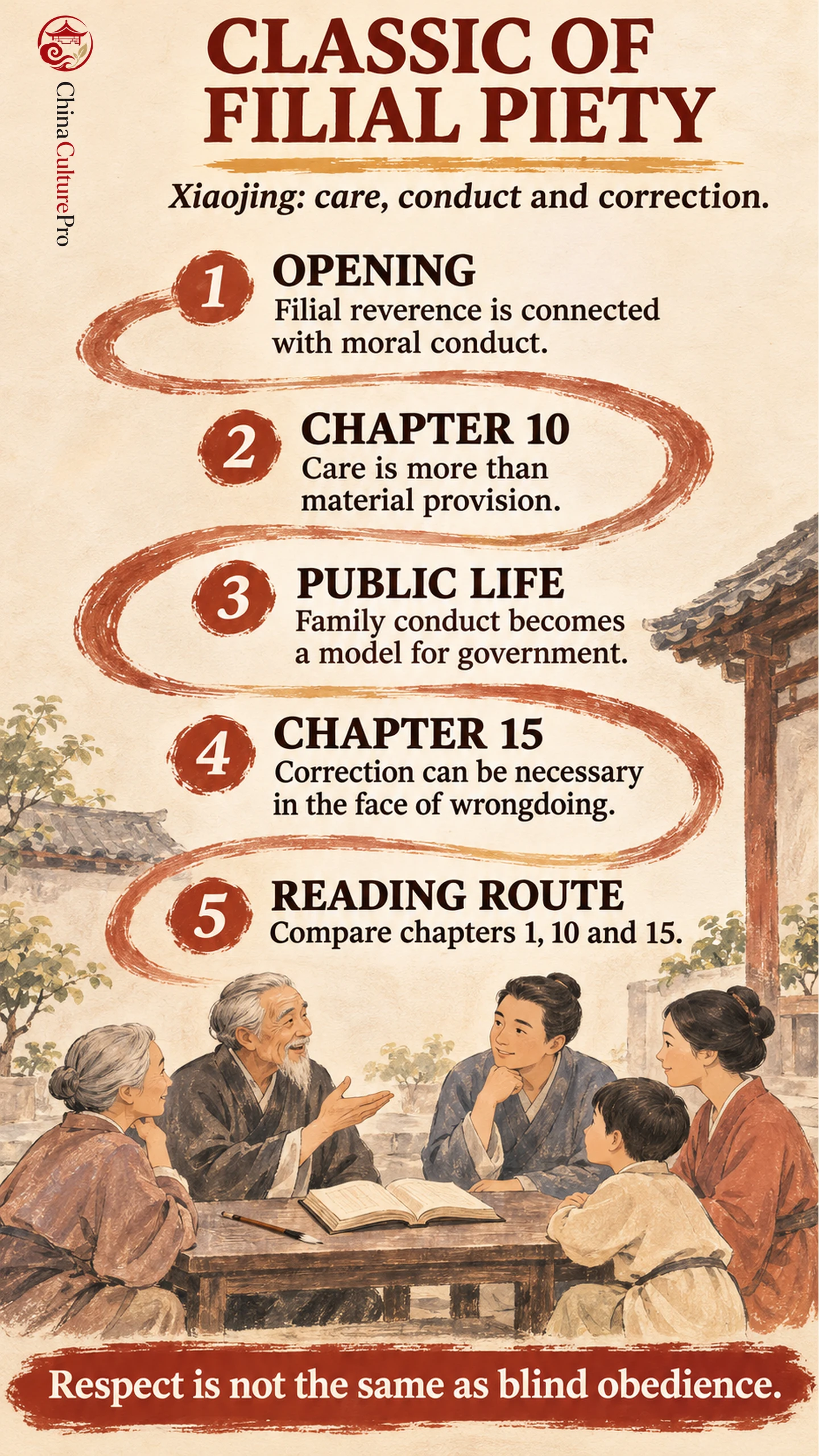
How can reverence for parents coexist with challenging a parent’s wrongdoing? The Xiaojing raises that question within its own discussion. Reading care, moral conduct and correction together offers a fuller introduction than treating filial piety as a synonym for submission.
Dialogue, Attribution and the Eighteen-Chapter Text
The consulted text has eighteen chapters and begins with Confucius (孔子, kǒngzǐ) speaking to Zengzi (曾子, zēngzǐ). That literary frame identifies the voices presented in the work; it does not prove that the surviving wording is a verbatim record of a historical conversation.[1]
Traditional attribution is another layer. The Ministry of Education’s dictionary records a tradition assigning the book to Zengzi’s disciples, as well as different textual and commentarial traditions. A speaker within a dialogue, a proposed author and a later commentator need not be the same person. Keep those roles separate when introducing the book.[2]
Filial Care in the Opening and Chapter 10
The opening calls filial reverence a foundation of virtue and moral teaching. It connects care for the body received from parents with conduct that brings honor to them. The account extends across a life rather than ending with the immediate act of providing something useful.[1]
Chapter 10 makes the range more concrete: respect in ordinary life, pleasure in supporting parents, concern in illness, grief in mourning and seriousness in sacrifice. It then rejects the idea that lavish material provision can compensate for serious failures of conduct. The passage therefore treats filial care as more than the quantity or expense of what is supplied.[1]
These are claims within a historical ethical text. They do not establish one uniform description of how every family lived, nor do they settle every question about obligations in contemporary families.
From Family Conduct to Political Order
The work repeatedly moves from family relationships toward public life. Chapter 2 connects a ruler’s love and respect for parents with conduct toward others. Chapter 14 describes qualities formed in the household as extending into service and office. Filiality is thus part of an account of government, not only a private family virtue.[1]
This extension deserves scrutiny. Ask what the text treats as analogous between family and political relationships, and what differences it leaves unexplored. Explaining its logic does not require accepting inherited rank or household authority as universal principles.
Chapter 15: Why Remonstrance Matters
Zengzi asks whether obeying a father’s commands can be called filial. The reply rejects that equation and draws comparisons with rulers who have correcting ministers, gentlemen who have correcting friends, and fathers who have correcting children. In the face of wrongdoing, correction is presented as necessary to avoid allowing another person to fall into unrighteous conduct.[1][3]
This is a substantial qualification of obedience. Yet it is not a declaration that the work rejects hierarchy altogether. Read the duty to remonstrate beside the text’s emphasis on respect and moral responsibility. The tension is part of the argument and should remain visible.
Later Copies and Commentaries
The National Palace Museum in Taipei catalogues a Qing-period calligraphic transcription of chapter 15, with its text reproduced in the object record. The work shows that the remonstrance chapter was copied as calligraphy in a later period. It is evidence of reception and transmission, not an original manuscript written by Confucius.[3]
In an annotated edition, distinguish the classical wording from explanations around it. A commentator can resolve an ambiguity, supply a historical interpretation or emphasize one aspect of filial conduct. Identify that contribution rather than silently merging it with the ancient dialogue.
A First Reading Route Through the Xiaojing
- Read chapter 1 and note how filial reverence connects the body, personal conduct and public life.
- Compare chapter 10’s account of care with chapter 15’s argument for remonstrance.
- Record your edition and chapter, separating the dialogue, commentary and your own interpretation.
For a broader comparison of conduct and ritual thought, the Book of Rites guide offers a different collection. Keep the texts distinct rather than assuming that every Confucian discussion has the same form or emphasis.
FAQs About the Classic of Filial Piety
Does the Xiaojing Demand Blind Obedience?
Chapter 15 explicitly challenges the equation of filial conduct with merely following a father’s commands and argues for correction in cases of wrongdoing.[1][3]
Is Filial Piety Only Material Support for Parents?
No. Chapter 10 also emphasizes respect, concern, grief and seriousness in different circumstances.[1]
Did Confucius Write the Surviving Book?
The dialogue’s use of Confucius as a speaker does not establish authorship. Traditional attribution and textual transmission are separate questions.[1][2]
Sources
[1] Chinese original. Xiaojing, eighteen-chapter text: chapters 1, 2, 10, 14 and 15
[2] Ministry of Education dictionary. Xiaojing: traditional attribution and textual traditions
[3] National Palace Museum, Taipei. Qing calligraphic transcription: chapter 15, Admonishing