

Quick Answer: What Is the Caigentan?
The Caigentan (菜根谭/菜根譚, càigēntán) is a Ming-period collection of short moral reflections associated with Hong Zicheng (洪自诚/洪自誠, hóng zìchéng).[1]
- Form: Brief entries use contrasts, images and compressed judgments.
- Themes: Integrity, ambition, simplicity and detachment recur.
- Reading approach: Read a whole entry, then compare it with another passage and your edition’s notes.[1][2]
Despite a title often rendered as “Vegetable Roots Discourses,” it is not a cookbook or a set of guaranteed formulas for success.

A memorable sentence can make the Caigentan look easy. Its difficulty often lies in the paired ideas around that sentence: strength without display, involvement without attachment, or quietness without lifeless withdrawal. Keeping those tensions visible makes a more rewarding reading than collecting slogans.
Author, Title and the Form of the Book
The name Hong Zicheng also appears alongside Hong Yingming (洪应明/洪應明, hóng yìngmíng) in Waseda University’s catalogue record. That record identifies a Former Collection (前集, qiánjí) and Latter Collection (后集/後集, hòují). These names are useful for navigating the two-part arrangement, rather than assuming that every modern edition groups the material in the same way.[3]
The Ministry of Education’s dictionary describes the work as drawing on Confucian, Buddhist and Daoist ideas, emphasizing character and reduced attachment to reputation and profit. The vegetable-root image belongs to a language of plain living and endurance. It should not be used to infer a dietary program.[1]
Three Passages That Reveal Its Method
The following examples refer to the Ming-edition section of the consulted Chinese text. They summarize the entries rather than reproduce a modern English translation.[2]
| Passage | Image or contrast | Question to consider |
|---|---|---|
| Former Collection, entry 5 | Unwelcome words become a whetstone for character. | Why might constant agreement be a poor measure of moral progress?[2] |
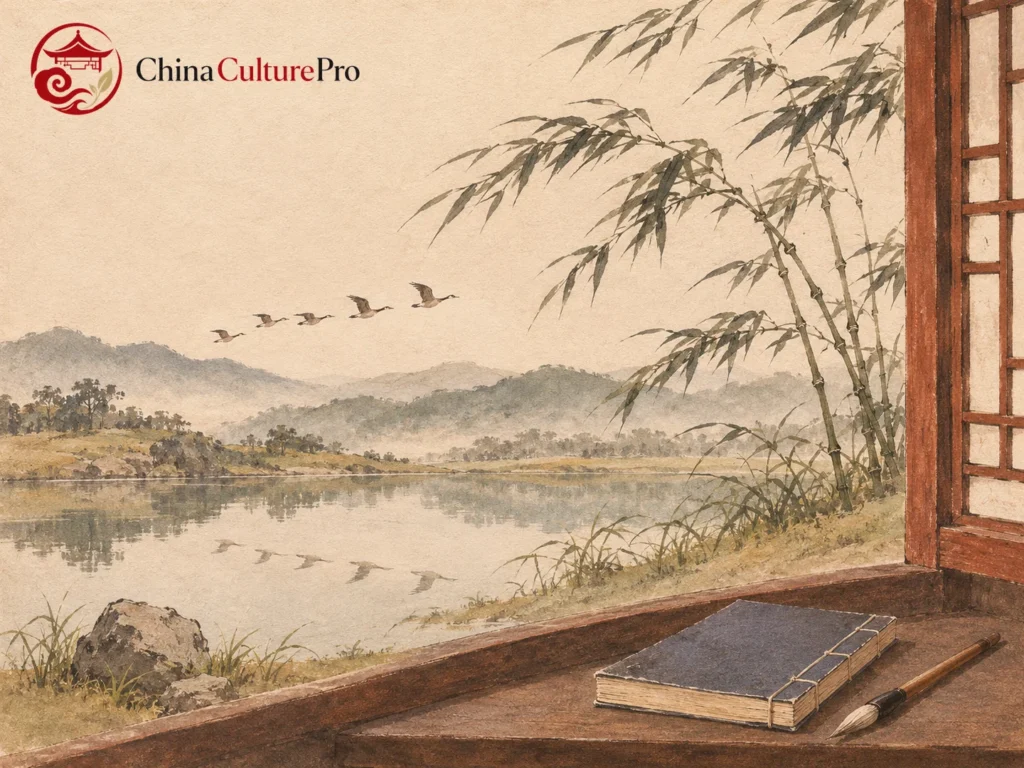
| Former Collection, entry 83 | Wind leaves no sound in bamboo; passing geese leave no lasting reflection in a pool. | How does the image distinguish responding to events from remaining attached afterward?[2] |
| Latter Collection, entry 5 | A small pool, modest stone or simple dwelling can contain the pleasure of landscape. | Does enjoyment require expensive possessions or distant scenery?[2] |
The entries make their points through images and reversals. A helpful first move is to state the contrast in plain language before deciding whether, or within what limits, you agree with it.
Engagement and Detachment Belong Together
The opening of the Former Collection prefers temporary isolation in keeping with moral principle to dependence on powerful people. The opening of the Latter Collection, however, warns that talking about mountains and forests does not prove genuine enjoyment of retreat, and criticizing fame does not prove freedom from its attractions. Withdrawal can itself become a pose.[2]
Read together, these passages ask about motives as well as appearances. The wind-and-bamboo image then offers a further distinction: meeting an event need not mean carrying its emotional residue indefinitely. This is an interpretation of the imagery, not evidence that the book supplies an infallible method for every difficult circumstance.
Likewise, the whetstone passage invites scrutiny of comfortable self-approval. It does not establish that every hostile remark is wise or that mistreatment should always be accepted.
Why Editions and Entry Numbers Matter
The consulted page presents both Ming- and Qing-edition arrangements. The former uses Former and Latter Collections, while the latter includes thematic groupings such as self-cultivation and social dealings. Number alone is therefore a fragile reference. Record the edition, section and opening words with a passage.[2]
An English selection may also rearrange entries by theme. Check whether its short headings belong to the source or were added by an editor; a modern heading can steer a reader toward an interpretation the aphorism leaves less settled.
A First Reading Route Through the Caigentan
- Choose one complete entry and identify both sides of its contrast.
- Compare it with a passage that seems to pull in another direction, such as integrity beside detachment.
- Note the edition and opening words, then write a limited interpretation that preserves the original image.
FAQs About the Caigentan
Is the Caigentan a Vegetarian Cookbook?
No. Its vegetable-root title introduces moral reflections and an image of plain living, not culinary instructions.[1][2]
Is It Exclusively a Buddhist Text?
No. The work draws on Confucian, Buddhist and Daoist ideas. Its passages should be read individually rather than assigned one exclusive label.[1]
Can I Identify a Passage by Its Number Alone?
Not reliably across editions. Include its section, edition and opening words, since arrangements and numbering differ.[2]
Sources
[1] Ministry of Education dictionary. Caigentan: title, form and intellectual influences
[2] Chinese originals. Caigentan: Ming- and Qing-edition arrangements
[3] Waseda University Library. Caigentan, Former and Latter Collections: catalogue record