


Quick Answer: What Is the Book of Rites?
The Book of Rites, or Liji (礼记/禮記, lǐjì), is a Confucian collection concerned with li (礼/禮, lǐ): ritual, patterned conduct and the ordering of relationships.[1][2]
- Scope: Its discussions extend from everyday behavior to teaching and social ideals.
- Form: It contains different chapters, voices and types of argument.
- Reading boundary: A prescribed rule is not automatically a report of universal practice.[2][3][4]
Read it as a historical collection of ritual thought, not an etiquette checklist for all Chinese people today.
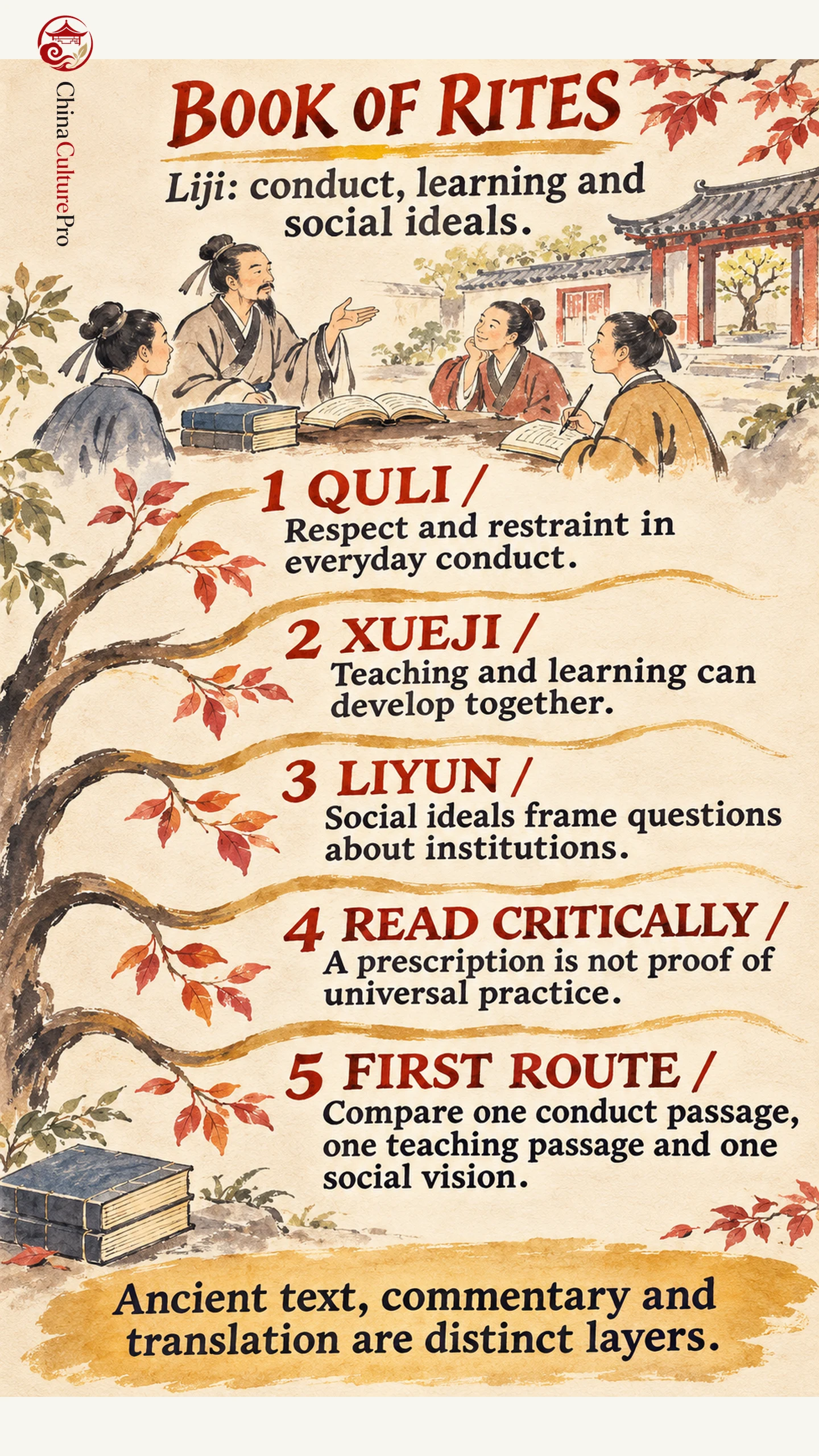
A passage about speaking respectfully and a discussion of teaching can seem far apart. In the Liji, both concern how people are formed through relationships and repeated actions. Three contrasting chapters offer a manageable way to explore that breadth.
A Collection of Ritual Thought, Not One Author’s Manual
The received forty-nine-chapter collection is traditionally associated with the Han scholar Dai Sheng (戴圣/戴聖, dài shèng). The Ministry of Education’s dictionary identifies it with records attributed broadly to Confucius’s disciples and later followers, and lists major commentators from subsequent periods. This traditional attribution should not become a claim that Dai Sheng personally composed every passage.[1]
The contents themselves range widely: conduct, mourning, music, education and discussions of ceremonies all appear. The collection also contains chapters titled Great Learning and Doctrine of the Mean. A contents list is therefore more useful than assuming that “rites” means one narrow subject.[5]
Everyday Conduct in Quli
Quli (曲礼/曲禮, qūlǐ), beginning with its upper section, emphasizes respect, measured speech and limits on self-assertion. It also asks readers to recognize faults in someone they love and merits in someone they dislike. These are judgments about relationships and conduct, not simply directions for a formal ceremony.[2]
The opening defines ritual through distinctions: closeness and distance, uncertainty, similarity and difference. A useful reading question is what a particular instruction is meant to clarify or restrain. That question brings its social purpose into view before deciding how to evaluate it.
Teaching and Learning in Xueji
Xueji (学记/學記, xuéjì) connects education with shaping society. Its account of teaching is not limited to recitation. Learning reveals what a student lacks, while teaching reveals where a teacher encounters difficulty; both can prompt further work. The text also criticizes instruction that pushes forward without considering whether students are ready.[3]
Its teacher guides rather than merely drags the learner along, encourages without crushing, and opens a problem without doing all the thinking. These ideas sit within a hierarchical educational world that also emphasizes authority and respect. Reading both features avoids turning the chapter into either a modern classroom manifesto or a caricature of mindless obedience.[3]
Social Ideals in Liyun
Liyun (礼运/禮運, lǐyùn) opens with a dialogue attributed to Confucius. Its description of datong (大同, dàtóng), a condition of great commonality, imagines care extending beyond one’s own family, provision for vulnerable people and the selection of capable persons. It then contrasts this with a world organized around families, inheritance and defensive institutions.[4]
This contrast is a way to examine values and social order. It does not establish that a fully documented utopian society once existed. The chapter moves from an idealized account toward explaining why ritual institutions matter within a less ideal world.[4]
How to Read Prescription Without Mistaking It for Practice
Keep asking whether a passage recommends conduct, explains a ceremony or imagines an exemplary order. Such statements can reveal what a text values without proving that everyone followed its recommendations. Differences of rank, generation and gender also belong to the text’s assumptions; explaining them does not require treating them as universal obligations.
When using a modern edition, distinguish the ancient passage from a commentator’s explanation and a translator’s choices. An explanatory note may clarify a difficult instruction, but it should remain identifiable as interpretation.
A First Reading Route Through the Liji
- Read the opening of Quli and identify the forms of respect or restraint each instruction encourages.
- Read Xueji and compare its descriptions of successful and unsuccessful teaching.
- Read the opening of Liyun, separating the idealized social vision from its account of institutions.
FAQs About the Book of Rites
Is the Liji Only About Religious Ceremonies?
No. The chapters discussed here also address everyday conduct, learning and political-social ideals.[2][3][4]
Does Every Rule Describe What Everyone Actually Did?
No. A recommendation establishes what the passage advocates; demonstrating actual practice requires further evidence.
Where Should a New Reader Begin?
Try Quli’s opening, Xueji and Liyun’s opening together. Their different scales make the collection’s range visible.[2][3][4]
Sources
[1] Ministry of Education dictionary. Liji: title, traditional attribution and commentaries
[2] Chinese original. Liji: Quli, upper section
[3] Chinese original. Liji: Xueji
[4] Chinese original. Liji: Liyun
[5] Chinese text contents. Liji: chapter index