

Quick Answer: What Is the Chuanxilu?
The Chuanxilu (传习录/傳習錄, chuánxílù), often called Instructions for Practical Living in English, collects teaching associated with the Ming philosopher Wang Yangming (王阳明/王陽明, wáng yángmíng).[1][2][3]
- Form: Recorded conversations and letters preserve questions as well as answers.
- Concerns: Moral understanding, action and the work of self-cultivation recur.
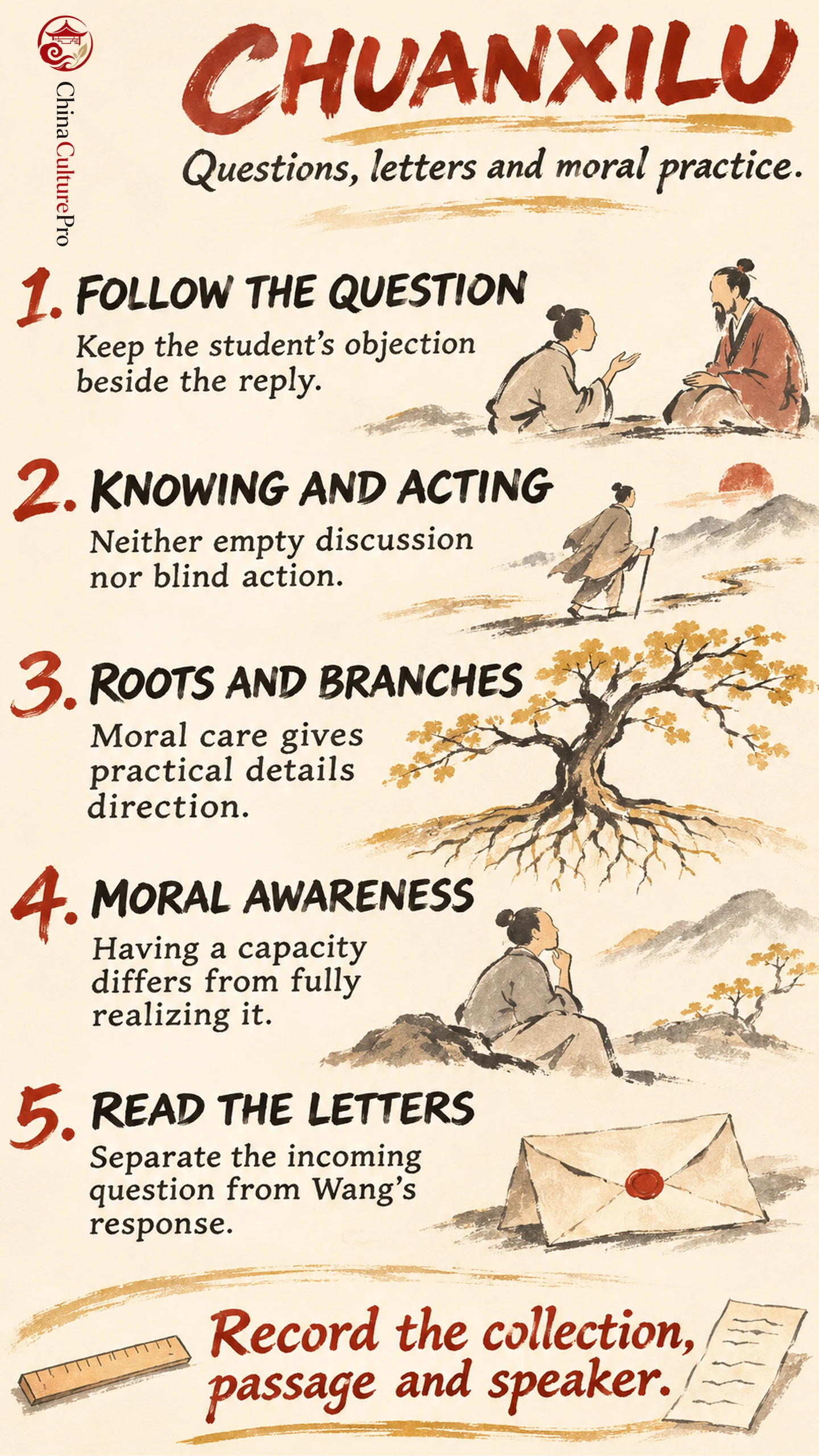
- Reading method: Keep a statement attached to the problem it answers.[2][3]
It is not a single uninterrupted treatise or a collection of slogans promising effortless certainty.
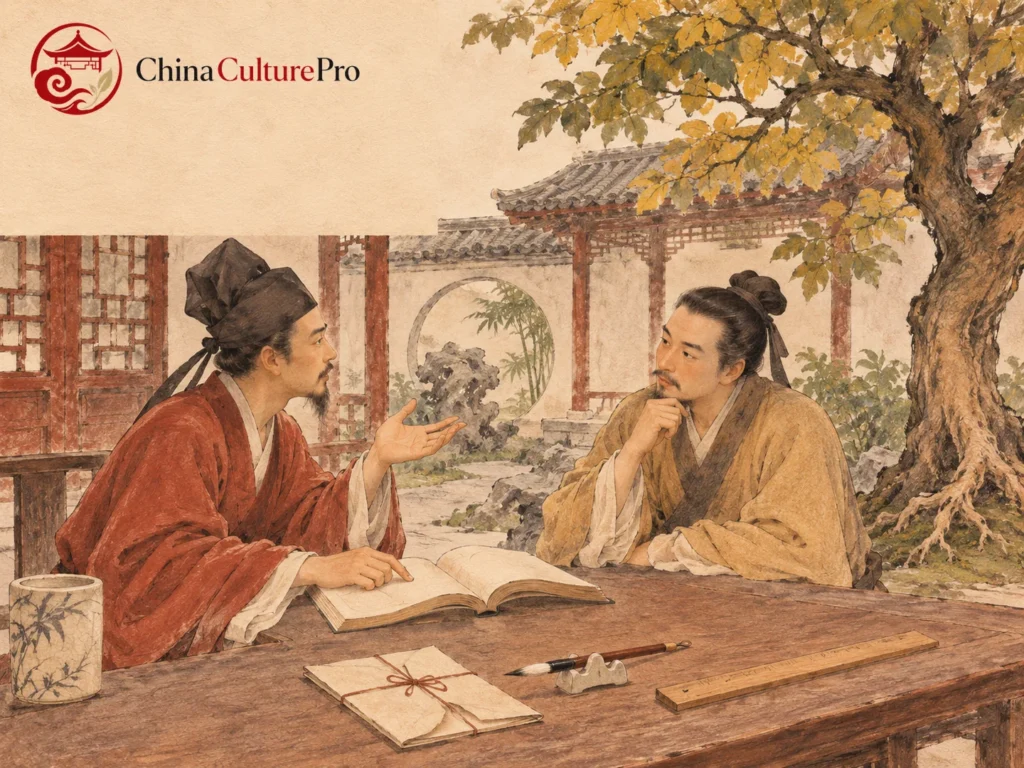
A student can agree with a teaching and still press a difficult objection. That movement is central to reading the Chuanxilu. Instead of starting with a famous sentence alone, follow what the questioner fears the teaching might overlook.
A Record of Teaching Through Questions and Letters
Wang Yangming’s personal name was Wang Shouren (王守仁, wáng shǒurén). “Yangming” is the name by which he is commonly known. The book’s form requires a further distinction: a recorded reply and a letter have different immediate audiences, and the collected work is not simply a transcript written from beginning to end by the philosopher.[1][2][3]
The upper collection identifies material recorded by disciples, including Xu Ai (徐爱/徐愛, xú ài). The middle collection contains letters and an editorial preface explaining choices of inclusion. Recorders and editors therefore belong to the reading context. Note who asks a question, who records the exchange and where a letter appears before comparing apparently similar statements.[2][3]
Knowing and Acting: More Than a Slogan
In Xu Ai’s exchanges, the teaching of zhixing heyi (知行合一, zhīxíng héyī), the unity of knowing and acting, answers a specific problem. Can someone really know filial care or fraternal respect while failing to practice it? Wang’s reply denies that merely being able to talk about a virtue amounts to genuine knowledge of it. He uses experiences such as recognizing an unpleasant smell to challenge a rigid separation between awareness and response.[2]
The discussion also criticizes two opposite failures: acting blindly without reflection, and discussing endlessly without actual practice. Its target is not thought itself. Reading the reply beside both failures prevents “unity” from being reduced to either impulsive action or the instruction to finish all learning before doing anything.[2]
Mind, Principle and the Details of Caring
Another exchange begins with Xu Ai worrying that seeking the highest good in the heart-mind might neglect the principles of particular affairs. Wang answers through family care. When Xu asks whether concrete details still need investigation, Wang explicitly says they do. Sincere care is compared with a root, while particular arrangements are its branches and leaves.[2]
The passage invokes the Book of Rites in explaining how deep affection finds expression in bearing and speech. Its claim is about the moral orientation that gives practical details their direction. It is misleading to turn it into “facts never matter” or “good intentions make every decision correct.”[2]
Liangzhi and Moral Judgment in a Letter
The letter to Gu Dongqiao (顾东桥/顧東橋, gù dōngqiáo) discusses liangzhi (良知, liángzhī), moral awareness. A concern is whether broad moral understanding can handle detailed, changing circumstances. Wang compares cultivated moral awareness with standards of measurement: possessing a measure differs from memorizing every possible length. The reply places sustained moral work at the center of responding to new situations.[3]
This does not license treating every private impulse as authoritative. The same discussion distinguishes a common capacity from fully realizing it. A reader can examine that distinction without assuming that the teacher’s answer settles every philosophical question about moral disagreement.
A First Reading Route Through the Chuanxilu
- Begin with Xu Ai’s questions in the upper collection; write the objection in your own words before reading the reply.
- Compare the knowing-and-acting exchange with the discussion of concrete family care.
- Read the letter to Gu Dongqiao and mark the incoming letter separately from Wang’s responses; record collection and passage with your notes.
FAQs About the Chuanxilu
Did Wang Yangming Write It as One Continuous Treatise?
No. The consulted collections contain recorded exchanges, letters and editorial framing. Their different forms matter for interpretation.[2][3]
Does Knowing and Acting Mean Acting Without Reflection?
No. The dialogue criticizes blind action as well as discussion without practice.[2]
Does Liangzhi Mean Every Personal Feeling Is Right?
That is not the argument. The letter distinguishes having moral awareness from fully realizing it through cultivation.[3]
Sources
[1] Stanford Encyclopedia of Philosophy. Wang Yangming: identity and historical context
[2] Chinese original. Chuanxilu, upper collection: Xu Ai’s recorded exchanges
[3] Chinese original. Chuanxilu, middle collection: editorial preface and letter to Gu Dongqiao