


Quick Answer: What Is Zizhi Tongjian?
Zizhi Tongjian (资治通鉴, Zīzhì tōngjiàn), usually translated as Comprehensive Mirror to Aid in Government, is a chronological history compiled under the Northern Song scholar Sima Guang (司马光, Sīmǎ Guāng). The completed work was presented in 1084. [1]
- Coverage: Events from 403 BCE to 959 CE, crossing many dynastic boundaries. [1]
- Scale: The main text contains 294 juan (卷, juàn), or textual divisions. [1]
- Reading value: It connects successive political events while offering judgments intended to inform government. [2]
Choose a manageable period and follow its sequence, keeping the historian’s commentary distinct from the events narrated.
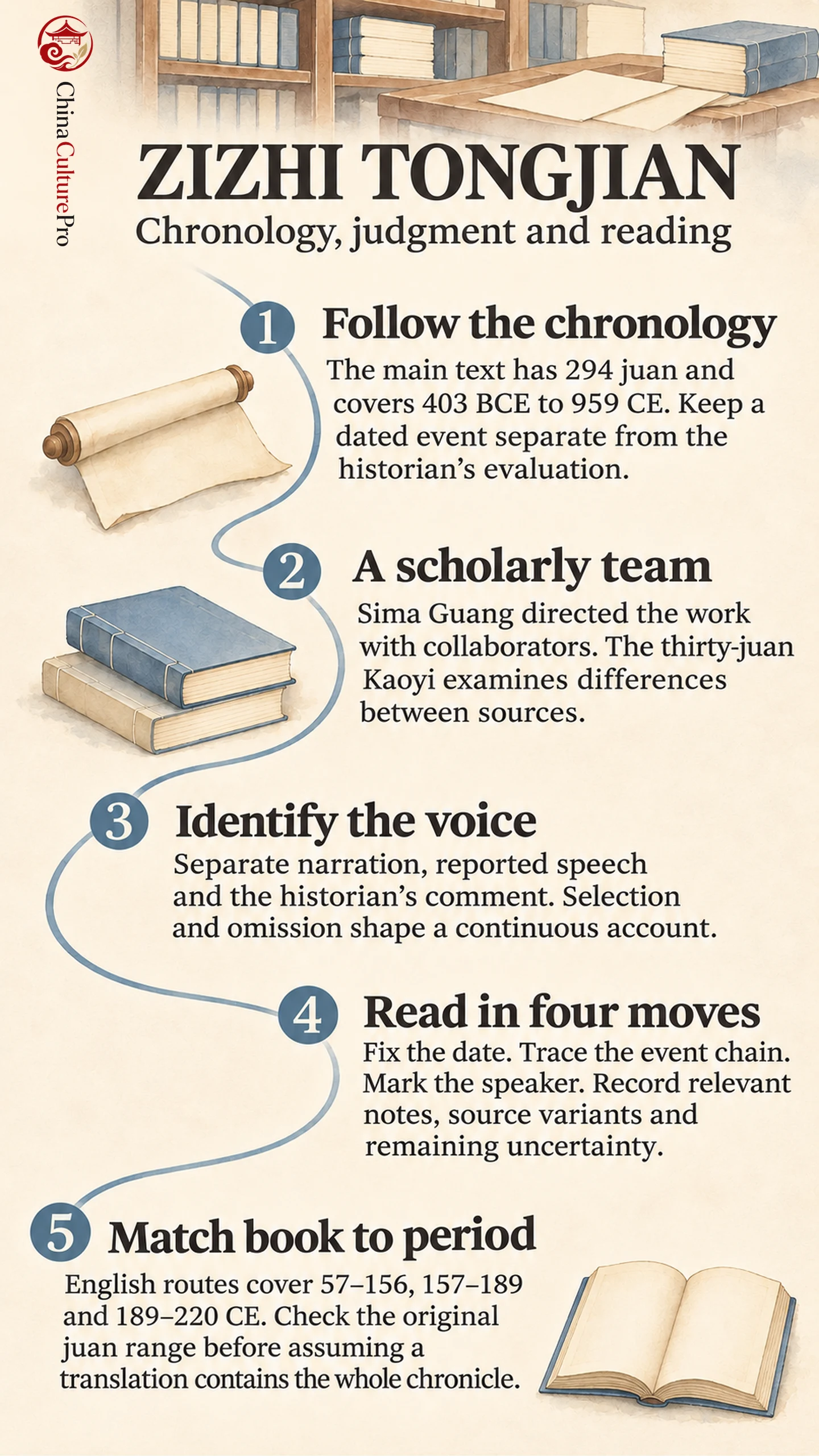
A chronicle makes the reader move through time. An appointment, a warning and a military decision may be separated across several entries, so a striking incident can acquire a different meaning when read with what comes before and after it. This guide offers a way into the work as historical literature, without requiring a first-time reader to tackle every volume in order.
How the Chronicle Works
The work was compiled in the Song dynasty, but its coverage runs from the Warring States era to the Five Dynasties period. [1] The date is the reader’s main organizing reference. Following one person may require moving between years instead of opening a self-contained biography.
The opening entry records the Zhou king’s recognition of the Wei, Zhao and Han families of Jin as lords. An extended commentary by Sima Guang then considers rank, ritual order and the consequences of granting that recognition. [3] This opening makes the distinction between a dated event and the historian’s evaluation visible immediately.
For comparison, the Shiji (史记, Shǐjì), or Records of the Grand Historian, distributes material among several forms, including annals and biographies. [2] Its author, Sima Qian, should also be distinguished from Sima Guang. For a different arrangement of court exchanges, explore Zhenguan Zhengyao (贞观政要, Zhēnguān zhèngyào).
The People Who Compiled It
The project involved a scholarly team. Liu Ban (刘攽, Liú Bān), Liu Shu (刘恕, Liú Shù) and Fan Zuyu (范祖禹, Fàn Zǔyǔ) appear among the collaborators recorded with the completed work. [2] Sima Guang set guidelines, supervised the undertaking and bore final responsibility for its historical presentation. [4]
His presentation memorial explains the selection principle: events connected with the rise and fall of states and the welfare of the people could offer examples to follow or warnings to heed. He also describes the Kaoyi (考异, Kǎoyì), a thirty-juan companion examining differences between sources. [2] The main chronicle and this discussion of source discrepancies perform different jobs; the existence of an editorial judgment does not make the underlying disagreements disappear.
History and Judgment
Keep three kinds of voice apart: the narrator’s account, speech attributed to historical actors, and an explicit comment by the historian. The opening volume’s commentary announces itself with a formula meaning that the minister Guang is speaking. [3] A judgment in that voice belongs to the Song compiler’s argument, even when it follows an event many centuries earlier.
Word selection and omission matter when comparing the chronicle’s account of Zhuge Liang with earlier sources. [4] A continuous narrative can be carefully researched and still be shaped by choices about emphasis. When a translator’s note identifies a variant, keep it beside the passage instead of treating the smoothest English narrative as the only possible account.
How to Read One Year
Begin with a year containing an episode that interests you, then extend the reading when its causes or consequences lead outside that boundary.
- Fix the date: Record the ruler and reign-era year, along with the BCE or CE equivalent supplied by your edition. Keep that date visible when the narrative changes location or political actor.
- Trace the event chain: Note what happened before the episode, the decision described and the next consequence. Follow references into adjacent years rather than assuming everything inside one entry began there.
- Mark the speaker: Distinguish narration, an actor’s reported words and the historian’s own comment. Ask which voice supports the conclusion you are drawing from the passage.
- Record the evidence: Read relevant translator’s notes and source variants. Write down a remaining uncertainty with the claim it affects, so a polished summary does not silently erase a disputed detail.
For an initial session, a short event chain is more useful than a list of disconnected famous quotations. A later rereading can test how its interpretation changes when the surrounding chronology is added.
Choosing an English Section
Rafe de Crespigny’s translations provide several routes into the Eastern Han dynasty and its collapse. Check both the historical years and the original juan range: a substantial English book may translate only one portion of the full chronicle.
| English reading route | Declared coverage | Original juan |
|---|---|---|
| A Hundred Years of Han | 57–156 CE; the translation was published in 2025. [5] | 44–53 |
| Emperor Huan and Emperor Ling | 157–189 CE; the revised second edition is recorded in 2018. [6] | 54–59 |
| To Establish Peace | 189–220 CE; published in 1996. [7] | 59–69 |
The shared year 189 and juan 59 are part of the books’ stated coverage. Use the contents to locate the particular episode rather than assuming their boundaries are exclusive. The last route reaches the transition toward the Three Kingdoms period.
For any translation, inspect its introduction, notes, date conventions and identification of speakers. A title promising a mirror of history does not itself establish that the book contains all 294 juan. Match the edition to a period you want to understand before deciding how much to read.
FAQs About Zizhi Tongjian
Does Zizhi Tongjian cover the Song dynasty?
Its original narrative ends in 959 CE, before the Song dynasty. The work’s Song context belongs to its compilation, not its chronological endpoint. [1]
Are its 294 juan the same as 294 printed books?
Juan are divisions of the text. A modern edition can bind several into one physical volume, so check the edition’s contents rather than equating juan with books on a shelf.
Can I begin with one period instead of the first volume?
Yes. Choose a well-annotated section, establish its dates and people, and follow references beyond it when needed. The English routes above identify manageable portions of the larger work.
Sources
[1] Library of Congress, National Central Library collection description. Zi Zhi Tong Jian: Comprehensive Mirror to Aid in Government
[2] Sima Guang and associated prefatory texts, Shidian Guji. Zizhi Tongjian: Presentation Memorial and Prefaces
[3] Sima Guang, classical text in an annotated edition, Shidian Guji. Zizhi Tongjian, Juan One
[4] Hoyt Cleveland Tillman, Academia Sinica. History and Culture: Sima Guang’s Reconstruction of Zhuge Liang’s Story
[5] De Gruyter Brill, publisher catalogue. A Hundred Years of Han, Volume One
[6] Australian National University Open Research Repository. Emperor Huan and Emperor Ling: Revised Second Edition
[7] Rafe de Crespigny, Australian National University research record. To Establish Peace