

Quick Answer: What Is Zhenguan Zhengyao?
Zhenguan Zhengyao (贞观政要, Zhēnguān zhèngyào) is a selection of court exchanges compiled by Wu Jing (吴兢, Wú Jīng). Its principal speaker is Emperor Taizong (唐太宗, Táng Tàizōng), discussing government with his advisers. [1]
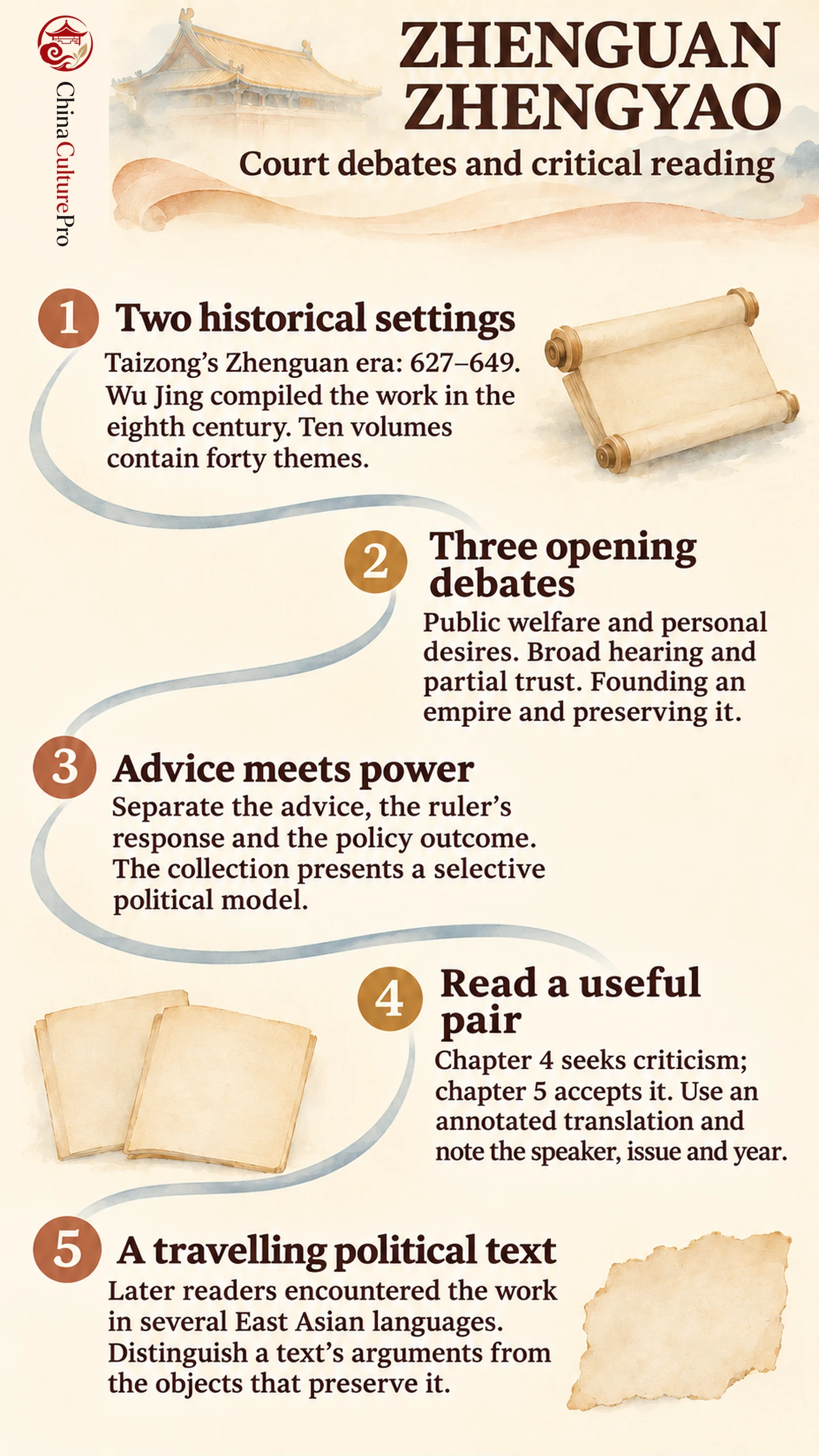
- Structure: Ten volumes contain forty thematic chapters. [6]
- Central questions: How should a ruler choose officials, receive criticism, restrain personal desires and preserve political stability? [1]
- Reading approach: Follow each debate’s policy issue, then ask how its selection presents a model of government.
The book is a shaped political classic; its dialogues need the same attention to sources and purpose as other historical writing. [3]
The book’s debates give political ideas speakers, audiences and immediate stakes. Reading it as classical prose means attending to the dialogue’s construction as well as its claims. Begin with the problem being discussed: a striking sentence becomes easier to interpret when you know whose conduct it seeks to change.
The Reign, the Compiler and the Book
Taizong’s reign began in 626 and ended in 649. Zhenguan, the reign-era name in the title, covers 627–649. Wu Jing selected material in the early eighth century, decades after the events; the final submission is commonly placed around 729, although details of compilation are debated. [2] Keep these two historical settings separate when placing the book within the Tang dynasty.
Wu Jing worked as an official historian. His compilation draws together court discussions and written submissions, presenting precedents that could speak to later political problems. [3] Its topical structure lets a reader compare exchanges about a shared concern across different years. The range reaches from relations between ruler and officials to agriculture, law, the imperial family and military policy. [1]
For background, the roles of Chinese emperors and scholar-officials help clarify why access to the ruler and the presentation of advice matter.
Three Opening Exchanges Worth Reading
All three examples occur in the opening chapter on the ruler’s way. Read the complete exchanges before lifting out a sentence; each develops a different relationship between the ruler’s conduct and political survival. [4]
| Exchange | Argument to follow |
|---|---|
| Public welfare and the ruler’s desires | Taizong links the people’s welfare with the ruler’s self-restraint. Personal indulgence can consume the resources on which stable rule depends. [4] |
| Broad hearing and partial trust | Wei Zheng (魏徵, Wèi Zhēng) contrasts hearing different voices with relying on a narrow source of information. The danger is that powerful intermediaries block news from reaching the ruler. [4] |
| Founding and preserving an empire | Fang Xuanling stresses the struggles of conquest; Wei Zheng stresses the dangers of complacency after success. Taizong connects their answers with their different experiences. [4] |
The third exchange is particularly useful for close reading. Notice that the advisers answer the same question from different positions. Then identify what the emperor does with the disagreement: does he reject an answer, reconcile the two, or change which problem now requires attention?
Advice, Power and Historical Evidence
The repeated invitation to speak frankly describes a political ideal. It does not establish how often officials actually reached the ruler or whether every recorded response gives a complete picture of court life. The collection is selective, and its materials helped construct Taizong’s reputation as a ruler willing to listen. [3]
Criticism could also be dangerous, and Taizong sometimes rejected advice. Reading a praise-filled response therefore requires a further question: was the adviser’s recommendation actually adopted? [2] Separate the act of speaking, the ruler’s verbal reaction and the policy outcome in your notes. They may appear together in one anecdote, but they answer different historical questions.
A general Chinese history overview can establish the wider sequence of events. If comparing the book with the Zizhi Tongjian (资治通鉴, Zīzhì tōngjiàn), begin with one overlapping episode and compare its placement, omitted context and narrative emphasis.
Reading the Text in English
The Essentials of Governance, edited and translated by Hilde De Weerdt, Glen Dudbridge and Gabe van Beijeren, provides an English route through the collection with contextual commentary. [1] Use an edition’s introduction and notes to distinguish a speaker’s ancient examples from the immediate Tang policy dispute.
The contents offer a useful pair: chapter four concerns seeking criticism, while chapter five concerns accepting it. [2] Compare them with two questions in mind: what makes criticism reach the ruler, and what makes it affect a decision? This pairing gives a more precise reading task than collecting attractive statements about listening.
Keep the chapter heading and episode’s year beside each note. Record who speaks, which proposal is at issue and what response is described. When a sentence depends on an earlier ruler’s example, use the notes before treating that example as a general historical rule. A good first session can consist of one complete exchange and a short account of how its argument works.
Why the Book Travelled Beyond China
The book circulated across East Asia as a practical manual of government. Its reception included translations into Tangut, Khitan, Jurchen, Mongolian and Japanese, showing that later readers approached its political lessons through several languages. [5]
Material survival offers another perspective. An ink-on-paper segment preserved at Keio University records a passage about government and consultation. [6] A manuscript fragment, a printed edition and a modern translation each give access to the work in a different form. Distinguish the wording of a passage from the later object that carries it; the object’s date does not by itself date the event described.
FAQs About Zhenguan Zhengyao
Did Emperor Taizong write Zhenguan Zhengyao?
No. Wu Jing compiled it in the eighth century from material about Taizong and his officials. The emperor is a principal speaker within the work. [1]
Is the book arranged as a chronological history?
Its main organization is thematic: forty chapters group political and ethical concerns within ten volumes. Dates inside episodes do not make the whole collection a continuous chronicle. [6]
Does the book show that Taizong always accepted criticism?
No. It includes rejected advice, and its ideal of receptive rulership should be distinguished from the outcome of individual disputes. [2]
Sources
[1] Cambridge University Press. The Essentials of Governance
[2] Hilde De Weerdt and David McMullen. The Essentials of Governance: Contents and Introductory Preview
[3] David McMullen, Journal of Chinese Studies. The Big Cats Will Play: Tang Taizong and His Advisors
[4] Wu Jing, classical Chinese text, Project Gutenberg. Zhenguan Zhengyao: Opening Exchanges
[5] Peter Kornicki, Sungkyun Journal of East Asian Studies. A Tang-Dynasty Manual of Governance and the East Asian Vernaculars
[6] Keio University Object Hub. Segment of Zhenguan Zhengyao