


Quick Answer: What Is Jingchu Culture?
Jingchu(荆楚,Jīngchǔ)culture describes a regional cultural heritage strongly associated with Hubei and the historical influence of Chu(楚,Chǔ)around the middle Yangtze. Ancient Chu’s territory also extended into areas of present-day Hunan and other provinces. The historical state and today’s cultural labels therefore need separate treatment. [1][2]
- Material heritage: Lacquer, silk and bronzes reveal craft skills and social practices.
- Music and literature: Bell ensembles and transmitted poetry supply different kinds of evidence.
- Living connections: Festival customs, craft teaching and new performances reinterpret regional heritage.
An excavated object, a poem and a modern festival do not all document the same period. Their dates, communities and contexts matter.
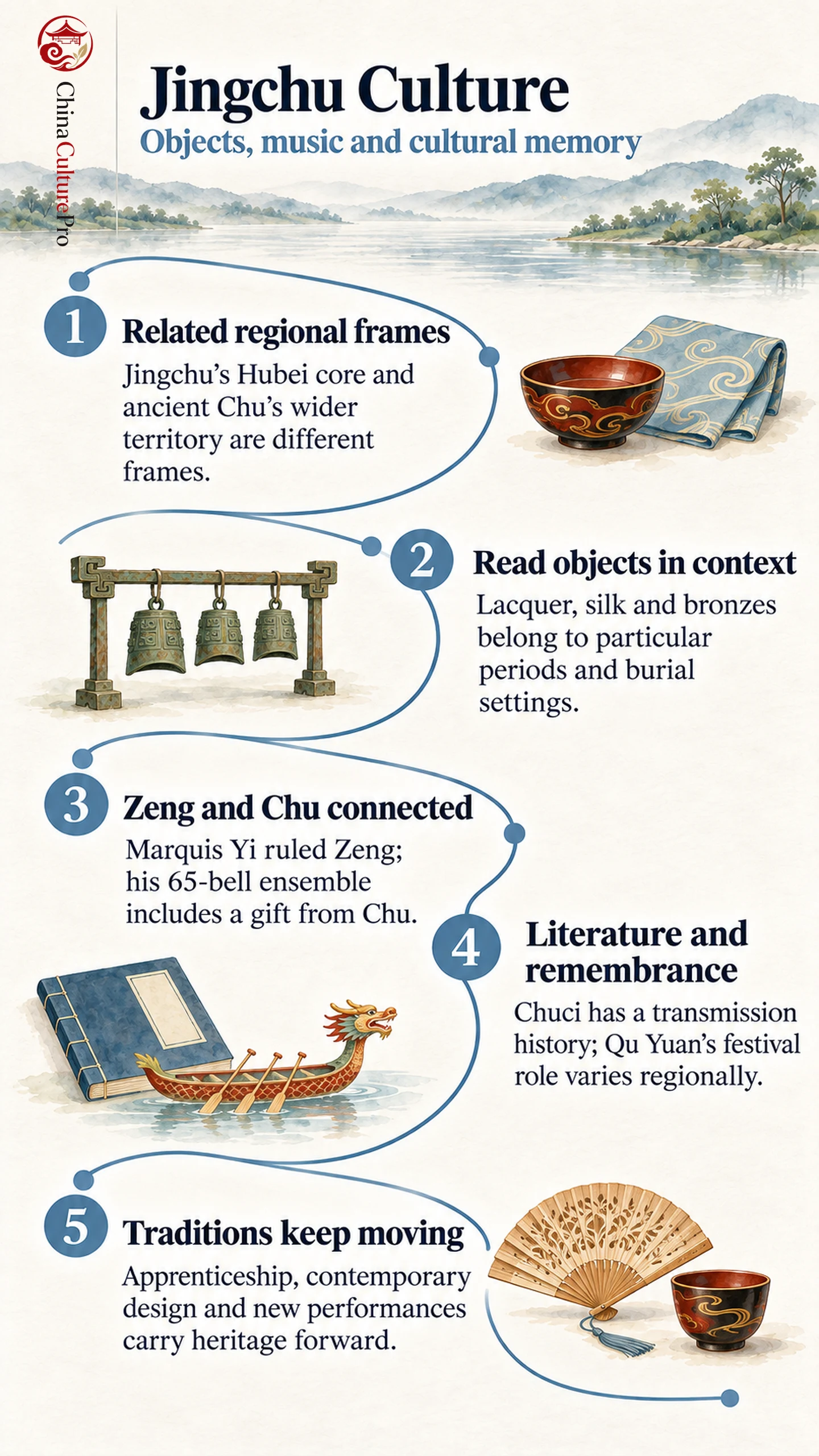
A red-and-black lacquer vessel, a bronze bell and a dragon boat can all introduce Jingchu culture. Their connections become more interesting when their differences remain visible: objects document particular societies, poems have transmission histories, and festivals carry local forms of remembrance.
Jingchu, Ancient Chu and Today’s Provinces
Jingchu is especially prominent in descriptions of Hubei’s regional heritage. Historical Chu, however, expanded and contracted over time, extending across a territory that modern provincial borders divide.
| Frame | What it describes | Why the distinction matters |
|---|---|---|
| Jingchu culture | A regional heritage label strongly associated with Hubei | Its modern use is broader than the archaeology of one ancient state. [1] |
| Ancient Chu | A changing political territory with distinctive material and literary traditions | Chu sites occur in present-day Hubei, Hunan, Henan, Anhui and elsewhere. [2] |
| Hubei and Hunan | Present-day provinces containing different local histories and communities | Shared Chu associations do not make their later regional traditions identical. |
Contemporary cultural planning can distinguish Jingchu, centered on Hubei, from the Huxiang region associated with Hunan. [1] That does not erase older connections across the provincial boundary. It shows why a regional term needs a stated context.
As in Chinese cultural geography, ask whether a source is discussing a state, an archaeological distribution or a modern regional identity. Each produces a different outline.
Lacquer, Silk and the Evidence of Tombs
Chu tombs preserve evidence of accomplished lacquer work, silk production and bronze casting. Lacquered objects include striking forms and decorative patterns; surviving silk and embroidery show varied designs, including birds and other creatures. [3]
These finds reveal materials and technical choices within particular burial settings. They should not be read as a complete inventory of ordinary household life, or as proof that everyone wore the clothing depicted in one image.
Chronology also changes the interpretation. Lacquer remained important after Chu’s conquest by Qin. A wooden lacquered vessel excavated at Shuihudi in Hubei, for example, belongs to the Qin period; later Han objects have their own forms and decorative treatments. [4] Sharing a material does not make every piece a Chu-state artifact.
For an individual object, distinguish the wooden or textile support, surface treatment, decoration and archaeological context. These questions turn a general impression of “colorful Chu art” into a more useful understanding of how an object was made, used and eventually buried.
The Zeng Bells: Music Across Political Boundaries
The celebrated bells excavated at Suizhou in 1978 belonged to Marquis Yi of Zeng(曾侯乙,Zēng Hóu Yǐ), a ruler of Zeng. Calling him a Chu ruler would erase an important distinction.
His ensemble of bianzhong(编钟,biānzhōng), or bronze chime bells, contains 65 bells. One was a gift from the king of Chu. Its presence within the burial assemblage offers direct evidence of a connection between the two courts. [5]
The bells are also evidence of musical knowledge. Their inscriptions record information concerning pitches and musical theory, while striking different parts of a bell can produce two tones. [5] They belong within the broader history of Chinese traditional music, with relationships to ritual systems discussed in Central Plains culture.
Original instruments, replicas and new performances must remain distinct. A successful reproduction project was completed in 1984. [6] Hearing a replica ensemble can demonstrate musical possibilities; it does not establish that a modern composition reproduces a documented ancient concert.
Poetry and Dragon Boat Memory
Chuci(楚辞,Chǔcí), often translated as Songs of Chu or Songs of the South, is an anthology associated with southern poetic traditions. Qu Yuan(屈原,Qū Yuán)is its central literary figure, but the collection includes works associated with other poets. Its imagery draws on encounters with spirits, journeys and political longing. [7]
The poems and their later interpretation cannot simply be treated as a contemporary biography. Scholarship examines how texts accumulated and how authorship and the figure of Qu Yuan were constructed through transmission. [8] The distinction preserves the poetry’s cultural significance while avoiding certainty about disputed personal details.
Qu Yuan also occupies a prominent place in the Dragon Boat Festival(端午节,Duānwǔ Jié)in Hubei and Hunan. The festival falls on the fifth day of the fifth lunar month and can include racing, ceremonial activity and shared food. Commemorated figures and local practices vary across regions. [9]
Festival remembrance is consequently evidence of community tradition. It does not by itself verify every element of an origin story or prove that one account explains all dragon boat customs.
How Regional Traditions Continue
Contemporary craft makes cross-provincial connections tangible. A documented example is lacquer maker Hao Guanxiong, born in Hubei and trained through apprenticeship, whose studio in Changsha produces objects including tea sets and fans. His practice brings inherited techniques into contemporary designs and daily-use objects. [10]
That is a specific maker’s experience, rather than a standard path followed by every practitioner. It shows how skills travel with people, and why a tradition’s present setting need not coincide with one ancient border.
Museum presentation performs another kind of work: preserving excavated material, explaining its context and supporting the study of replicas. [6] Modern stage presentations belong within Chinese performing arts, where choreography and arrangement are creative decisions.
These forms of continuation can coexist. An artifact remains archaeological evidence, a craftsperson transmits practical knowledge, and a performer interprets an inherited subject. Understanding which activity is taking place makes regional heritage more intelligible than assuming everything labeled Jingchu is an unchanged survival.
FAQs About Jingchu Culture
Is Jingchu Culture the Same as Hubei Culture?
Jingchu is strongly associated with Hubei, but its historical references reach beyond the province. Hubei’s present-day cultural life also contains histories extending beyond ancient Chu.
Were the Marquis Yi Bells Made for a Chu Ruler?
The ensemble belonged to a ruler of Zeng. Its inclusion of a bell given by the king of Chu demonstrates a relationship between different courts.
Does Every Dragon Boat Tradition Commemorate Qu Yuan?
No. He is especially prominent in Hubei and Hunan’s festival remembrance. Other communities honor different figures or maintain different local explanations and customs.
Sources
[1] Ministry of Culture and Tourism. Reading the Yangtze through Hubei’s Regional Culture
[2] Hubei Provincial Archives. Chu Culture
[3] Hubei Provincial Museum. Brief Introduction to Exhibition of Chu Culture
[4] Hubei Provincial Museum. The Art of Lacquered Articles in the Qin and Han Dynasties
[5] Hubei Provincial Museum. The Chime Bells of Marquis Yi of Zeng
[6] Hubei Provincial Museum. China Memory: Documents on the 45th Anniversary of the Marquis Yi Excavation
[7] Gopal Sukhu, Columbia University Press. The Songs of Chu: An Anthology of Ancient Chinese Poetry by Qu Yuan and Others
[8] Martin Kern. Qu Yuan and the Chuci: Reconstructing Qu Yuan
[9] UNESCO Intangible Cultural Heritage. Dragon Boat Festival
[10] Hunan Provincial Government / Xinhua. Inheritor of Chu-style Lacquer Coating Craft