


Quick Answer: What Defines Guizhou Culture?
Guizhou culture includes the languages, arts, social practices and histories of communities across this mountainous province in southwest China. There is no single provincial costume, festival calendar or ethnic tradition.
- Community knowledge: Singing, oral memory and practical teaching connect generations within particular local settings.
- Craft traditions: Dyeing, stitching and other skills give materials different forms and meanings.
- Historical connections: Migration, local governance and contact with neighboring regions helped shape settlements.
- Continuing practice: Schools, workshops, families and performers sustain and adapt inherited skills.
A named tradition should be connected to its community and locality. A festival photograph or staged presentation cannot represent the everyday life of everyone in Guizhou.
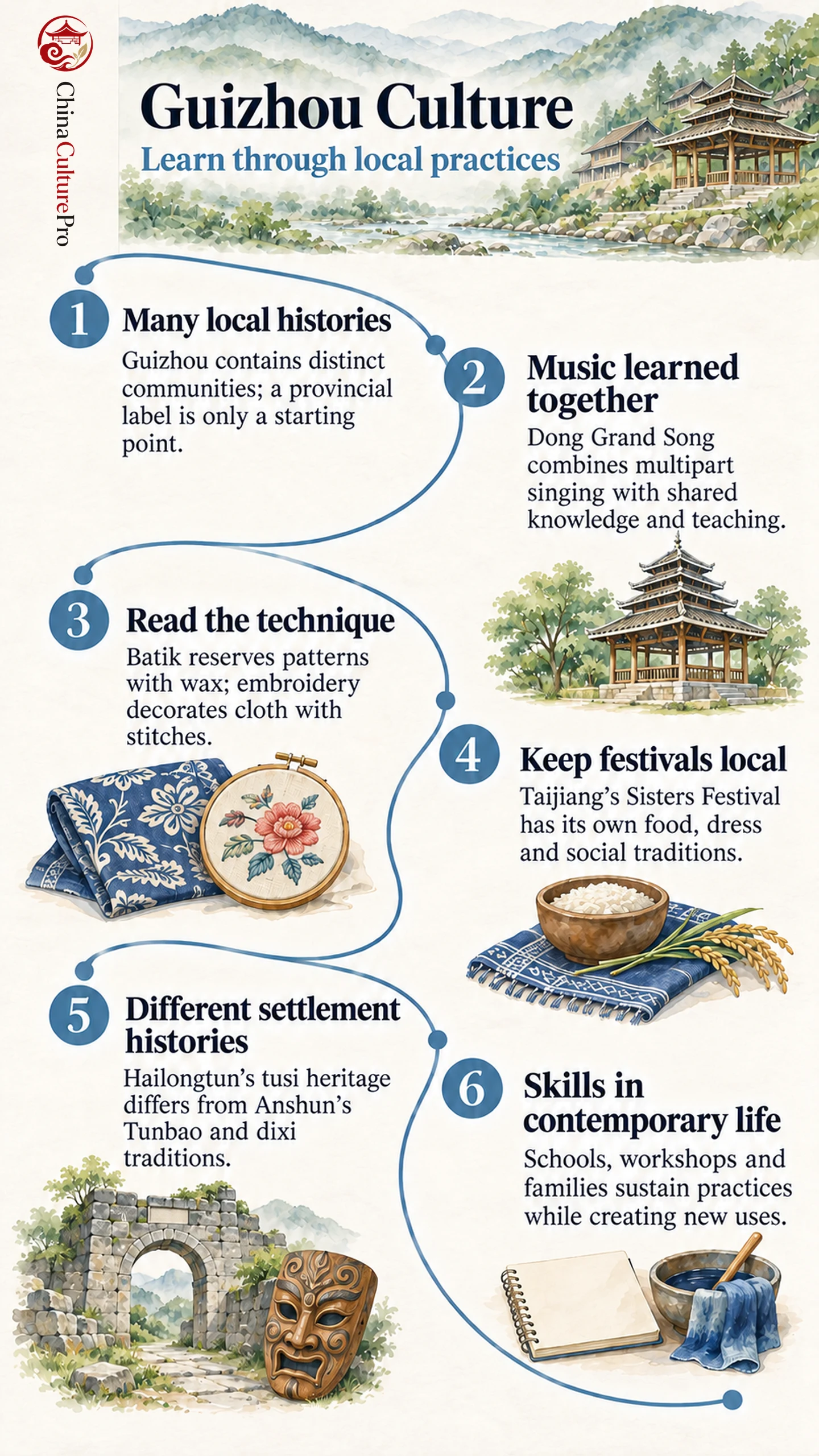
A chorus, an indigo textile and a carved performance mask offer different ways into Guizhou culture. Their significance depends on who makes or uses them, where they belong and how knowledge is learned. Specific examples reveal more than a collage of provincial symbols.
A Province of Distinct Communities and Local Histories
Miao(苗族,Miáozú), Dong(侗族,Dòngzú), Bouyei(布依族,Bùyīzú), Shui(水族,Shuǐzú)and Han(汉族,Hànzú)communities are among those whose histories form part of Guizhou. These names identify different communities, rather than subdivisions of one uniform “Guizhou ethnic culture.”
Locality adds another necessary distinction. Shui communities, for example, are concentrated in areas including Sandu and neighboring counties, with settlements also across the provincial boundary in Guangxi. [1] A provincial outline and a community’s distribution therefore describe different things.
The wider categories discussed in Chinese ethnic groups also cannot supply every local detail. Dress, repertoire and festival practices may differ within a named community.
This guide selects particular examples. More focused accounts of Miao culture, Dong culture and Shui culture provide room to examine their separate languages, histories and practices.
Dong Grand Song: Knowledge Learned Together
Grand Song(侗族大歌,Dòngzú dàgē)is a multipart Dong singing tradition performed without instrumental accompaniment or a conductor. Its repertoire includes greeting songs, children’s songs, ballads and pieces imitating sounds from the natural world.
Skilled singers teach groups of learners. Performance can take place at a village drum tower, in homes or in other shared spaces. Singing can carry historical knowledge, social values and feelings as well as musical invention. [2]
Understanding this practice means attending to listening, coordination and repertoire. It is learned expertise, rather than evidence that every member of a community is naturally a singer.
Within Chinese traditional music, this example shows how a musical form can also support social relationships. A polished public performance presents one aspect of it; teaching and informal participation reveal others. The tradition’s international heritage recognition concerns this particular practice, not every type of singing throughout Guizhou.
Batik and Embroidery: Read the Technique and Locality
Batik(蜡染,làrǎn)uses wax to reserve areas of cloth during dyeing. In documented Miao examples from Danzhai, makers draw with wax, dye the cloth with indigo, and remove the wax to reveal contrasting patterns. [4] This is a description of the craft’s principle, rather than a production recipe.
Danzhai, Zhijin and Anshun have distinct local traditions within Guizhou’s batik heritage. [3] A blue-and-white textile alone does not identify one place or maker.
Embroidery works differently: stitched thread builds decoration on a surface. Dyeing and stitching may appear in related clothing traditions, but they should not be treated as the same technique. When examining a garment, distinguish its cloth, dyed design, stitched decoration and additional ornaments.
A collection record can provide useful information about locality, maker and date. A modern piece made through an inherited technique remains a modern object; it does not have to be ancient to carry cultural knowledge. [4]
Festivals Belong to Particular Communities
The Sisters Festival(姊妹节,Zǐmèi Jié)provides a specific example from Miao communities around Laotun and Shidong in Taijiang. Its documented traditional period is the fifteenth to seventeenth days of the third lunar month.
Activities include sharing sisters’ rice, singing, visiting and social exchange, with festive clothing playing a prominent role. Courtship is one part of the celebration, alongside wider community relationships. [5] These dates and customs should remain attached to that local tradition.
Bouyei communities have different celebrations, including Sanyuesan(三月三,Sānyuèsān)and Liuyueliu(六月六,Liùyuèliù), alongside their own music, dance and theatrical practices. [6] One festival’s activities cannot be transferred to another simply because both occur in Guizhou.
Festive dress also belongs to an occasion. It can communicate local skill, identity and family participation without describing what a person wears to school or work. Describing the event and community gives a photograph more meaning than calling it a universal provincial costume.
Settlement History Beyond the Village Postcard
Guizhou’s cultural landscape also records governance and migration. Hailongtun Fortress is the Guizhou component of the serial World Heritage property known as the Tusi(土司,tǔsī)Sites.
The tusi system involved hereditary regional rulers recognized by imperial authorities. Hailongtun’s remains belong to that historical administrative setting. [7] A fortress therefore answers different questions from a craft workshop or village performance space.
Around Anshun, Tunbao(屯堡,Túnbǎo)communities preserve histories connected with migration and military-agricultural settlement. Their dixi(地戏,dìxì)uses carved wooden masks, singing, percussion and martial action to perform stories. [8] This is a particular local tradition within the regional diversity of Han Chinese culture.
Dixi also belongs within Chinese performing arts. Its performance histories should be studied on their own terms; the age of a settlement does not prove that every present-day theatrical detail has remained unchanged.
How Skills Continue in Contemporary Life
Transmission takes place in contemporary institutions as well as families. In Ceheng, a documented school program has incorporated Bouyei embroidery and dance into teaching materials. Wider local initiatives also support performance and cultural learning. [6]
A Danzhai batik workshop offers another example, combining practical training with the design of objects such as bags, scarves and household textiles. [9] New uses can sustain work for skilled makers while changing the setting in which a technique is encountered.
These activities have different purposes. A school lesson introduces knowledge, a workshop trains practical skill, and a festival creates an occasion for participation. A performance arranged for visitors may draw on the same skills without carrying the full social or ritual role of a community event.
Reading Guizhou culture through these settings makes change visible. Living traditions depend on people continuing to practice, teach and make choices.
FAQs About Guizhou Culture
Is There One Guizhou Ethnic Culture?
No. Guizhou contains different communities and local traditions. A provincial label is useful for orientation, but specific practices need their own community and place.
Does Festival Dress Represent Everyday Clothing?
Not necessarily. Festival clothing serves particular ceremonial and social occasions. It should not be used to infer someone’s daily clothing or lifestyle.
Is a Tourist Performance the Same as a Community Ritual?
The settings and purposes may differ. A presentation can demonstrate genuine skills while selecting, shortening or rearranging material for its audience.
Sources
[1] National Ethnic Affairs Commission. Shui Communities: Overview
[2] UNESCO Intangible Cultural Heritage. Grand Song of the Dong Ethnic Group
[3] Guizhou Provincial Information Office. Guizhou Batik Culture
[4] University of Hong Kong Libraries. Batik Fabric: Gifts from Lanmama
[5] China Intangible Cultural Heritage Digital Museum. Miao Sisters Festival
[6] Guizhou Provincial Information Office. Guizhou Revives Bouyei Culture in New Era
[7] UNESCO World Heritage Centre. Tusi Sites
[8] National Ethnic Affairs Commission / China Ethnic News. Tunbao Communities and Dixi in Anshun, Guizhou
[9] China Intangible Cultural Heritage Digital Museum. A Batik Workshop Case in Danzhai