

Quick Answer: What Is Central Plains Culture?
Central Plains culture refers to traditions associated with Zhongyuan(中原,Zhōngyuán), a historical region centered on Henan and the middle and lower Yellow River. Its significance includes early settlements and courts, later religious and educational institutions, and continuing local arts. [1]
- Historical evidence: Excavated buildings, bronzes and inscriptions help explain successive societies.
- Shared institutions: Temples, academies and village organizations connected ritual, learning and community life.
- Living traditions: Regional opera and craft continue through performers, makers and audiences.
Zhongyuan has no single boundary valid for every period. It overlaps strongly with Henan, but neither the region nor its archaeological cultures should be treated as one modern ethnic group.
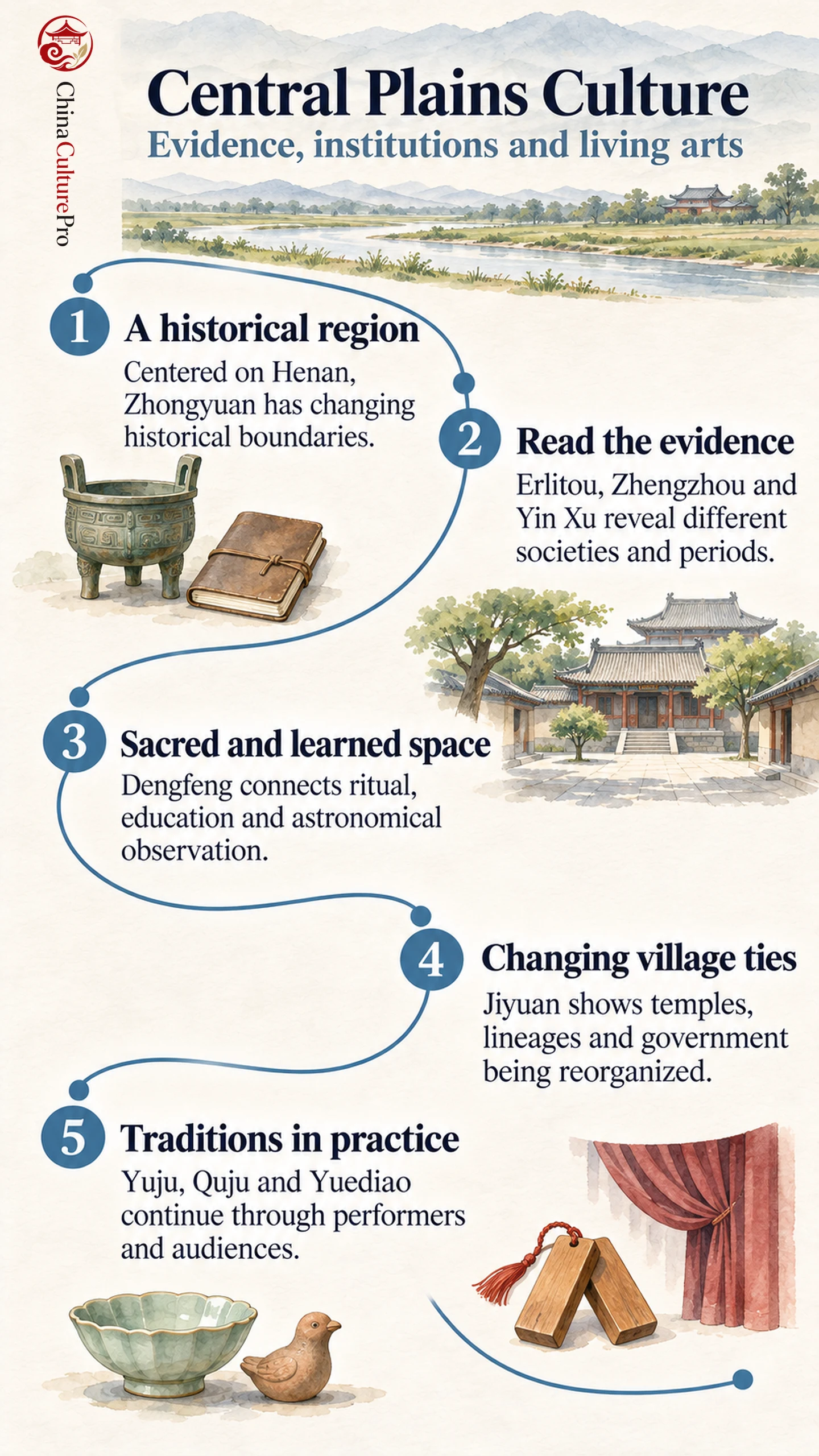
A bronze vessel, a temple courtyard and a contemporary opera performance reveal different parts of Central Plains culture. Reading them together requires attention to their dates, settings and makers: the region’s importance lies in successive histories, rather than one unchanging tradition.
Where Is Zhongyuan, and How Does It Relate to Henan?
In archaeological discussion, Zhongyuan commonly describes a region centered on Henan around the middle and lower Yellow River. River valleys, plains and adjoining uplands connected farming settlements and later political centers. The exact extent depends on the research question and period being discussed. [1]
Today’s Henan culture is a related provincial subject. Zhongyuan is a historical and cultural frame; Henan is an administrative one. Neither label makes every resident’s language, religion or family practice identical.
“Central” also needs context. A capital could represent political centrality, a sacred mountain could express a cosmological center, and an archaeological survey could define a particular study area. These meanings can overlap without being interchangeable. The distinctions become clearer when read alongside Chinese cultural geography.
The region’s development involved surrounding communities and cultural exchange. Calling it an important center of early civilization does not establish it as the exclusive source of every Chinese tradition. [1]
Archaeology, Writing and the Changing Capitals
Erlitou(二里头,Èrlǐtóu)and Yin Xu(殷墟,Yīnxū)illustrate why archaeological evidence and historical labels must be read carefully. Excavated material establishes activities at particular sites; identifying a site with a dynasty recorded in later texts can require a separate argument.
| Evidence or setting | What it contributes | Interpretive limit |
|---|---|---|
| Erlitou | Evidence of an early Bronze Age society, including prestigious bronze objects and substantial buildings. [2] | Its relationship to the Xia dynasty remains debated. |
| Zhengzhou’s Shang-period remains | An important archaeological setting for studying earlier Shang society. [2] | Its remains should be distinguished from later Shang Anyang. |
| Yin Xu near Anyang | Late Shang palaces, ancestral shrines, royal burials and inscribed oracle bones. [3] | Royal evidence does not describe every household or community. |
At Yin Xu, oracle-bone inscriptions(甲骨文,jiǎgǔwén)provide evidence of writing, divination and social organization. The excavated tomb of Fu Hao also preserves a particularly rich assemblage of royal burial objects. These are concrete sources for interpretation, rather than proof of a timeless regional character. [3]
Later periods require their own evidence. A chronological museum presentation can follow changing capitals and material practices across successive dynasties. [7] It is more informative to ask what a city’s role was in a particular century than to combine every capital into one continuous court.
Dengfeng: Sacred Space, Learning and Observation
Dengfeng, near Mount Song, brings another meaning of centrality into view. The idea of a center of heaven and earth connected sacred landscape, astronomical observation and imperial authority. It expresses a historical worldview, rather than a modern geographical measurement.
The World Heritage property comprises eight groups of monuments associated with ritual, education and observation. They were constructed across different dynasties, and individual buildings have undergone rebuilding. Their value therefore lies partly in accumulated histories. [4]
The surrounding cultural landscape includes Buddhist, Daoist and Confucian traditions. [8] Shaolin’s place within Chinese Buddhism belongs within that wider setting; one famous institution cannot stand for the entire area. Temples, an academy and an observatory served different purposes even when their prestige drew on related ideas of sacred location.
This is a useful example of the overlapping institutions discussed in religion in China. Sharing a landscape does not make their teachings or practices identical.
Village Temples and Family Traditions
Central Plains social history also extends beyond courts and major monuments. Village institutions organized relationships among families, local worship and government.
A study of Jiyuan in Henan traces changes from the Ming into the Qing. Village administration was affected by migration and land transfers. During the Qing, village altars became important organizational units; lineage divisions subsequently operated within them. Yet the broader temple-centered organization could continue to connect different lineages. [5]
This case shows institutions being reorganized, rather than simply surviving unchanged from antiquity. Kinship, local ritual and state administration interacted, but no one of them alone explains village society.
The scope matters: evidence from Jiyuan establishes a local historical example. It does not prove that every Central Plains village followed the same sequence, or that today’s families maintain identical customs. Likewise, regional affiliation should remain distinct from the categories used to discuss Chinese ethnic groups.
Opera, Craft and Living Regional Connections
Living culture can be heard as well as excavated. Yuju(豫剧,Yùjù), Quju(曲剧,Qǔjù)and Yuediao(越调,Yuèdiào)are distinct opera genres associated with Henan. Treating all regional stage performance as one “folk opera” obscures those differences.
A January 2026 presentation in Beijing brought professional ensembles representing the three genres together. Its program included established works, newly created historical drama and modern adaptations. Craft demonstrations alongside the performances included Ru porcelain, three-color glazed pottery and clay work from Xunxian. [6]
The event illustrates several forms of transmission: performers learn a repertoire, new productions reinterpret subjects, makers demonstrate skills, and audiences encounter practices beyond their original local setting. These are ongoing activities, rather than evidence that a present-day performance reproduces an ancient event exactly.
For comparisons across genres, Chinese performing arts offer a wider frame. Central Plains culture remains most intelligible when each practice retains its own community, medium and history.
FAQs About Central Plains Culture
Is Zhongyuan Another Name for Henan?
The terms overlap, but they are not exact synonyms. Henan is a present-day province; Zhongyuan describes a historical region whose scope varies with period and subject.
Is the Central Plains the Only Origin of Chinese Culture?
No. It was an important center, and its societies developed through interaction with other regions. That significance does not make all Chinese traditions derivatives of one place.
Are Central Plains Traditions All Ancient Survivals?
No. Some preserve long histories, while others have been reorganized, revived or newly adapted. Their specific records matter more than a general claim of uninterrupted continuity.
Sources
[1] Henan Provincial Institute of Cultural Heritage and Archaeology. The Central Plains and Surrounding Regions: Integration and Development of Chinese Civilization
[2] National Gallery of Art. The Golden Age of Chinese Archaeology: Teaching Packet
[3] UNESCO World Heritage Centre. Yin Xu
[4] UNESCO World Heritage Centre. Historic Monuments of Dengfeng in The Centre of Heaven and Earth
[5] Liuwen Li. Village and Lineage: Transformations in Village Society in the Central Plains (Zhongyuan) in Ming-Qing
[6] Henan Provincial Department of Culture and Tourism. Henan’s Three Major Opera Genres Perform Together in Beijing
[7] Henan Museum. A Great Civilization Rises with Capitals Established in the Central Plain
[8] UNESCO. Songshan UNESCO Global Geopark