

Quick Answer: Who Was Hong Sheng?
Hong Sheng (洪昇, Hóng Shēng; 1645–1704) was a Qing-dynasty playwright and poet from Qiantang, now Hangzhou. His best-known work is The Palace of Eternal Life (长生殿, Chángshēng Diàn), completed in 1688.[1][2]
- The play follows the Tang emperor Xuanzong and his consort Yang Yuhuan through attachment, rebellion, separation and an otherworldly reunion.[3][6]
- Its fifty scenes extend beyond a famous performed excerpt.[2]
- Hong’s other surviving dramatic work and poetry collections help place the masterpiece within a larger literary career.[1]
The author belongs to the Qing period; the Tang setting and the lovers’ supernatural ending belong to the drama’s imaginative world.
Hong Sheng gives readers more than a doomed imperial romance. He makes an intimate promise unfold against public catastrophe, then lets music, memory and supernatural possibility carry the story beyond loss. A useful first reading keeps the text’s emotional argument together with its changing scale: palace life, a threatened empire and an imagined celestial settlement.
A Qing Writer and a Dangerous Performance
Hong lived during the early Qing dynasty. He was an Imperial Academy student rather than a serving government official. In 1689, a performance during mourning for an empress brought punishment; he returned to Zhejiang in 1691.[1]
The event should not become a simple story of a banned masterpiece. Judith T. Zeitlin’s study connects the scandal with court politics and the risks of a salon performance between private and public life. Hong was imprisoned and expelled from the Academy, but the play itself was not banned and continued to circulate and be performed.[2]
His Surviving Works Beyond One Famous Title
The Palace of Eternal Life is a long chuanqi (传奇, Chuánqí) play, a form that could be read as literature and adapted for musical performance.[2]
Si Chanjuan (四婵娟, Sì Chánjuān), classified as zaju (杂剧, Zájù) drama, also survives. These two titles give a starting point for exploring his preserved dramatic writing.[1]
His surviving poetry collections include Xiaoyue Lou Ji (啸月楼集, Xiàoyuè Lóu Jí), Baiqi Ji (稗畦集, Bàiqí Jí) and Baiqi Xuji (稗畦续集, Bàiqí Xùjí). The Palace Museum describes travel, friendship, personal hardship and people’s suffering among the concerns of his poetry.[1]
Begin with the long play for the largest view of his dramatic world; turn to the poetry for a different scale of writing about place, friendship and hardship.
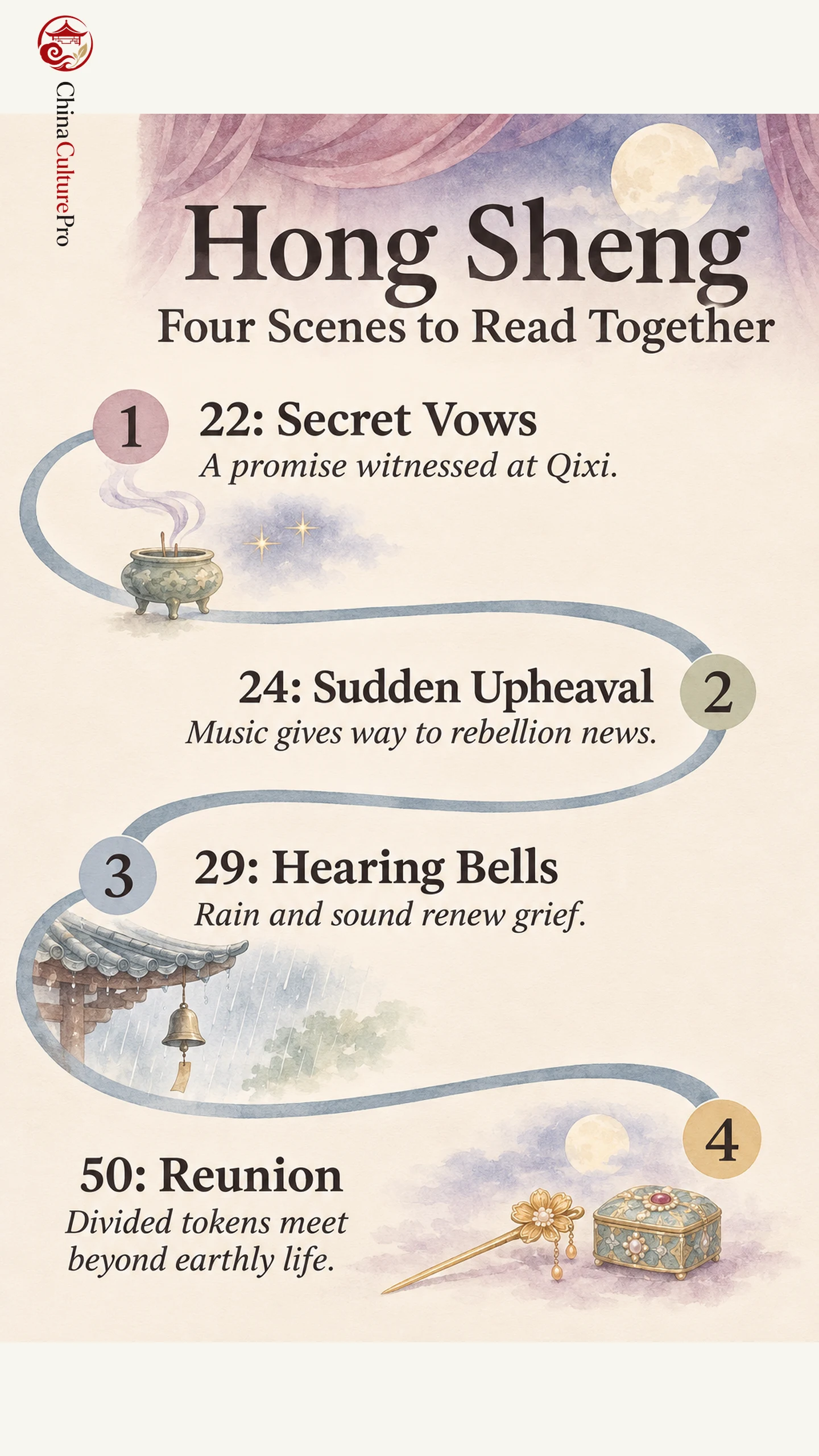
Four Scenes That Open Up The Palace of Eternal Life
| Scene | What changes | What to notice |
|---|---|---|
| 22: Secret Vows. | The lovers promise lasting union at Qixi. | The Cowherd and Weaver Girl witness the promise and anticipate separation. [3] |
| 24: Sudden Upheaval. | Rebellion news interrupts a garden banquet. | Singing and flute music give way to drums and urgent speech. [4] |
| 29: Hearing Bells. | The emperor shelters from rain on the journey toward Shu. | Wind, rain and bells become the sound of grief. [5] |
| 50: Reunion. | The lovers meet in a celestial palace. | Divided hairpin and box are reunited; earthly loss receives an otherworldly answer. [6] |
The sequence makes a useful comparison: the vow promises permanence, public events destroy security, sound renews grief, and the ending changes the terms on which union becomes possible. Read the reunion alongside the earlier scenes rather than letting it erase their consequences.[3][4][5][6]
Reading a Script and Watching Kunqu
Kunqu (昆曲, Kūnqǔ) performance gives sung language, gesture and stage action their own pace. A recording can reveal emphasis that a plot summary misses: a held phrase, a pause before news arrives or a physical response to a sound. Our Kunqu guide introduces the performance tradition.
Keep the printed scene numbers separate from a production’s arrangement. Long chuanqi texts were not necessarily staged in their entirety, and a famous excerpt may leave most of the dramatic structure outside the evening’s programme.[2]
For a dated example, a 2008 report records a Shanghai Kunqu Theatre production presented in Beijing in four parts over more than ten hours. That four-part structure belongs to the production; it does not turn Hong’s fifty-scene text into an original four-act play.[7]
Before comparing page and stage, note the scene titles included in the performance. Watch how transitions are handled and ask which relationships or political events are carried offstage. A short selection can be artistically complete while offering only one angle on the longer work.
English Editions and a Starting Point
The same play appears under several English titles. The Palace of Eternal Youth is the title of a Chinese–English edition published by Foreign Languages Press in 2004. Japan’s National Diet Library credits Yang Xianyi and Gladys Yang as translators and Xu Shuofang as the Chinese text’s editor.[8]
Use translator and Chinese title to identify the work, rather than assuming that Eternal Youth and Eternal Life designate different plays. Check whether a volume contains the full text or selected scenes, and whether it supplies annotations for songs, allusions and theatrical conventions.
For historical orientation, place the emperor and rebellion within the Tang dynasty. Then return to the drama as a later literary construction: historical background can clarify the stakes without converting invented dialogue or celestial events into historical evidence.
FAQs About Hong Sheng
Did Hong Sheng write during the Tang dynasty?
No. He lived from 1645 to 1704, during the Qing dynasty. His most famous play looks back to Tang imperial figures.[1][2]
Is the lovers’ reunion a historical event?
The celestial reunion is part of the play’s supernatural resolution. It should be read as drama rather than an account of a documented meeting.[6]
Must a production perform all fifty scenes?
No. The fifty-scene text and a staged selection have different scales. Check a production’s programme to see which scenes and adaptations you are watching.[2]
Sources
[1] The Palace Museum. Hong Sheng
[2] Judith T. Zeitlin, Binghamton University. Two Late Imperial Chinese Opera Scandals: 1689 and 1874
[3] Hong Sheng, Wikisource transcription. The Palace of Eternal Life, scene 22
[4] Hong Sheng, Wikisource transcription. The Palace of Eternal Life, scene 24
[5] Hong Sheng, Wikisource transcription. The Palace of Eternal Life, scene 29
[6] Hong Sheng, Wikisource transcription. The Palace of Eternal Life, scene 50
[7] China Intangible Cultural Heritage Network. The Palace of Eternal Life: a 2008 production report
[8] National Diet Library, Japan. The Palace of Eternal Youth: bilingual edition record