


Quick Answer: Who Was Huang Zunxian?
Huang Zunxian (黄遵宪, Huáng Zūnxiàn; 1848–1905) was a late Qing poet and diplomat from Jiaying, now Meizhou in Guangdong. His career took him to Japan, the United States, Britain and Singapore, while his writing brought foreign experience and new technologies into Chinese verse.[1]
- Read his collected poetry for a career extending beyond diplomacy and patriotic verse.
- Compare the Japan poems with his prose study of Japan: they perform different kinds of inquiry.
- Begin with Jin Bieli (今别离, Jīn Biélí): four poems about separation under modern conditions.[4]
His innovation worked through inherited poetic resources; calling him modern does not mean that all his poetry is modern free verse.[2]
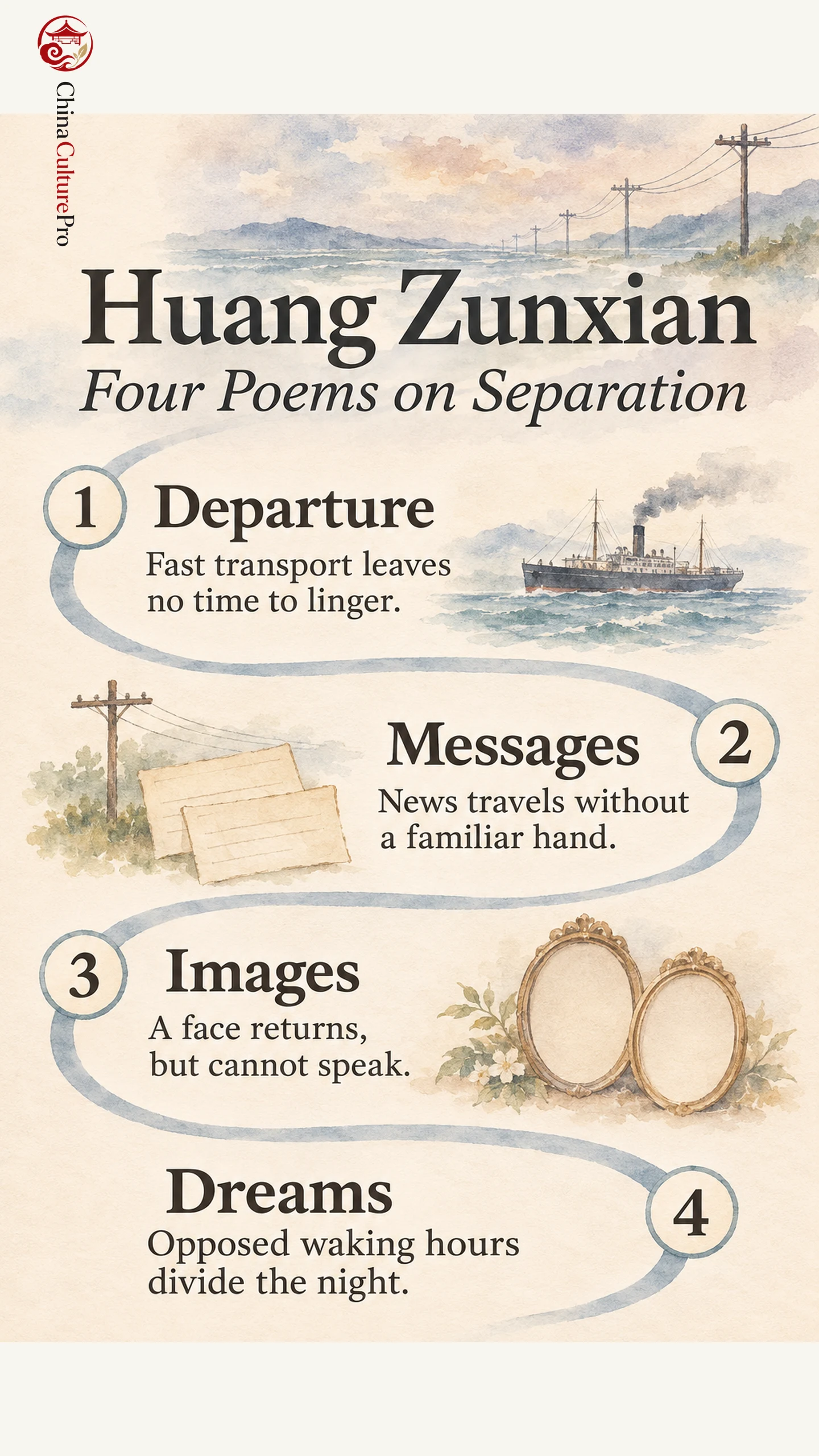
What happens to a farewell when the train will not wait, the message travels faster than handwriting and a photograph supplies a face without a voice? Huang’s poetry lets such changes alter the experience of familiar subjects. Technology becomes part of how longing works, rather than an unusual object added to a conventional scene.
Diplomacy and the Late Qing World
Huang passed the provincial examination in 1876. His overseas posts included service in Japan, the San Francisco consulate, the British legation and the Singapore consulate. After working for reform in Hunan during the 1898 reform period, he was dismissed and returned home.[1]
These movements place him within the final decades of the Qing dynasty, when encounters abroad and arguments over institutional change pressed on established habits of thought. Read the career as context, while allowing each poem its own speaker and occasion.
Huang is associated with the poetic revolution (诗界革命, Shījiè Gémìng): the effort to bring new subject matter and perceptions into poetry. Liang Qichao admired his role in this renewal. His work helps connect the history of classical Chinese verse with the changing concerns that precede modern Chinese literature.[2]
Three Major Works and Their Different Jobs
| Work | What kind of reading it invites |
|---|---|
| Renjinglu Shicao (人境庐诗草, Rénjìnglú Shīcǎo). | The collected poetry: follow changing places, occasions and concerns across a writing life. [1] |
| Poems on Miscellaneous Subjects from Japan (日本杂事诗, Rìběn Záshì Shī). | Poems linked with commentary, turning observations and knowledge of Japan into literary form. [3] |
| Treatises on Japan (日本国志, Rìběn Guózhì). | A prose inquiry drawing on historical materials and contemporary political investigation. [3] |
The collection name refers to Huang’s study, the Hut within the Human Realm. A Guangdong cultural-history account dates its construction to 1884 and explains the name through Tao Yuanming’s poem about building a dwelling among people. The title thus gives the collection a place of belonging without limiting it to domestic or secluded subjects.[2]
Keep the two Japan titles distinct. Shared geographical interest does not make prose investigation and poems with notes interchangeable. Their different forms give the reader different routes into the same writer’s effort to understand a changing world.
Jin Bieli: Four Ways of Experiencing Separation
Read the four parts as distinct poems with connected questions.[4]
| Part | Modern condition | Emotional effect |
|---|---|---|
| 1: Departure. | Fast transport and fixed departure times. | The traveller is already far away before the person seeing them off has returned. [4] |
| 2: Messages. | Telegrams and transmission through intermediaries. | Speed brings news without the beloved’s handwriting or complete meaning. [4] |
| 3: Images. | Exchanged photographs. | A recognizable face is present, but cannot speak. [4] |
| 4: Dreams. | Opposed waking and sleeping times across the world. | Even an imagined meeting in dreams becomes difficult to coordinate. [4] |
Each connection leaves something missing. Compare what can travel—people, words, images—with what remains out of reach.[4]
Japan, Observation and the Limits of Old Categories
In his 1890 preface to the Japan poems, Huang recalls arriving on diplomatic service in 1877, reading Japanese books and getting to know local scholars and officials. He also acknowledges having dressed what he saw in inherited classical meanings, and describes the long process of testing his understanding.[3]
That self-correction is essential. The poems and notes reveal a situated observer learning how to describe unfamiliar institutions and practices. Treat their comparisons as part of that historical encounter, rather than a transparent catalogue of Japan or a declaration that every foreign reform deserved adoption.
This makes annotation valuable: identify which allusion belongs to an inherited literary vocabulary, which object belongs to the observed world and where the poem brings the two together. A classical reference can be a method of thinking about change, while also carrying assumptions that deserve examination.
Where to Read Him in English
For a free introduction, Renditions offers Selections from Huang Zunxian’s Writings on Japan, translated by Jack W. Chen and Yunshuang Zhang in its Spring 2013 issue. The selection includes the preface and poems with explanatory notes.[3]
For a broader guide, J. D. Schmidt’s Within the Human Realm: The Poetry of Huang Zunxian, 1848–1905 was published by Cambridge University Press in 1994. It combines biography and criticism with a substantial selection of translated poetry; it is not simply a complete English version of Renjinglu Shicao.[5]
The publisher’s description identifies traditional verse, foreign-land poems, political satire and scientific verse among the book’s subjects. That range helps a reader avoid reducing Huang either to a diplomat who happened to write or to a poet interested only in machines.[5]
Start with a short translated selection and its notes, then widen the reading. For each poem, record its occasion, its speaker and the particular relationship between new knowledge and inherited language. This is more useful than assigning the whole career one unchanging attitude toward modernity.
FAQs About Huang Zunxian
Did Huang Zunxian abandon classical verse?
No. His innovation included using inherited forms and resources to address new things and experiences. His place in poetic renewal is broader than a simple change from classical to free verse.[2]
Does faster communication cure separation in Jin Bieli?
No. Speed, messages and photographs leave dimensions of absence unresolved.[4]
Is Treatises on Japan the same book as his Japan poems?
No. One is a prose study; the other connects poems and commentary. Reading them together can show how Huang approached related questions through different forms.[3]
Sources
[1] Wuhan Publishing House. Huang Zunxian: author biography and poetry reading
[2] Guangdong cultural-history portal. From poetic revolution to educational renewal: Huang Zunxian at Renjinglu
[3] Huang Zunxian, translated by Jack W. Chen and Yunshuang Zhang. Selections from Huang Zunxian’s Writings on Japan, Renditions
[4] Huang Zunxian, Wikisource transcription. Jin Bieli: four poems
[5] Cambridge University Press. Within the Human Realm: The Poetry of Huang Zunxian, 1848–1905