
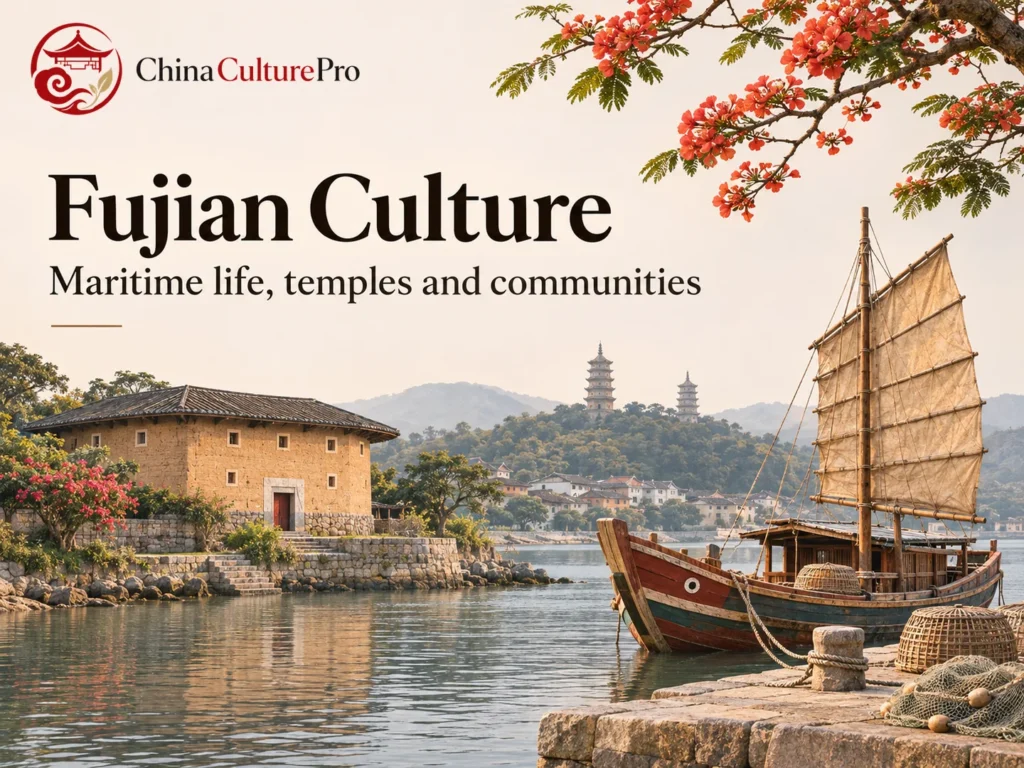

Quick Answer: What Is Fujian Culture Known For?
Fujian(福建,Fújiàn)culture encompasses the local traditions of a southeastern Chinese province with both coastal and inland communities.
- Maritime skills: Wooden shipbuilding connects carpentry, seafaring knowledge and apprenticeship.
- Religious communities: Sea-goddess festivals and Buddhist monasteries represent different kinds of religious life.
- Communal architecture: Earthen courtyard houses express particular approaches to shared residence and defense.
- Local performance: Different opera traditions use different regional speech and stage conventions.
Fujian culture is broader than its best-known southern coastal traditions. Provincial residence, language, ethnic identity and religious participation describe different things; none supplies a complete identity for everyone who lives there.

A shipwright’s timber joints, a temple procession and an inward-facing earthen house offer different starting points for understanding Fujian. Read together, they reveal connections among work, belief and community organization. This guide uses Chinese cultural geography to connect those examples without turning them into one provincial personality.
Fujian Is Larger Than Minnan
Minnan(闽南,Mǐnnán)means southern Fujian, a regional frame rather than another name for the entire province. Hakka(客家,Kèjiā)traditions in western Fujian belong to another important cultural setting. Fujian’s provincial heritage planning recognizes these regional traditions separately, alongside other cultural areas. [1]
She(畲族,Shēzú)communities add an ethnic dimension that should not be confused with those regional labels. A Hakka regional tradition and a She community are not equivalent categories. Nor does either label describe every resident’s language, occupation or daily practice.
Transmission also happens in contemporary institutions. A July 2026 provincial report describes She heritage teaching in schools and community spaces, including the Jindouyang martial-arts teaching base in Fu’an. Its examples include folk songs, dance and other skills. This is evidence of organized teaching, rather than a reason to imagine an entire community living unchanged in the past. [2] The dedicated guides to Minnan culture and She culture explore those settings more closely.
Maritime Knowledge: Ships, Trade and Ritual
Fujian’s maritime heritage includes practical knowledge embodied in wooden vessels. Watertight bulkheads divide a hull into compartments, limiting the spread of water if part of the vessel is damaged. Building them involves fitted timber, sealed joints and coordinated work under a master craftsperson. UNESCO’s account emphasizes oral instruction and apprenticeship: the heritage lies in skilled work as well as the finished boat. [3]
Ceremonies belong to this history too, but they answer a different question. Song-period inscriptions at Jiurishan near Quanzhou record wind-prayer ceremonies associated with the seasons of departure and return. The university maritime museum’s description identifies the carvings as records of those observances. [4]
Together, these examples show two responses to maritime uncertainty: technical construction and religious ritual. The inscriptions document what people did and commemorated; they do not establish that ceremonies controlled the weather.
Temples Connect Different Religious Communities
Mazu(妈祖,Māzǔ)devotion is especially associated with Meizhou Island in Putian and with maritime communities beyond Fujian. The island’s festival marks her traditional birthday on the twenty-third day of the third lunar month. Processions, offerings, drumming and ceremonial gestures bring participants together around a shared devotional occasion. [5]
That calendar belongs to religious tradition. Stories of the goddess rescuing sailors should be identified as devotional narratives, rather than presented as independently verified biography. The separate Mazu guide explains her wider religious significance.
Kaiyuan Temple(开元寺,Kāiyuán Sì)in Quanzhou represents a different institution: a Buddhist monastery. Its principal buildings and eastern and western stone pagodas form a major historic complex. Municipal heritage documentation connects the monastery’s history with the officials, monks and local families of the trading city. [6]
These are not interchangeable examples of one generic temple religion. Chinese Buddhism provides another framework for understanding monastic life, while individual participation and belief vary.
Tulou: Communal Houses in Different Shapes
The familiar photograph of a circular tulou(土楼,tǔlóu)can conceal the variety of these earthen buildings. UNESCO’s Fujian Tulou property includes both circular and square plans. Its 46 inscribed buildings form a selected heritage property, rather than a census of all such buildings in the province. [7]
Their architecture organized shared residence. Tall earthen walls and tiled roofs enclosed inward-facing courtyards; timber structures supported rooms arranged across several floors. Different households occupied sections of a larger building. Restricted entrances and protected outer walls also served defensive purposes.
The courtyard therefore mattered as much as the striking exterior: these were inhabited arrangements for households and communal activity. Their forms should not be reduced to an unusual skyline.
Tulou are one architectural tradition within Fujian. They do not describe every local home, and a circular shape alone cannot establish a building’s age, community history or heritage status.
Regional Opera Has More Than One Local Voice
Minju(闽剧,Mǐnjù), also called Fuzhou opera, uses Fuzhou speech onstage. Its development brought together several musical and theatrical strands; the provincial cultural department describes its circulation across central, eastern and northern Fujian and overseas. [8]
Puxian opera(莆仙戏,Púxiānxì)has a different regional base in Putian, Xianyou and surrounding communities. It uses Xinghua speech in singing and dialogue and has distinctive performance gestures. Its repertoire has also circulated among overseas Puxian communities. [9]
These differences matter when identifying a performance. “Fujian opera” is too broad to tell a reader which stage language or tradition they are encountering. Language, repertoire and trained movement supply more useful clues than a generalized costume image. The broader Chinese performing arts guide places regional theatre alongside other performance forms.
FAQs About Fujian Culture
Is Fujian Culture the Same as Minnan Culture?
No. Minnan refers to southern Fujian and its wider cultural connections. Fujian includes other regional settings and ethnic communities, so the two labels have different scopes.
Are All Fujian Tulou Circular?
No. Square buildings are also part of the recognized tradition. Circular examples are visually prominent, but shape alone does not explain a building’s history or community.
Does Every Fujian Temple Honor Mazu?
No. Mazu temples are one part of Fujian’s religious landscape. Buddhist monasteries and other religious institutions have different affiliations, practices and community histories.
Sources
[1] Fujian Provincial People’s Government. Fujian 15th Five-Year Culture and Tourism Development Plan
[2] Fujian Department of Culture and Tourism. Reply on She cultural heritage protection, July 2026
[3] UNESCO Intangible Cultural Heritage. Watertight-bulkhead technology of Chinese junks
[4] Shanghai Jiao Tong University C. Y. Tung Maritime Museum. Song wind-prayer inscriptions at Jiurishan
[5] Fujian Provincial People’s Government. National ICH: Mazu Festival
[6] Quanzhou Municipal People’s Government. Kaiyuan Temple and maritime communities
[7] UNESCO World Heritage Centre. Fujian Tulou
[8] Fujian Department of Culture and Tourism. Introduction to Minju
[9] Fujian Department of Culture and Tourism. Introduction to Puxian opera