

Quick Answer: What Is Zhejiang Culture Known For?
Zhejiang(浙江,Zhèjiāng)culture encompasses the histories and living traditions of a coastal province in eastern China. Commerce, literature, landscape design and skilled craft provide connected ways to understand it.
- Trading networks: Inland workshops and coastal ports connected products with distant markets.
- Books and writing: Private collections, literary works and museums preserve different kinds of cultural memory.
- Designed landscapes: Poetry and art helped shape the experience of celebrated places.
- Local arts: Theatre and carving traditions retain distinct regional histories.
These connections do not create a single provincial character. A city, workshop or theatrical tradition should be understood through its particular setting and development.
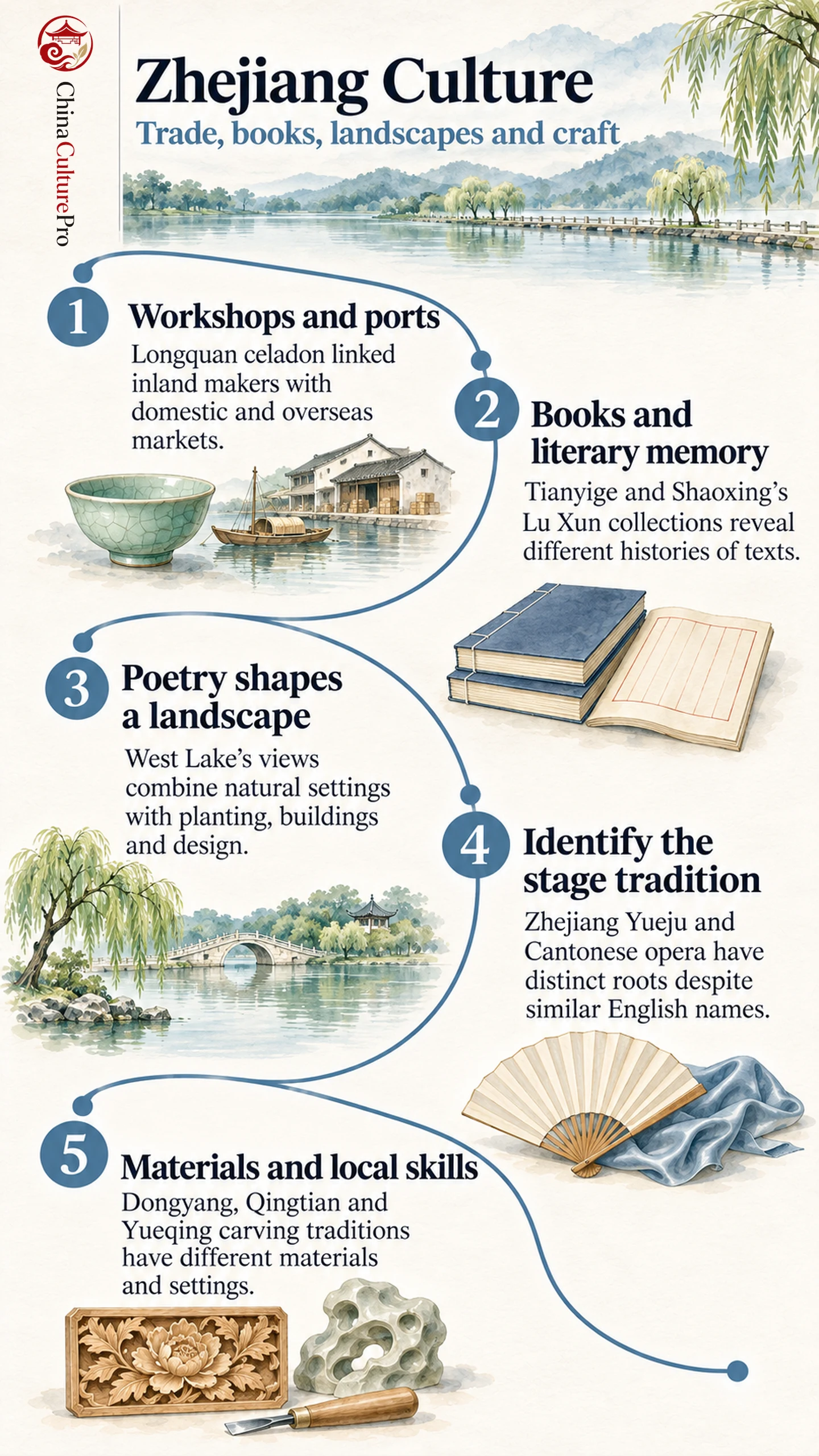
A green-glazed bowl, a library building and a theatrical costume reveal different parts of Zhejiang culture. Each connects local knowledge with a wider audience: goods travel, books circulate, and performances develop as artists and audiences meet in new settings.
Commerce Connected Inland Workshops and Ports
Longquan celadon(龙泉青瓷,Lóngquán qīngcí)illustrates how inland production and maritime exchange worked together. Kilns in Zhejiang produced green-glazed ceramics for domestic and overseas markets, and forms and decorative choices responded to different uses and customers. Their influence extended to workshops outside China. [1]
Ports connected this production with wider routes. Mingzhou, now Ningbo, and Quanzhou in Fujian were among the places through which Longquan wares reached Southeast Asia. [2] A ceramic object can consequently document relationships among raw materials, makers, merchants and consumers.
The comparison with porcelain traditions in Jiangxi culture is useful: different production centers developed different materials, technologies and markets. Neither province’s ceramics can be reduced to one interchangeable category of “Chinese porcelain.”
Commerce here describes institutions and activities. It should not be turned into a claim that every person from Zhejiang shares an entrepreneurial temperament. The historically useful questions concern who produced an object, how it moved and where it was used.
Books and Literature: Ningbo and Shaoxing
Tianyige(天一阁,Tiānyī Gé)in Ningbo makes the work of collecting books visible. Fan Qin(范钦,Fàn Qīn)established the library in the sixteenth century. His collection included local gazetteers and examination records, as well as other works.
These materials preserve information about places, administration and learned careers. The building and the continuing history of its collection show that literary culture also depends on selecting, copying, housing and caring for texts. [3]
Shaoxing provides a modern literary connection through Lu Xun(鲁迅,Lǔ Xùn). The Lu Xun Literature Edition Museum opened near his former residence in October 2026, presenting editions, translations and documentary material associated with his work. [4]
A writer’s text and the history of its publication are related subjects. Different editions and translations show how readers encounter a work across time and language. A museum can present that transmission without implying that a hometown alone explains an author’s ideas.
West Lake: A Landscape Shaped by Poetry and Design
West Lake(西湖,Xī Hú)in Hangzhou is a cultural landscape shaped by both natural features and human work. Causeways, islands, gardens, temples and ornamental planting have contributed to the vistas associated with its literary and artistic reputation.
Poets and artists helped give particular views meaning, while successive interventions made those views physically legible. The landscape’s influence extended to garden design elsewhere in China and into Japan and Korea. [5]
This relationship offers a useful entry into Chinese painting techniques: a landscape can be represented in art while also being arranged and experienced through artistic conventions.
Seasonal planting adds another layer. The lake’s cultural landscape includes traditions of peach blossom and willow planting, lotus, osmanthus and winter-flowering plum. [6] These plants contribute to changing seasonal experiences rather than a single permanent scene.
Reading the lake as cultural heritage therefore involves its construction and maintenance as well as its appearance. Calling a place beautiful supplies less explanation than asking how people selected, named and sustained its views.
Yueju Opera: A Zhejiang Tradition with a Wider Stage
Yueju(越剧,Yuèjù)developed around Shengzhou, historically Shengxian, from local sung storytelling and related performance traditions. It reached Shanghai in the early twentieth century, where new audiences and theatrical conditions contributed to its development.
Women’s companies became especially influential. That history should not be simplified into a claim that the genre has always consisted exclusively of female performers. Its music, acting and stage design developed through artistic exchange and adaptation. [7]
Another naming distinction matters in English: Cantonese opera(粤剧,Yuèjù)has the same Mandarin romanization but different Chinese characters and regional roots. It belongs to Cantonese-speaking cultural networks associated with Guangdong, Guangxi and the wider Lingnan cultural setting. [8]
Both belong within Chinese performing arts. A shared English rendering such as “Yue opera” is insufficient to identify which tradition a program describes; the Chinese name and regional context resolve the ambiguity.
Regional Crafts Have Their Own Materials and Places
Zhejiang’s carving traditions provide another way to read locality through materials. Three frequently associated names identify different regional practices. [9]
| Tradition | Regional and material identification |
|---|---|
| Dongyang woodcarving(东阳木雕,Dōngyáng mùdiāo) | Woodcarving associated with Dongyang |
| Qingtian stone carving(青田石雕,Qīngtián shídiāo) | Stone carving associated with Qingtian |
| Yueqing boxwood carving(乐清黄杨木雕,Yuèqīng huángyáng mùdiāo) | Boxwood carving associated with Yueqing and the wider Wenzhou setting |
Yueqing boxwood work, for example, includes sculpture carved in the round. Its material, scale and treatment invite a different kind of looking from a flat decorative panel. [10] Recognizing a category is only a beginning: individual makers, techniques and dates still need attention.
This is also why a modern work can continue an inherited practice without being an antique. Material knowledge persists through making and teaching, while objects acquire new subjects and settings.
As in Chinese cultural geography, the most useful regional account connects specific places and practices. Zhejiang’s literary, commercial and artistic histories become clearer through those relationships.
FAQs About Zhejiang Culture
Does Zhejiang Have One Uniform Regional Culture?
No. Its cities and communities have distinct histories, languages and practices. A provincial frame helps locate examples but cannot replace their local context.
Is Yueju the Same as Cantonese Opera?
Zhejiang Yueju and Cantonese opera are different traditions. Their Mandarin names sound alike, but the Chinese characters, regional histories and performance contexts differ.
Are Zhejiang’s Cultural Landscapes Entirely Natural?
Natural settings and human work often interact. West Lake’s celebrated views include designed causeways, planting, buildings and other interventions accumulated over time.
Sources
[1] The Palace Museum. Longquan of the World: Longquan Celadon and Globalization
[2] Smithsonian National Museum of Asian Art. Longquan: Ceramics in Mainland Southeast Asia
[3] The Palace Museum. Tianyige
[4] Zhejiang Provincial Information Office. Lu Xun Literature Edition Museum Opens in Shaoxing
[5] UNESCO World Heritage Centre. West Lake Cultural Landscape of Hangzhou
[6] West Lake Museum. Introduction
[7] China Intangible Cultural Heritage Digital Museum. Yueju
[8] UNESCO Intangible Cultural Heritage. Cantonese Opera
[9] Zhejiang Provincial Information Office. Folk Art
[10] China Intangible Cultural Heritage Digital Museum. Yueqing Boxwood Carving