
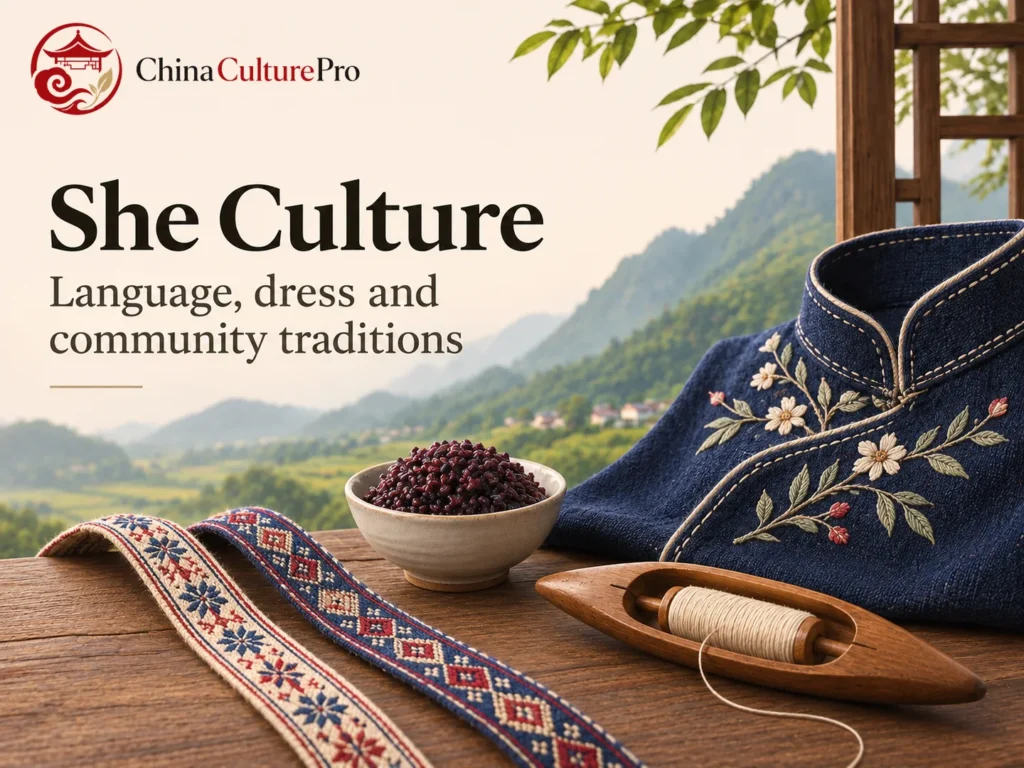

Quick Answer: What Does She Culture Include?
She(畲族,Shēzú)culture includes the language practices, crafts, oral traditions and community customs of an ethnic group concentrated especially in Fujian and Zhejiang, with communities elsewhere in southeastern China. Its ethnic identity does not correspond to one uniform language or garment. [1]
- Language: Different communities have different linguistic histories.
- Textile arts: Garment construction, embroidery and woven bands are distinct skills.
- Songs and stories: Oral works transmit narratives, social knowledge and ceremonial expression.
- Celebration: Seasonal gatherings connect ancestry, food and performance.
Regional examples are essential. A wedding outfit, a festival program or a linguistic label cannot describe every She person’s daily life.
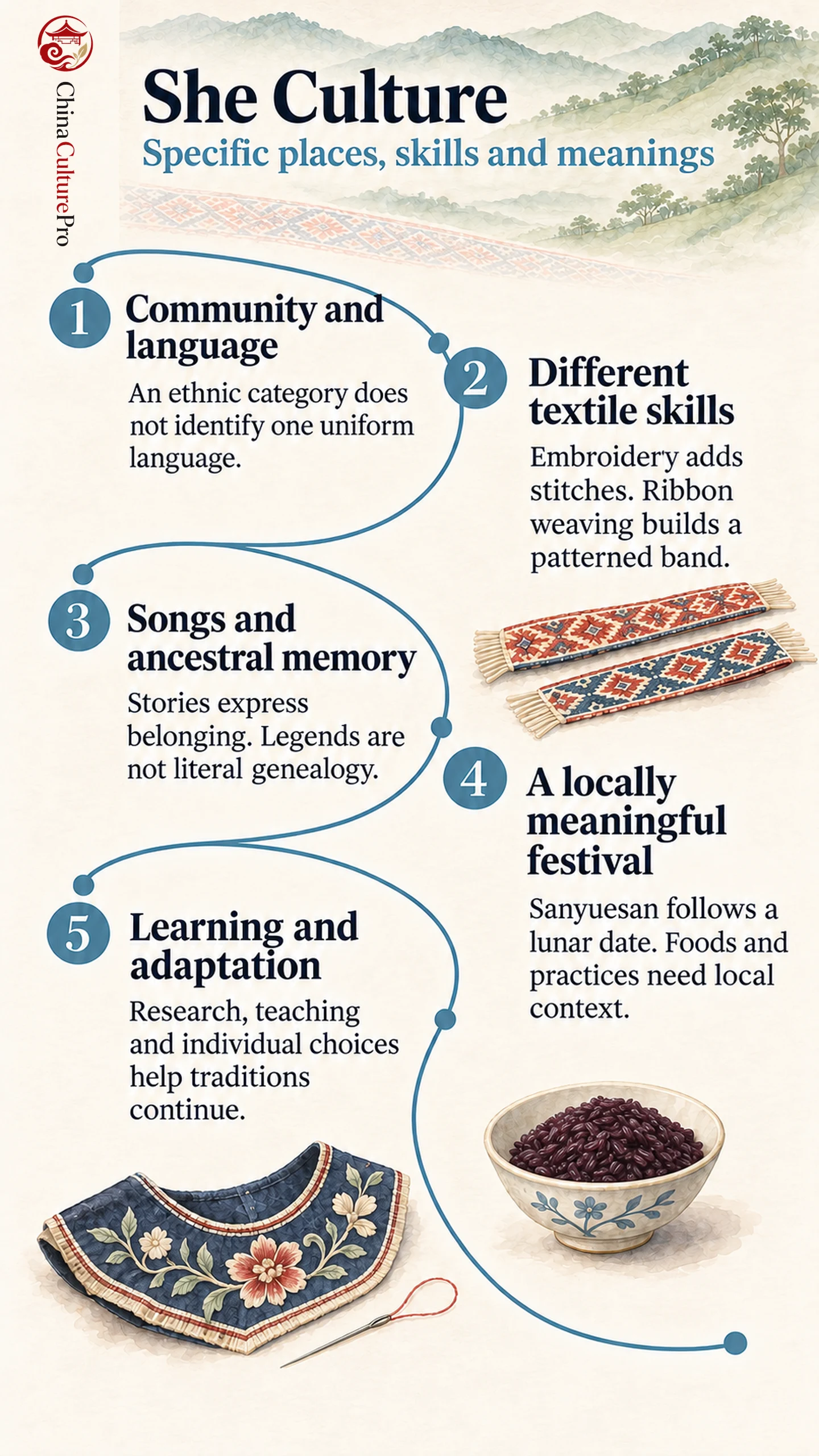
A decorated jacket and a narrow patterned band may belong to the same outfit while being made in different ways. The same need for distinction applies to speech and ceremony: learning about She culture means connecting specific practices with the people and places that sustain them.
Communities and Different Language Histories
Fujian and Zhejiang contain important She communities, while others live in provinces including Jiangxi, Guangdong and Anhui. The geography involves dispersed settlements and relationships with neighboring communities. [1] Guides to Fujian culture and Zhejiang culture provide regional context; neither province is culturally identical with one ethnic group.
Shehua(畲话,Shēhuà)is commonly discussed in relation to Hakka Chinese(客家话,Kèjiāhuà). This linguistic setting differs from Ho Ne(畲语,Shēyǔ), a Hmong-Mien language documented in parts of Guangdong. Similar English labels can hide that distinction. [1][2]
Linguistic classification depends on evidence about vocabulary, sounds and their historical relationships. Dress, ancestral stories and geographical proximity alone cannot determine which language family a community’s speech belongs to. [2]
The wider framework of Chinese ethnic groups therefore needs a second level of description: which place, which language and whose experience are being discussed.
Phoenix Attire, Embroidery and Woven Ribbons
Phoenix attire(凤凰装,fènghuángzhuāng)is a recognizable name for traditional clothing associated especially with women’s dress. Yet the complete outfit, its construction and its decorative components are different things.
A description of Luoyuan and Huokou practice in Fujian records collaboration between tailors and embroiderers. Embroidered collars and apron pieces can be prepared before being incorporated into garments; further embroidery can appear on sleeves, lapels and other surfaces. That division of work helps explain how a finished outfit comes together. [3]
Woven ribbons(彩带,cǎidài)provide a separate craft example. Jingning’s national heritage record, published in 2021, describes bands made using cotton, ramie or silk threads. Their uses include clothing decoration, belts, carrying straps and gifts expressing affection or good wishes. [4]
| Technique | What creates the decoration |
|---|---|
| Embroidery | Stitches are worked onto a textile surface, including pieces later incorporated into clothing. [3] |
| Ribbon weaving | Threads form a narrow patterned band; the structure and pattern are created through weaving. [4] |
Some bands include characters as well as other motifs. Their meaning should be identified from the particular object and context, rather than assumed from color alone. A woven wish for good fortune expresses cultural meaning, not a guarantee of protection. [4]
Folk Songs, Ancestral Stories and Panhu
Folk songs serve several purposes. The Ningde heritage record distinguishes narrative songs, songs concerning everyday subjects such as work and affection, and ritual songs associated with weddings or ancestral ceremonies. They communicate knowledge as well as providing entertainment. [5]
Singing may involve exchanges between people, so knowing a melody is not the whole skill. The words, the response and the social occasion all matter. Oral transmission includes learning how to respond to other people as well as remembering words.
Panhu(盘瓠,Pánhù)belongs to an important ancestral narrative tradition. The Gaohuang Song(高皇歌,Gāohuánggē)retells stories associated with this figure and community origins. Related stories can also appear in ancestral images and ceremonial settings. [6]
These are sources for understanding memory, belonging and ritual interpretation. They do not establish literal biological descent or one independently verified migration route for every She family. The narrative’s cultural importance can be explained without treating legend as a complete historical chronology.
Within performing arts, distinguish the story being told from the way a particular singer presents it.
Sanyuesan and Dark Rice
Sanyuesan(三月三,sānyuèsān)refers to the third day of the third lunar month. A national heritage record associated with Jingning, listed in 2008, connects its observance with ancestral remembrance, singing, social gathering and other activities. [7]
Dark rice(乌饭,wūfàn)is one characteristic food. Its color comes from plant-derived liquid used with the rice; the name does not necessarily identify a naturally black rice variety. Stories connecting this food with an ancestral struggle are transmitted legends, rather than a securely dated explanation of every family’s practice. [7]
The connection between food, remembrance and sharing matters within wider food culture. A dish can mark an occasion without becoming the sole defining food of an ethnic group.
A lunar date shared by several communities also does not establish identical celebrations. The participants, stories, foods and ritual settings must be identified locally.
Community Traditions in Changing Settings
Wedding customs offer a specific example of sung interaction. In documented Jingning practice, welcoming parties can encounter playful obstacles, requests and riddles, with singing incorporated into hospitality. These activities connect verbal skill with relationships between participating families. They are not instructions that every contemporary wedding must follow. [8]
Craft knowledge also continues through research and discussion. In August 2024, a Zhejiang textile society team visited She cultural organizations and workshops around Lishui while preparing garment specifications. Discussions covered regional differences, materials, colors, classification and making techniques. [9]
The work illustrates why documenting a tradition requires attention to variation. A technical description can help explain and transmit a craft; it does not make one outfit compulsory for everyone. People sustain recognizable forms through teaching, adaptation and individual choices.
FAQs About She Culture
Is Shehua the Same as Ho Ne?
No. Shehua is discussed in relation to Hakka Chinese, while Ho Ne belongs to Hmong-Mien. An ethnic label and a language-family label describe different things. [1][2]
Do All She People Wear Phoenix Attire Daily?
No. Heritage clothing describes particular regional forms and occasions. A ceremonial outfit should not be treated as a uniform daily dress code or a test of someone’s ethnic belonging.
Are She Ribbons Embroidered?
Traditional patterned ribbons are woven. Embroidery is a different technique that may appear elsewhere on an outfit. A finished garment can bring both methods together. [3][4]
Is She Sanyuesan the Same as Every Other Third Month Festival?
No. A shared lunar date does not mean identical stories, ceremonies or foods. Identify the particular community and practice rather than combining all celebrations into one. [7]
Sources
[1] National Ethnic Affairs Commission. She ethnic group overview
[2] Martha Ratliff. Ho Ne (She) Is Hmongic: One Final Argument
[3] Fujian Provincial Government. National ICH: She ethnic attire
[4] China Intangible Cultural Heritage. She ribbon weaving
[5] China Intangible Cultural Heritage. She folk songs
[6] National Ethnic Affairs Commission. She customs
[7] China Intangible Cultural Heritage. She Sanyuesan
[8] China Intangible Cultural Heritage. She wedding customs
[9] China Association for Science and Technology. Zhejiang textile society fieldwork on She garment specifications,2024