

Quick Answer: What Does Lisu Culture Include?
Lisu(傈僳族,Lìsùzú)culture includes the language, arts and community practices of people living in parts of Yunnan, Sichuan and neighboring countries. Nujiang and Weixi are important settings in China, but neither represents every Lisu community. [1][2]
- Language and writing: A spoken language and its different writing systems require separate attention.
- Oral arts: Named song genres carry narratives, social commentary and personal expression.
- Instrumental music: Local instruments support particular singing and dancing forms.
- Community occasions: Weddings and New Year gatherings combine inherited practices with changing circumstances.
Cultural belonging does not require one faith, one costume, one script or a fixed set of performances.
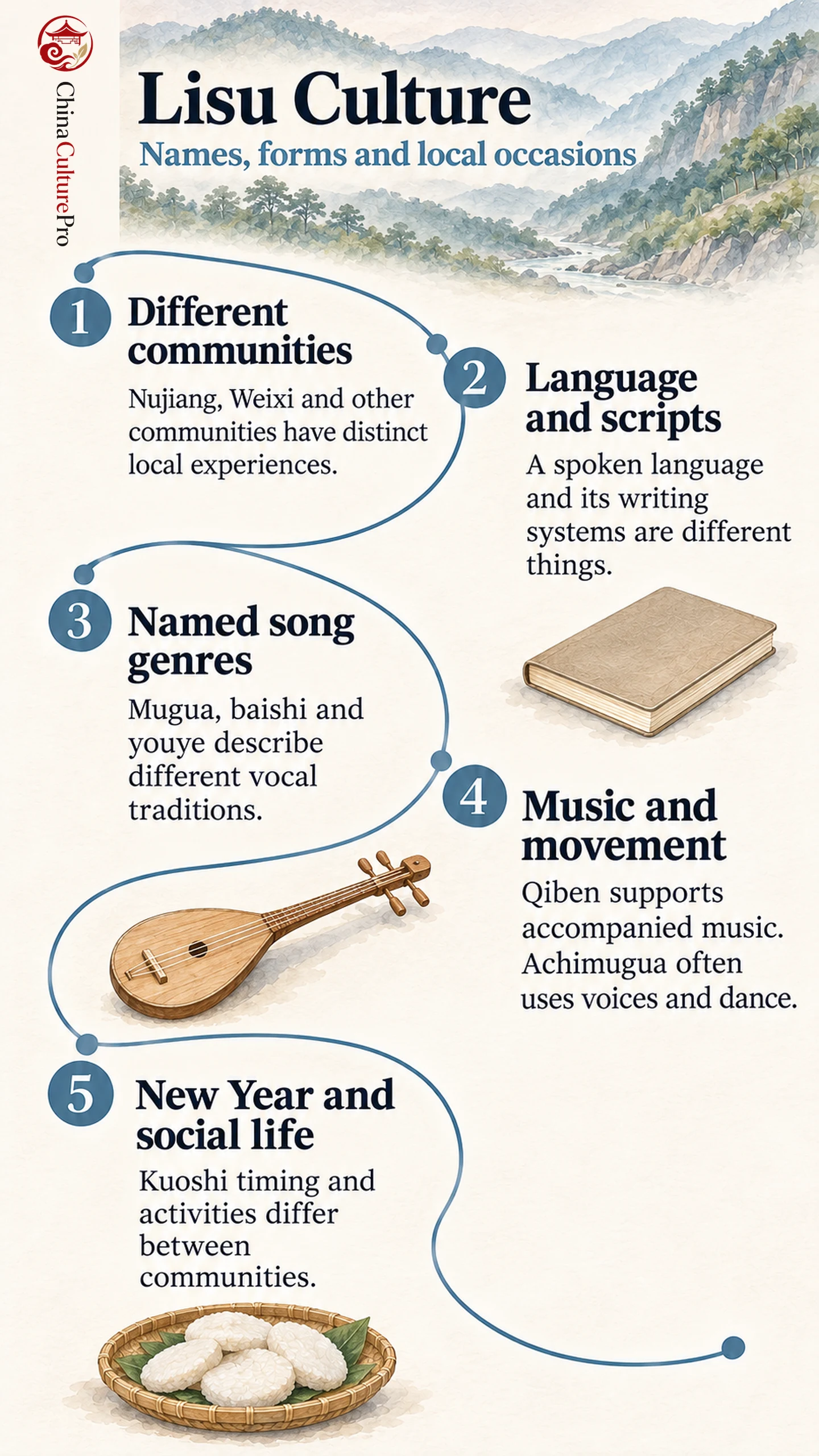
Some Lisu writing resembles familiar capital letters, while a folk-song title may describe either a story or a way of singing. Reading these forms well means asking what each name identifies and where it is used, within the wider setting of Yunnan culture.
Lisu Communities and Regional Differences
In China, important communities include those in Nujiang, Weixi and other parts of Yunnan, as well as southwestern Sichuan. Settlements often exist alongside other ethnic communities. Their local histories involve different settlements and relationships with neighboring communities. [1]
Religious life also differs. Research on Lijiang and Weixi wedding practices distinguishes its field sites from Nujiang communities shaped more strongly by Christian musical traditions. That comparison concerns particular places and histories; it does not divide all Lisu people into two uniform religious camps. [7]
The distinction matters when reading a cultural display. A church choir, a narrative song and a village dance may all connect with Lisu life, but they are different practices. As with other Chinese ethnic groups, the ethnic name alone cannot establish an individual’s language, beliefs or musical experience.
Lisu Language and Different Writing Systems
The Lisu language(傈僳语,Lìsùyǔ)has regional varieties and is spoken across national borders. A linguistic description distinguishes northern, central, southern and eastern varieties, while identifying the literary variety’s relationship to central speech. That is a language description, not a count of identical community cultures. [2]
The Fraser script(老傈僳文,lǎo Lìsùwén)uses upright and inverted capital-letter forms, with punctuation-like marks representing tones. Familiar shapes therefore work within a specifically Lisu system. It is not English written with unusual typography. [2]
A new Lisu orthography(新傈僳文,xīn Lìsùwén)was developed in the 1950s using Latin letters and principles associated with Chinese phonetic spelling. Other local writing experiments also form part of the history. Script choice should be identified for the particular text, rather than assuming every Lisu reader uses the same system. [1][2]
Mugua, Baishi and Youye: Song Genres
Mugua(木刮,mùguā), baishi(摆时,bǎishí)and youye(优叶,yōuyè)are named genres in the national heritage record for Lisu folk songs. They are not three instruments or three ethnic subgroups. [3]
| Genre | What helps distinguish it |
|---|---|
| Mugua | Associated especially with narrative songs and long oral works concerning subjects such as origins, production and relationships. |
| Baishi | Heard in social and festive settings; it can include inherited narrative material and improvised responses to another singer. |
| Youye | Particularly associated with Fugong communities; documented forms include reflective exchanges and lighter songs of personal expression. |
The genres differ in their words, performance styles and social occasions. They should not become rigid rules about the age or gender of every singer. Lead singing, responses, vocal ornament and additional syllables can contribute to the texture. [3]
An oral work can preserve a story while allowing a performance to respond to its listeners. Understanding the genre therefore involves more than translating its title. Within performing arts, the text and the way people perform it are connected but distinct.
Qiben Music and Achimugua Dance
The qiben(其奔,qíbēn)is a locally made plucked instrument used to accompany singing and dancing. A Yunnan heritage account describes a Nujiang form with a hollowed wooden body, a wooden soundboard and four metal strings. Although its music is sometimes compared with three-string lute music, that comparison is not a reliable string count for every instrument. [4]
Qiben-supported songs address work, animals, affection, marriage and other everyday subjects. Their light, dance-oriented character provides a useful contrast with solemn long narrative performance, without making one form representative of all Lisu music. [4]
Achimugua(阿尺木刮,āchǐmùguā)is a collective song-and-dance tradition associated especially with Tongle and Xinle around Yezhi in Weixi. Its name evokes goats and their calls. Lead, supporting and accompanying voices work with coordinated steps; most forms described in the provincial record use no instrumental accompaniment. [5]
Inherited words and improvisation both have a place. The movement and vocal sound connect to a local pastoral setting, but a story about a dance’s creation should not be treated as a documented founding event.
Kuoshi and Changing Community Occasions
Kuoshi(阔时节,kuòshíjié)is a New Year celebration. A national heritage record associated with Lushui, published in 2021, describes variable local timing and activities including visiting, songs, dance and games. It does not establish a single calendar date observed everywhere. [6]
Rice or corn cakes and fermented grain drinks occur in documented New Year food traditions. Such foods connect preparation and sharing with the occasion, rather than defining every person’s daily diet. [8] The wider subject of food culture includes these relationships between a dish and its setting.
Weddings provide another example of change. A study published in 2026 drew on 2020–2021 fieldwork in Lijiang and Weixi. The researcher attended seven weddings with different combinations of traditional and modern elements. Music and dance unfolded across different spaces and interactions rather than functioning only as a fixed ceremonial checklist. [7]
That documented variation is a reason to identify a particular family, place and occasion before describing a custom as universally Lisu.
FAQs About Lisu Culture
Is Lisu Writing the Same as English?
No. The Fraser system uses some familiar-looking letter forms, but assigns them to Lisu speech and marks tones. Knowing English letters does not supply the pronunciation or meaning of a Lisu text. [2]
Are All Lisu Songs Unaccompanied?
No. Qiben music provides a documented accompanied form, while many Achimugua performances rely on voices and dance without instruments. Identify the particular genre and setting. [4][5]
Do All Lisu People Follow the Same Religion?
No. Regional and family histories differ. The broader context of religion in China helps distinguish ethnic identity from individual faith; neither a script nor a performance alone determines someone’s beliefs. [7]
Does Kuoshi Have One Date Everywhere?
No. Local customs and calendars differ. A public festival’s dates describe that event, and should not automatically be applied to every household or community celebration. [6]
Sources
[1] National Ethnic Affairs Commission. Lisu ethnic group overview
[2] Marija Tabain, David Bradley and Defen Yu. Central Lisu
[3] China Intangible Cultural Heritage. Lisu folk songs
[4] Yunnan Intangible Cultural Heritage Protection Center. Lisu folk songs qiben
[5] Yunnan Intangible Cultural Heritage Protection Center. Achimugua
[6] China Intangible Cultural Heritage. Kuoshi festival
[7] Keyi Liu. Music, Dance, Co-Presence, and Ethnographic Contingency at Indigenous Lisu Weddings in Southwest China
[8] National Ethnic Affairs Commission. Lisu customs