


Quick Answer: Who Was Cui Hao?
Cui Hao (崔颢, Cuī Hào) was an eighth-century Tang poet and official, best known for a celebrated tower poem. He died in 754; his birth year is uncertain. [1]
- Read the tower poem for the movement from a vanished legendary world to homesickness.
- Read two short river songs together for a compact encounter between voices.
- Read a mountain journey poem for a prospect that ends by questioning worldly ambition.
These readings show a range of poetic situations beyond the fame of one tower poem.
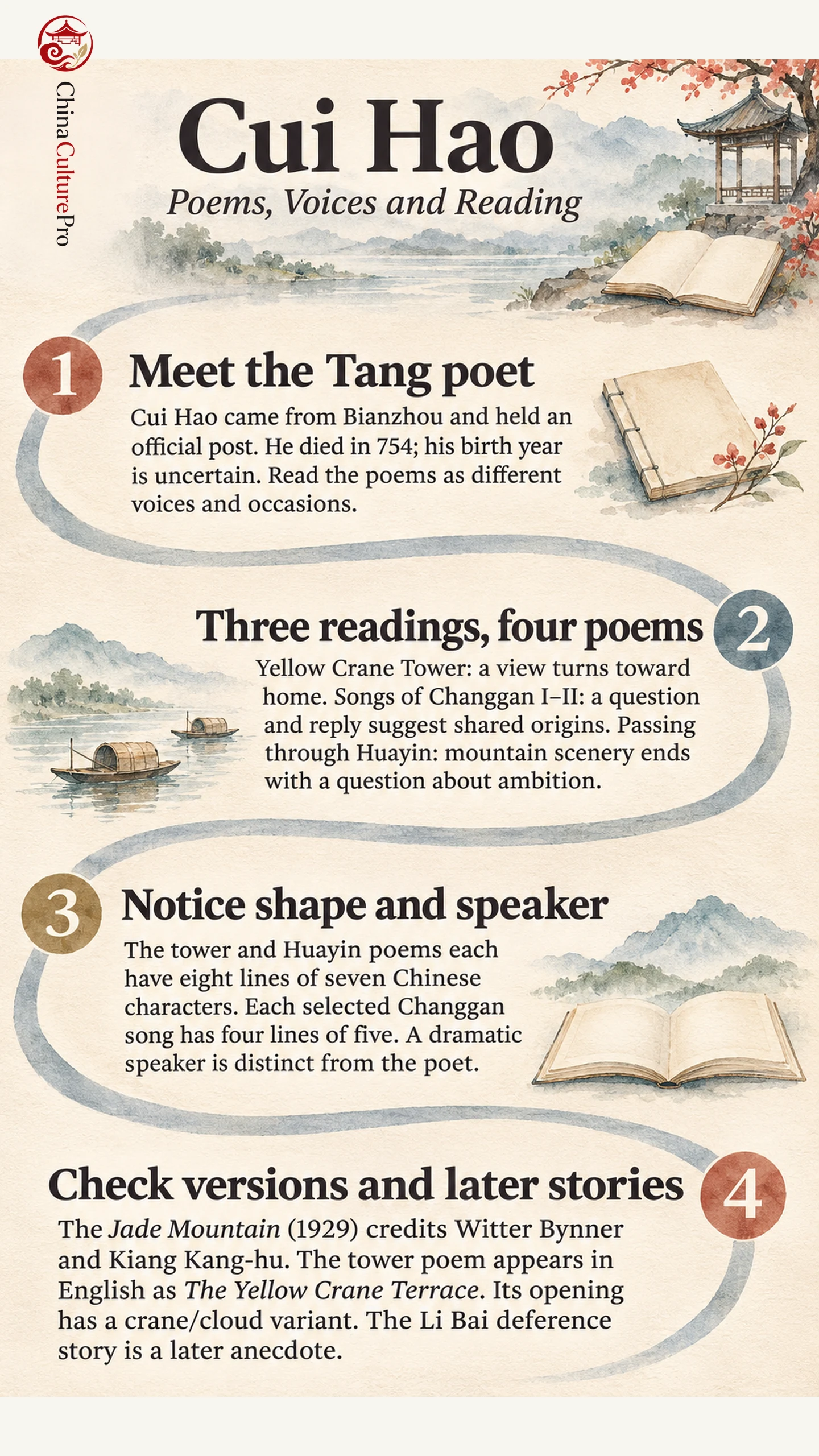
Cui Hao’s poems can open a wide landscape or hold a brief exchange between people in boats. Their endings matter: a view can become a question about home, a stranger can become a possible neighbour, and a road can suggest a different way to live. Begin with the movement of each poem before turning its voice into a statement about the poet’s life.
An Eighth-Century Poet and Official
Cui came from Bianzhou, associated with present-day Kaifeng in Henan. He passed the imperial examination and held an official post in the central administration. The biographical outline places him within the Tang dynasty, but leaves substantial gaps. [1]
That limited record makes the poems especially important. The three groups below offer concrete entry points into his writing: a tower view, river conversation and mountain journey. Read them within the broader tradition of Tang poetry, while allowing each speaker and occasion its own concerns.
Three Readings and What to Notice
- Yellow Crane Tower: In this poem (黄鹤楼, Huánghè Lóu), a legendary rider has departed, the crane never returns, and clouds outlast human absence. A clear view of trees and grasses then gives way to evening and a question about home. Follow the shift from the remote past to a present observer whose surroundings awaken longing. The scene’s emotional force comes from that change in perspective. [2]
- Songs of Changgan, first two poems: These pieces from the four-poem group (长干曲, Chánggān Qǔ) can be read as a paired encounter. A woman asks where the other traveller lives, gives her own home place and stops her boat to ask whether they might share an origin. The answering voice identifies a life by the river and a common Changgan background, despite their not having known each other when young. Notice how a few questions and place references create the possibility of recognition. [3]
- Passing through Huayin: This poem (行经华阴, Xíng Jīng Huàyīn) presents towering peaks, clouds dispersing by an imperial shrine and a landscape opening after rain. Roads and mountain strongholds place the view within a world of travel and power. The final question addresses people pursuing reputation and profit: how does that pursuit compare with learning the way of long life here? The mountain becomes an imagined alternative to the road’s ordinary ambitions. [4]
Form, Perspective and the Last Turn
The longer two poems use the eight-line framework of regulated verse, or lushi (律诗, lǜshī). The Changgan pieces work on a much smaller scale. Looking at their Chinese line shapes helps distinguish these reading experiences. [4]
| Reading | Visible shape in Chinese | What to follow |
|---|---|---|
| Yellow Crane Tower | Eight lines, seven characters per line | Recurring images and the closing turn toward home. [2] |
| Passing through Huayin | Eight lines, seven characters per line | Paired landscape details and the final question. [4] |
| First two Songs of Changgan | Four lines of five characters in each poem | A question, an answer and the relation between speakers. [3] |
The guide to Chinese regulated verse explains the larger formal tradition. English translations may arrange or expand lines differently, so their printed shape need not reproduce the original’s character count.
Voice also changes the reading. The woman in the Changgan encounter is a dramatic speaker; the poem does not identify her speech as an incident from Cui’s own life. Likewise, Huayin’s closing alternative invites reflection without documenting that the author abandoned his official career. [3][4]
English Versions and Comparing Editions
An established English entry is The Jade Mountain (1929), translated by Witter Bynner from texts prepared by Kiang Kang-hu. It presents the traditional Three Hundred Tang Poems anthology (唐诗三百首, Tángshī Sānbǎi Shǒu), rather than Cui Hao’s complete collected works. [6][7]
Bynner’s version of the tower poem is titled The Yellow Crane Terrace. The different English noun does not by itself indicate a different Chinese poem. [8]
When comparing translations, check the author, Chinese title and opening words. Titles and romanizations vary, and the tower poem also circulates with a crane or a white cloud in its opening line. Keep that textual variation separate from a translator’s choices about English phrasing. [2]
The literary allusions guide provides a useful next step when legendary figures or earlier imperial references carry more meaning than a literal landscape description reveals.
FAQs About Cui Hao
Did Li Bai refuse to write after reading Cui Hao?
The later Tang Caizi Zhuan (唐才子传, Táng Cáizǐ Zhuàn) tells a story in which Li Bai (李白, Lǐ Bái) defers to Cui’s tower poem and leaves without composing his own. Treat it as a record of literary reputation and anecdote, rather than a verified transcript of their lives. The Li Bai guide and the distinction between history and legend offer related context. [5]
Is Yellow Crane Tower a four-line poem?
Its Chinese text has eight lines of seven characters each. Four printed couplets should not be mistaken for four individual verse lines. [2]
Why do some versions begin with a crane and others with a cloud?
The Chinese text has a recorded opening-line variant: the departing figure rides a yellow crane in one version and a white cloud in another. Compare the actual text used by each edition. [2]
Sources
[1] Ministry of Education, Taiwan. Revised Mandarin Chinese Dictionary: Cui Hao
[2] Cui Hao, Chinese text hosted by Wikisource. Yellow Crane Tower, Including Opening-Line Variant
[3] Cui Hao, Chinese text hosted by Wikisource. Collected Poems: Songs of Changgan
[4] Chinese poetry education resource, TPPS. Seven-Character Regulated Verse: Passing through Huayin
[5] Xin Wenfang, Chinese text hosted by Chinese Text Project. Tang Caizi Zhuan, Volume One: Cui Hao
[6] Smithsonian Institution, Collections Search Center. The Jade Mountain: Translation Credits and Catalogue Record
[7] WorldCat. The Jade Mountain: 1929 Knopf Publication Record
[8] Classical Chinese Literature. Yellow Crane Tower: Chinese Text and Witter Bynner Translation Credit