


Quick Answer: Who Was Dai Wangshu?
Dai Wangshu (戴望舒, Dài Wàngshū; 1905–1950) was a Chinese poet, translator and editor associated with modernist writing. His career connected Hangzhou, Shanghai, France and Hong Kong. [1][2]
- Begin with an alley poem for atmosphere, repeated sounds and an elusive encounter.
- Compare a short mirrored poem to see repetition organize a whole text.
- Read the wartime poems for their different ways of joining personal vulnerability, imagined space and hope.
His writing offers more than one emotional register. The person speaking, the audience addressed and the shape of the poem all deserve attention.
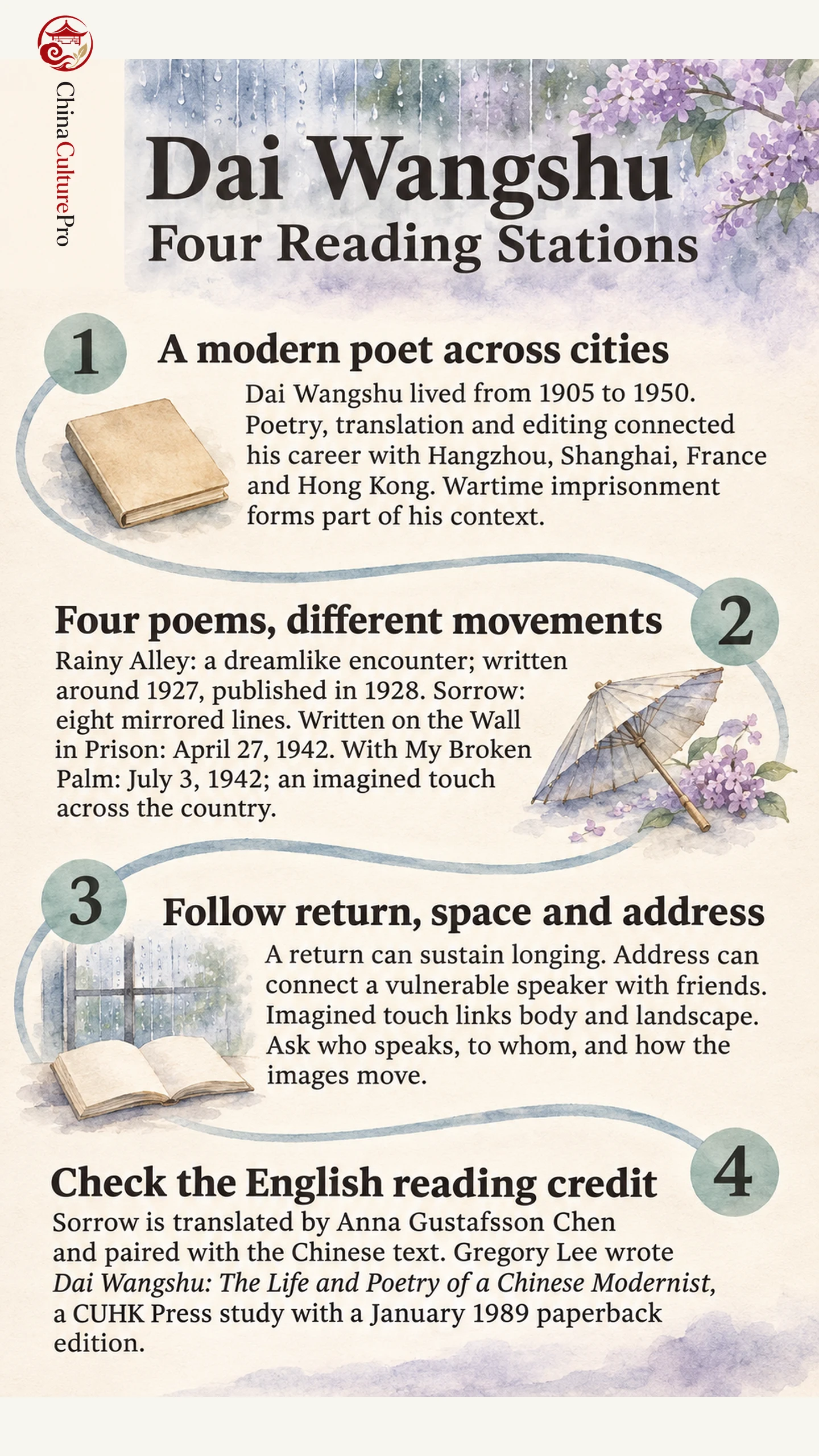
Dai Wangshu’s name is closely associated with an umbrella, rain and a lilac-like woman. Reading beyond that familiar scene reveals a poet who could turn a repeated line inward or address friends and a country under occupation. Four poems provide a compact route through those different possibilities.
A Poet, Translator and Editor across Cities
Born in Hangzhou, Dai studied French and spent 1932–1935 in France. Translation and editorial work accompanied his own poetry: he translated French verse, including poems by Paul Verlaine, and helped establish literary periodicals in Shanghai before working in Hong Kong. This places him within a network of modern Chinese literature. He died in Beijing in 1950. [1]
During the Japanese occupation of Hong Kong, he was imprisoned in Victoria Prison. His wartime poems need that historical setting, while their imagined scenes still call for close attention as poetry. [9]
His writing and translations in Hong Kong’s cultural world have also been the subject of research into the relationship between modernist aesthetics and wartime literary commitments. That perspective helps keep translation, poetic experiment and historical pressure in view together. [2]
Four Poems and What to Notice
- Rainy Alley: This poem (雨巷, Yǔ Xiàng), written around 1927 and published in 1928, follows a speaker carrying an oil-paper umbrella and hoping for an encounter. The woman is associated with lilac colour, fragrance and sadness; her approach and disappearance remain dreamlike. Repeated phrases make the walk seem hesitant and prolonged. At the end, the poem returns toward its opening, with the longing still unresolved. Notice how the return changes the experience of the scene. [3][8]
- Sorrow: The eight lines of this poem (烦忧, Fányōu) mirror themselves: the first four return in reverse order. A withheld name sits at the centre of that structure. The reader can follow the pattern even before deciding what particular relationship lies behind the feeling. Its repetition turns concealment into an organizing principle. [6]
- Written on the Wall in Prison: This poem (狱中题壁, Yùzhōng Tí Bì), dated April 27, 1942, addresses friends from the possibility of the speaker’s death. He imagines their return, remembrance and a future in which his remains reach sunlight and open air. The dark, damp cell gives that imagined openness its force. Read for the movement from a threatened individual toward a community that may survive him. [4]
- With My Broken Palm: This poem (我用残损的手掌, Wǒ Yòng Cánsǔn de Shǒuzhǎng), dated July 3, 1942, imagines a damaged hand passing over the country’s landscapes. Cold, water, plants, blood and ashes make geography something felt through the body. The poem turns toward a distant, intact corner associated with warmth, spring and renewal. Follow how changes of sensation carry the movement from devastation toward hope. [5]
Repetition, Imagined Space and the People Addressed
Repetition does different work in the earlier two poems. Rainy Alley returns to an unresolved desire after the dreamlike passing of the woman; Sorrow folds its lines back around something that cannot be spoken directly. In both cases, the formal pattern sustains the feeling through return. [3][6]
The wartime poems change the scale of the imagined relationship. The prison poem turns to friends who may carry memory into a future victory. The palm poem makes bodily touch travel across a country that the speaker cannot physically survey in that way. Their emotional force depends on acts of address and imagination as well as historical circumstances. [4][5]
This is a useful way into Chinese poetry: ask who speaks, to whom, and what a repeated image or changing space makes possible.
English Reading and Translation Credits
An accessible short starting point is Anna Gustafsson Chen’s English translation of Sorrow, presented alongside the Chinese text. The signed page makes both the translator’s credit and the mirrored eight-line arrangement clear. This offers one poem in bilingual form. [6]
For a longer English-language study, Gregory Lee’s Dai Wangshu: The Life and Poetry of a Chinese Modernist was published by the Chinese University of Hong Kong Press in a paperback edition dated January 1989. [7]
When searching for the wartime poems, keep their Chinese titles beside the English ones. Renderings of the hand or palm, and of the prison-wall title, differ across English accounts. A matching Chinese title gives a firmer point of identification than an English noun alone. [9]
FAQs About Dai Wangshu
Who is the girl in Rainy Alley?
The poem does not name her. It creates a dreamlike figure through resemblance, fragrance, colour and movement. A particular biographical identity or a single fixed allegorical meaning goes beyond what the text itself establishes. [3]
Were the two wartime poems written on the same date?
Their texts carry different dates: April 27, 1942, for Written on the Wall in Prison, and July 3, 1942, for With My Broken Palm. These are composition dates recorded with the texts; publication dates are separate. [4][5]
Who translated the online poem Sorrow?
The version discussed here is credited to Anna Gustafsson Chen. It pairs her translation with the Chinese original, allowing readers to compare the mirrored line pattern. [6]
Sources
[1] Hangzhou Municipal Archives. Dai Wangshu: Biography
[2] Chinese University of Hong Kong. Dai Wangshu’s Writings and Translations in Hong Kong, 1938–1949
[3] Dai Wangshu, Chinese text hosted by Chinese Poetry Library. Rainy Alley
[4] Dai Wangshu, Chinese text hosted by Chinese Poetry Library. Written on the Wall in Prison, Dated April 27, 1942
[5] Dai Wangshu, Chinese text hosted by Chinese Poetry Library. With My Broken Palm, Dated July 3, 1942
[6] Dai Wangshu, translated by Anna Gustafsson Chen. Sorrow: English Translation and Chinese Text
[7] Columbia University Press distribution catalogue. Gregory Lee, Dai Wangshu: The Life and Poetry of a Chinese Modernist
[8] Cheng Zhaoxia, published by China Writers. Rainy Alley: Publication and Reading Context
[9] Hong Kong Memory. Victoria Prison: A Poet in Jail?